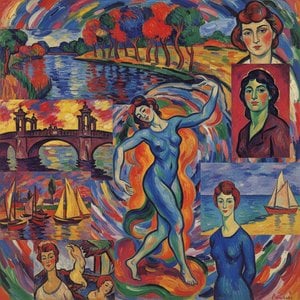
André Fougeron (1913–1998): The Bold Visionary of Nouveau Réalisme
André Fougeron, born October 1st, 1913, in Paris’s XVII arrondissement, emerged from a working-class upbringing as a self-taught painter who defied convention and championed social realism. His artistic journey began with an early fascination for drawing and culminated in a prolific career marked by groundbreaking contributions to the Nouveau Réalisme movement and unwavering engagement with political activism.
Early Life & Artistic Formation
Fougeron’s formative years were shaped by his apprenticeship as a metal worker, providing him with practical skills alongside an innate artistic sensibility. He honed his craft independently, submitting his first painting to the Salon des Indépendants in 1928—a pivotal moment that established him within the Parisian avant-garde.
The Rise of Nouveau Réalisme & Artistic Collaborations
Alongside fellow artists Maurice Estève and Édouard Pignon, Fougeron spearheaded the establishment of the unemployment fund for artists and craftsmen in 1936—a testament to his commitment to artistic solidarity. Inspired by Pablo Picasso’s monumental Guernica, he joined Louis Aragon’s Maison de la culture movement and actively participated in the Spanish Civil War effort, capturing the fervor and brutality of the conflict with visceral imagery.
Political Engagement & Resistance During WWII
Mobilized during World War II, Fougeron served in the military and bravely escaped imprisonment on the Belgian front. Returning to Paris after liberation, he embraced his role as a resistance fighter within the artistic community, establishing clandestine printing presses and advocating for social justice.
Legacy & Artistic Style
Fougeron’s distinctive style evolved throughout his life—embracing influences from photography, hyperrealism, and comics while retaining a steadfast dedication to political commentary. His paintings explored themes of labor, urban life, and societal struggles with unflinching honesty, solidifying his place as one of the foremost figures of Nouveau Réalisme and leaving an indelible mark on 20th-century art history.
Notable Works & Recognition
- Mother and Child in Red Uniform (1944): A poignant depiction of maternal resilience amidst wartime hardship, reflecting Fougeron’s humanist vision.
- Martyrdom at Sakiet III (1937): This monumental canvas embodies the spirit of Nouveau Réalisme—combining expressive brushstrokes with jarring juxtapositions to convey profound emotional impact.
- Return from the Market (1950): Fougeron’s masterful use of color and composition captures the essence of everyday life, mirroring his belief in the transformative power of art.
André Fougeron died September 10th, 1998, leaving behind a legacy of artistic innovation and unwavering political conviction—a testament to his enduring influence on French culture and modern art.
Otázky a odpovědi
Kde najdu díla umělce André Fougeron seskupená podle techniky?
Chcete-li najít všechna díla umělce André Fougeron v určité technice, navštivte jeho stránku Podle techniky.
Mohu si prohlédnout díla umělce André Fougeron podle nálady?
Díla umělce André Fougeron si můžete prohlédnout podle nálady na jeho stránce Galerie nálad, kde jsou umělecká díla uspořádána podle jejich vyvolané nálady.
Mohu si prohlédnout díla umělce André Fougeron podle barevného spektra?
Stránka Sestavení podle barev umělce André Fougeron umožňuje prohlížet jeho díla uspořádaná podle barev.
Mohu navštívit virtuální muzeum děl umělce André Fougeron?
3D galerie umělce André Fougeron je stránka, která v rámci virtuální trojrozměrné galerie prezentuje umělecká díla tohoto tvůrce.