Early Life, Family and Artistic Training
Allan Walton was born on 20 October 1891 in Cheadle Hulme, Cheshire. His upbringing was shaped by the industrial landscape of the region, as his family was deeply involved in the Manchester cotton mill industry. This connection to textiles would later become a significant part of his professional life. He received his formal education at Harrow School, where the foundations of his disciplined approach to study were laid.
His path toward a career in design and art began with a focus on structure. In 1911, he studied architecture within Arnold Mitchell’s practice. However, the pull of painting proved stronger than the technical demands of architecture. Seeking a different way to see the world, he moved to Cornwall, where he was taught to paint by Stanhope Forbes. This period allowed him to develop his skills in the open air, learning to observe the natural world directly.
As his training progressed, Walton moved toward the heart of the London art scene. He studied at the Westminster School of Art under Walter Sickert. This period of study helped him refine his technique and expand his understanding of composition and light. By moving from the structured world of architecture to the expressive methods taught by his mentors, he began to find the specific visual language that would define his later work.
Artistic Training in London and Paris
After his early studies, Walton moved to London to enroll at the Slade School of Fine Art. It was a period of intense learning alongside other emerging talents, including Henry Young Alison and William Oliphant Hutchison. These years in London helped him absorb the shifting styles of the time, moving beyond his initial training toward a more modern way of seeing the world.
His curiosity eventually led him to Paris, where he spent a year at L’Académie de la Grande Chaumière. This time in the city was transformative. He found himself immersed in a creative environment that included contact with influential figures like Pablo Picasso and Henri Matisse. Being part of the Parisian milieu allowed him to witness the evolution of new ideas firsthand, shaping the way he approached color and composition in his later years.
Textile Design and Decorative Arts
Walton’s creative energy was never confined to the canvas. He saw a way to bring art into the very fabric of daily life, a belief that led him to partner with his brother Roger to establish Allan Walton Textiles in London in 1925. This venture was more than a business; it was an experiment in how modern design could meet domestic utility. The company became known for pioneering new screen printing techniques, allowing for more personal and particular patterns to be reproduced. He even collaborated with prominent artists like Vanessa Bell and Duncan Grant, commissioning their designs to be translated into beautiful, wearable, or livable art.
His eye for pattern and form extended into the household through a wide variety of mediums. He worked as a designer for carpets, furniture, and even electric fires, proving his ability to adapt his vision to almost any material. In 1934, his influence reached the dining table when he produced ceramic designs for the Bizarre range and Foley china, working under the direction of Clarice Cliff for a Harrods exhibition. Whether it was a piece of pottery or a length of fabric, Walton sought to bridge the gap between fine art and the objects people used every day.
Technique and Artistic Style
Walton’s approach to the canvas was defined by a specific way of seeing the light that moved across the English countryside. He favored a luminous color palette, often leaning into the quiet, muted blues and greens found in coastal and rural settings. Rather than seeking photographic precision, he used expressive brushstrokes to build up texture and atmosphere. This method allowed him to capture the immediate feeling of a place, a quality that aligned him closely with the spirit of British Landscape Art during the early 20th Century.
His sensibility was not limited to the easel. He possessed a deep understanding of how color and pattern could function within a living space, leading to his involvement in the broader design landscape. His expertise in these practical applications was recognized by his peers when he became an original member of the Council of Industrial Design. This role highlighted his ability to bridge the gap between fine art and the functional beauty of everyday objects, from ceramics to textiles.
- By the Green Blind (1948)
- St Paul's (1928)
- Swiss Interior (1923)
Key Works and Notable Paintings
Walton’s output often reflected the quiet rhythms of the places he inhabited. In 1928, he captured the presence of St Paul's, a work that remains a significant part of his recorded history. His interest in the structure of spaces was also evident in his earlier explorations, such as Swiss Interior, which dates to about 1923. These pieces show a man deeply attentive to how light and form occupy a room or a city street.
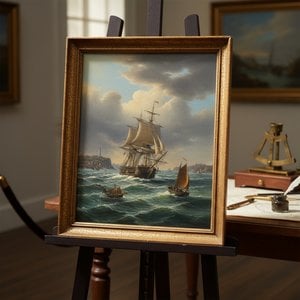
His connection to the water and the coast frequently surfaced in his compositions. One such piece, Yacht at Anchor, was rendered on panel, focusing on a maritime scene. This interest in the sea continued into his final years; his 1948 work, By the Green Blind, depicts a tranquil coastal scene, capturing a sense of stillness through his characteristic brushwork. These paintings often sought to find the emotional weight in a simple landscape or a moment of rest on the water.
- St Paul's (1928)
- Swiss Interior (about 1923)
- By the Green Blind (1948)
- Yacht at Anchor
Later Years and Death
The later years of Walton's life were marked by significant professional responsibilities within the British art community. In 1943, he took on the role of director of the Art School in Glasgow. This period of leadership came after years of active involvement in various artistic circles, including his time serving on the Executive Committee of the London Group in 1925. His influence extended into the realm of international competition, as his work was featured in the painting event of the 1948 Summer Olympics.
His life came to an unexpected end shortly after that Olympic appearance. He died on 12 September 1948 in St. Pancras, England, just weeks after the conclusion of the Summer Games. His passing occurred before he could begin a new chapter as a professor of design at the Royal College of Art. He was 56 years old.
Otázky a odpovědi
Jak mohu si prohlédnout všechna umělecká díla umělce Allan Walton?
Veškerá díla umělce Allan Walton na tato webová stránka si můžete prohlédnout na jeho stránce Všechná umělecká díla.
Jak se umění umělce Allan Walton v čase vyvíjelo?
Kronika umělce umělce Allan Walton je interaktivní časová osa ovládaná skrolováním, která představuje díla umělce v chronologickém pořadí, rozdělená do kapitol podle jednotlivých období jeho kariéry.
Pod jakými dalšími jmény nebo pseudony je Allan Walton známý/á?
Allan Walton je známý/á také pod jmény Norman Allan Walton.
Mohu si díla umělce Allan Walton seřadit podle barvy?
Díla umělce Allan Walton si můžete prohlédnout podle barev na jeho stránce Sestavení podle barev.