The Vyborg Beginnings
March 1, 1894, marks the start of Alexander Paischeff in Vyborg. The air in the Kunstverein drawing school carries the weight of formal training as he spends years between 1908 and 1912 refining his hand. He moves next to Helsinki, entering the Finnish Art Association drawing school. By 1914, the curriculum at the Helsinki School of Arts and Crafts begins to shape his technical foundation. His gaze shifts toward Petersburg for further study, absorbing the influences of a larger, more complex artistic landscape.
The early years are defined by movement and academic rigor. He is not merely a student but an observer of form. His first exhibition arrives in Helsinki in 1914, signaling his entry into the public eye. At this stage, the brush captures life through the lens of animals. The textures of fur and the weight of livestock occupy his early canvases.
Evolution of Subject and Style
A shift occurs in the progression of his work. The focus drifts from the animal kingdom toward the quietude of landscapes. This transition marks a change in how he perceives space and light, moving into the realms of Impressionist and Modern sensibilities. His later years see him navigating the art scenes of Russia, Scandinavia, and Germany during the 1930s.
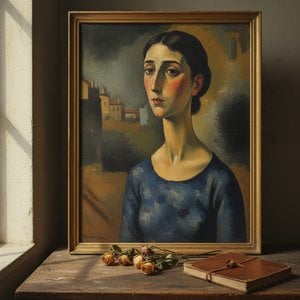
The work remains grounded in tangible reality even as his style matures. One can see this in his 1939 Self-Portrait, an oil on canvas held within the Ateneum collection. It is a moment of direct confrontation with the medium. His technical development is mirrored by his intellectual pursuits; he does not only paint but also authors essays regarding Finnish painters, documenting the very traditions he inhabits.
A Life Interrupted
Personal connections weave through his biography. He shares a lineage with Mary Paischeff, a dancer, and was married to the textile artist Eva Anttila. Their daughter, Eila, would later follow a path into art criticism. These familial ties to the creative arts suggest an environment saturated with visual and performative expression.
The timeline reaches its end in Helsinki on November 15, 1941. His legacy remains visible through specific surviving works and auction records:
- Self-Portrait (1939): An oil on canvas measuring 45 cm by 40 cm.
- Horse in stable: A piece that reached a realized price of 316 USD at Murrays in 2025.
- Artistic Range: Works spanning both paintings and works on paper.
Otázky a odpovědi
Kolik děl umělce Alexander Paischeff je možné si prohlédnout?
Na stránce Všechná umělecká díla si můžete prohlédnout 7 uměleckých děl děl autora Alexander Paischeff.
Pod jakými dalšími jmény nebo pseudony je Alexander Paischeff známý/á?
Alexander Paischeff se vystupuje även pod alternativními jmény A. Paischeff.
Kde najdu díla umělce Alexander Paischeff uspořádaná podle tématu?
Díla umělce Alexander Paischeff si můžete prohlédnout podle tématu na stránce Atlas témat.