Untitled 13: A Fragment of Blake’s Visionary Landscape
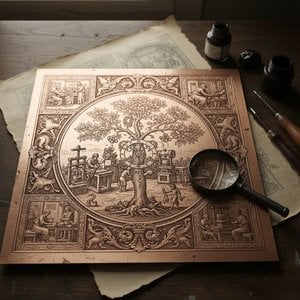
The artwork presents a striking black and white etching or engraving depicting a reclining figure—a solitary presence amidst an expansive, turbulent landscape rendered in dense crosshatching and energetic lines. Immediately arresting is its raw expressive quality, unmistakably rooted in the distinctive style of William Blake, a visionary artist who challenged conventional artistic boundaries and probed the depths of human consciousness. Unlike meticulously crafted portraits or landscapes aiming for realism, this piece prioritizes conveying emotion and capturing the essence of Blake’s imaginative worldview—a deliberate rejection of academic conventions that aligns perfectly with the Romantic aesthetic.
- Composition: The central focus is a human figure lying horizontally on the ground, positioned slightly off-center. Surrounding it are amorphous shapes and patterns created through intricate linework, suggesting an enclosed space yet avoiding precise delineation. This deliberate ambiguity contributes to the artwork’s unsettling atmosphere.
- Color Palette & Technique: Strikingly devoid of color, the monochrome palette amplifies the dramatic interplay between light and shadow—a hallmark of Blake's etching process where lines are incised into a metal plate before being inked and pressed onto paper. The meticulous application of crosshatching generates a textured surface that mimics the ruggedness of natural terrain.
- Line Work & Style: Lines dominate this artwork, exhibiting remarkable dynamism and variation in thickness. They aren’t merely decorative; they are instruments of expression—dense, purposeful, and imbued with an almost frenetic energy. Blake's technique embodies a Romantic impulse to capture the immediacy of experience, prioritizing feeling over accurate representation.
- Symbolic Resonance: The reclining figure itself evokes themes of vulnerability and repose, juxtaposed against the chaotic landscape which speaks to forces beyond human control—a motif prevalent in Blake’s oeuvre. It invites contemplation on mortality, spirituality, and the relationship between humanity and nature.
Historical Context & Influences
William Blake (1757-1827) emerged during a period of profound intellectual ferment—the Romantic Age—characterized by an embrace of imagination, emotion, and individualism. His artistic output was profoundly impacted by Enlightenment ideals yet fiercely opposed to their rationalism. Blake’s fascination with alchemy, mysticism, and biblical symbolism reflects the broader spiritual anxieties of his time, mirroring the burgeoning interest in esoteric traditions alongside scientific advancements. The artwork's stylistic choices—particularly its expressive linework and tonal contrasts—echo the aesthetic sensibilities championed by artists like Caspar David Friedrich and Eugène Delacroix, who sought to convey sublime grandeur and evoke profound emotional responses.
Exploring Texture & Emotional Impact
The artist’s masterful use of crosshatching creates a palpable textural quality that transcends mere visual representation—it embodies the very essence of Blake's artistic vision. The resulting surface resembles weathered stone or turbulent water, mirroring the artwork’s underlying mood of unease and intensity. Viewing Untitled 13 stimulates contemplation on themes of isolation, resilience, and the confrontation with existential questions. It serves as a powerful reminder that art can communicate truths beyond words—capturing fleeting moments of beauty and confronting uncomfortable realities with unflinching honesty.
Considerations for Reproduction
A high-quality reproduction of Untitled 13 captures not only its visual splendor but also the intangible spirit of Blake’s original etching. Utilizing archival inks on premium paper ensures that the artwork retains its luminosity and textural depth—allowing collectors and interior designers alike to appreciate the enduring legacy of this seminal Romantic masterpiece.
Otázky a odpovědi
Z čeho je dílo "Untitled 13" vyrobeno a v jakém je stylu?
„Untitled 13“ od Vilém Blake kombinuje techniku Acrylic On Canvas s uměleckým směrem Romanticism. Technika a směr popisují způsob vzniku a styl tohoto díla.
Do které místnosti by se vzhledem k barevné skladbě doporučovalo umělecké dílo „Untitled 13“ od Vilém Blake?
Vzhledem k jeho Neutrals barevnosti je dílo „Untitled 13“ doporučeno do místnosti Living Room.
Jakým způsobem se dílo „Untitled 13“ zapojuje do témat a stylu umělce Vilém Blake?
V rámci tvorby umělce Vilém Blake se dílo „Untitled 13“ řadí do stylu Romanticism a doplňuje tak motivy visionary art, blake style, romantic aesthetic, symbolism, imagination.
Jaké barvy dominují dílu „Untitled 13“ od Vilém Blake?
„Untitled 13“ je definováno paletou Neutrals, které dominuje Gray (#8d8d8d).
Kolik lidí si prohlíží „Untitled 13"?
Statistiky k dílu „Untitled 13“ od Vilém Blake naleznete na stránce Statistiky tohoto díla: měsíční návštěvnost díla, návštěvnost děl daného umělce a rozpis nedávných návštěvníků podle zemí a jazyků.
Hangi tónem se "Untitled 13" sklání?
„Untitled 13“ skloní se k Green to Violet Spectrum tónu.
Mohu si "Untitled 13" prohlédnout podrobněji?
X-ray pohled na dílo „Untitled 13“ od Vilém Blake naleznete na stránce Rentgenové snímky tohoto uměleckého díla: jde o interaktivní prohlídku obrazu skrze jedenáct optických vrstev.
Jak výrazné jsou barvy díla „Untitled 13"]?
Barvy díla „Untitled 13“ od Vilém Blake vykazují Muted saturaci s Monochromatic intenzitou.



 Zobrazit v interiéru
 Přepnout na tiskové verze
 Odeslat
 Sdílet
 Podrobnosti
 Průvodce

 Stáhnout obrázek
 Podobné kousky
 Rentgenové snímky
 Slideshow
 Statistiky
 Přečíst si více






































 Skleněná varianta je dostupná pouze u rozměrů menších než 110 cm