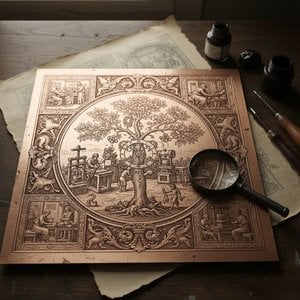
Job´s Despair 1: A Romantic Lament
William Blake’s “Job’s Despair” stands as a cornerstone of Romantic art, encapsulating the era's preoccupation with profound emotion and spiritual questioning. Executed in black and white etching on paper around 1825, this artwork transcends mere visual representation; it embodies a visceral response to biblical narrative—specifically Job’s agonizing suffering following divine retribution.
- Artist: William Blake (British, London 1757–1827 London)
- Medium: Etching on Paper
- Dimensions: Unknown
- Date: Circa 1825
Blake’s masterful technique—characterized by meticulous hatching and cross-hatching—captures the bleakness of Job's predicament with breathtaking precision. Fine lines delineate forms, building up tonal values that convey not just visual appearance but also palpable sorrow. The border itself is ornate, reflecting Blake’s stylistic penchant for decorative embellishment and reinforcing the artwork’s formal grandeur.
Composition & Symbolism
The composition immediately commands attention with Job dominating the central plane, arms outstretched in supplication—a gesture laden with grief and desperation. Surrounding him are figures of comforters, arranged in poses mirroring his anguish, creating a dynamic interplay of emotion. Behind Job looms a monumental rectangular block, interpreted as representing divine judgment or perhaps an impenetrable barrier to solace.
Blake’s deliberate asymmetry contributes to the artwork's dramatic impact, while the border serves as a visual constraint, emphasizing the emotional core of the scene. Recurring motifs—such as swirling clouds and stylized drapery—further amplify the sense of turmoil and spiritual struggle.
Romantic Ideals & Blake’s Visionary Style
"Job's Despair" firmly establishes Blake as a champion of Romantic ideals: an unwavering belief in emotion, imagination, and the sublime. His distinctive style—marked by intricate line work and symbolic imagery—is evident throughout, mirroring his broader artistic mission to explore the depths of human experience and wrestle with existential questions.
Research into similar artworks like “Job’s Comforters” and “Job’s Evil Dreams 1” reveals Blake's consistent engagement with themes of faith, loss, and divine retribution. These pieces demonstrate his ability to transform biblical stories into emotionally resonant visual narratives—a testament to his enduring legacy as a visionary artist.
Historical Context & Artistic Influence
Created during the Romantic period (roughly 1798-1837), “Job’s Despair” reflects the broader cultural anxieties of its time – disillusionment with Enlightenment rationalism alongside an intensified interest in spirituality and emotion. Blake's etching stands as a precursor to later Expressionist explorations of psychological torment, cementing his position as a pivotal figure in art history.
Consider commissioning a high-quality reproduction of “Job’s Despair” to infuse your interior space with the artwork’s evocative atmosphere and profound symbolic depth. Its enduring power continues to inspire viewers today—a timeless masterpiece capturing the essence of human suffering and spiritual yearning.



 Zobrazit v interiéru
 Přepnout na tiskové verze
 Odeslat
 Sdílet
 Podrobnosti
 Průvodce

 Stáhnout obrázek
 Podobné kousky
 Rentgenové snímky
 Slideshow
 Statistiky
 Přečíst si více






































 Skleněná varianta je dostupná pouze u rozměrů menších než 110 cm