Umělecké dílo zobrazené na této stránce je chráněno autorským zákonem, což znamená, že nemůžeme legálně vytvářet ani prodávat jeho identickou reprodukci. Tato ochrana je vymáhána na základě mezinárodních dohod, jako například Berberská úmluva a národními zákony, včetně těch stanovených v Americký autorský zákon – Díl 17. Všechna práva vyhrazena.
Tato metoda je plně v souladu s autorským právem, protože nezahrnuje kopírování ani duplikování chráněného díla. Jde o kreativní reinterpretaci – nový obraz, který je inspirován originálem, ale není s ním identický.
Giclée nebo plátěný tisk muzeální kvality s rychlou výrobou a širokou nabídkou povrchových úprav. ( Koupit ručně malovaný obraz Přepnout na digitální obraz)
Vyberte si z našich přednastavených velikostí, které odpovídají původním proporcím díla.

Zadejte šířku a výšku, které potřebujete pro váš rám nebo stěnu. Tisk lze pouze oříznout, nikdy však nelze zvětšit obraz nad jeho původní rozměr, proto při výběru jiného formátu dochází ke ztrátě části obrazu. Před samotným tiskem vám zašleme digitální náhled k schválení. Obraz zobrazený na této stránce nenabízí skutečný výřez — ten uvidíte pouze v náhledu.
Celosvětové doručení () do 2 týdnů namísto standardních 4/5 týdnů. (9 listopad)
Yvaral
Rozměry reprodukce
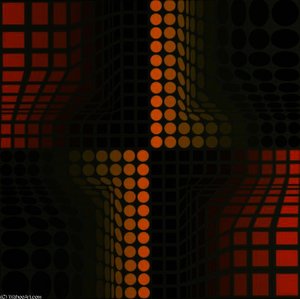
Victor Vasarely’s Yvaral, completed in 1956, is more than just an image; it’s a carefully constructed illusion, a testament to the burgeoning field of Op Art and a profound exploration of how our eyes perceive space and movement. This striking work, measuring 210 x 200 cm, immediately captivates with its stark contrast – a pristine white background punctuated by precisely arranged black circles that seem to vibrate with an almost unsettling energy. Born in Pécs, Croatia (then Austria-Hungary) in 1906, Vasarely’s artistic trajectory began unexpectedly, initially pursuing medical studies before embracing the visual world with unwavering conviction. His journey, shaped by influences from the Bauhaus movement and his time within Bortnyik's Műhely workshop, culminated in a revolutionary approach to art – one that deliberately manipulated perception through geometric abstraction.
The deliberate restriction of the color palette – solely black and white – is crucial to Yvaral’s impact. This stark dichotomy dramatically enhances the optical illusion, making the circles appear to pulsate and shift with every glance. Vasarely wasn't simply depicting shapes; he was engineering a visual experience, exploiting the way our brains process information. The dominant form, of course, is the circle – repeated countless times – but it’s not merely repetition for its own sake. Vasarely meticulously arranged these circles to create larger geometric forms—squares and quadrants—that contribute to the overall structure while simultaneously disrupting any sense of static stability.
The artwork’s execution suggests a serigraph or screen print, a technique favored by Vasarely for its ability to achieve incredibly precise color application and uniform tonal values. The smooth texture, characteristic of printed media, speaks to this meticulous process. It is likely that the original work was created using this method, ensuring the consistent distribution of ink across the canvas. While a photograph of an original work could also account for the image’s appearance, the level of detail and precision strongly points towards a serigraphic reproduction.
Beyond its purely visual impact, Yvaral evokes deeper symbolic resonances. The dynamic arrangement of circles can be interpreted as representing movement, energy, and perhaps even disorientation – mirroring the very experience of engaging with Op Art. The repetitive patterns might also suggest themes of order and chaos, a fundamental duality that Vasarely consistently explored in his work. This piece isn’t just about seeing; it's about *experiencing* perception itself.
Z historického hlediska je „Yvaral“ dílem stylů Op Art, které patří do širší éry Modern.
Stav autorských práv pro dílo „Yvaral“ od Victor Vasarely: toto dílo spadá do stále chráněno autorským právem. To určuje, zda lze volně vytvářet reprodukce tohoto obrazu.
Hlavní barvou díla „Yvaral“ od Victor Vasarely je Black (#100d06).

1906 - 1997 , Chorvatsko

Master the nuances of Giclée printing with our expert guide. Discover how pigment-based inks and museum-grade substrates create fade-resistant, high-fidelity art reproductions designed for discerning collectors seeking unparalleled quality and longevity.

Embark on a visual journey through the mesmerizing world of Op Art. Discover the masters of optical illusion, explore geometric abstraction, and learn how to curate high-impact kinetic works for your private collection with expert guidance from art professionals.

Explore the profound artistry of black and white photography. From historical mastery to the interplay of light and shadow, discover how monochrome captures timeless emotion and form through a sophisticated lens of art history.
Explore the mesmerizing world of Victor Vasarely. Discover how his Bauhaus-inspired Op Art masters the science of perception through geometric abstraction and vibrant color. A sophisticated guide for discerning art collectors seeking to understand the legacy of optical illusion.
 Sdílet
 Sdílet
 Podrobnosti o díle
 Průvodce

 Stáhnout
 Podobné položky
 Slideshow
 Otázky a odpovědi
 Statistiky

 Zobrazit více






































 Skleněná varianta je dostupná pouze u rozměrů menších než 110 cm