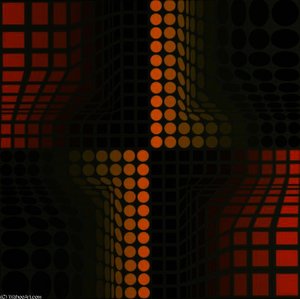
Victor Vasarely’s “Abstract Composition 17”: A Dance of Perception
Victor Vasarely's "Abstract Composition 17" is more than just an image; it’s an invitation to experience the world anew. Born in 1906 in Pécs, Croatia – then part of Austria-Hungary – Vasarely’s life was a deliberate pursuit of visual harmony, beginning with a surprising detour from medical studies into the realm of art. His early training at the Podolini-Volkmann Academy and, crucially, Sándor Bortnyik's “Műhely” workshop, profoundly shaped his approach, immersing him in the principles of functional design and geometric abstraction championed by the Bauhaus movement. This confluence of influences ultimately led to his groundbreaking contribution to Op Art – Optical Art – a style dedicated to manipulating perception through carefully constructed visual illusions.
The Geometry of Movement
This striking black-and-white composition exemplifies Vasarely’s mastery of Op Art. The artwork is dominated by an intricate network of interlocking lines, squares, and rectangles, meticulously arranged to create a dynamic sense of movement and depth. It's a deliberate rejection of traditional representational art; the focus isn't on depicting a recognizable scene but rather on exploring the very nature of visual perception. Vasarely’s technique involved precise execution – oil paint applied with exacting control onto canvas – to achieve this remarkable effect. The high contrast between black and white amplifies these optical effects, drawing the viewer into a captivating dance of shifting forms.
A Historical Context: Op Art and the Pursuit of Illusion
Emerging in the 1960s, Op Art represented a significant shift in artistic thinking. Artists like Vasarely sought to harness scientific principles – particularly those related to optics and visual perception – to create artwork that actively engaged the viewer’s eye. This wasn't simply about creating pretty patterns; it was an intellectual exploration of how our brains interpret visual information. The movement coincided with a broader cultural fascination with technology and its impact on human experience, reflecting a desire to understand and manipulate the world around us through new artistic means.
Symbolism and Emotional Impact
"Abstract Composition 17" possesses a profound symbolic resonance despite its lack of overt subject matter. The geometric forms – squares, rectangles, lines – can be interpreted as representing fundamental building blocks of reality, suggesting an underlying order within apparent chaos. The artwork’s ability to generate movement and vibration taps into primal human responses, evoking feelings of excitement, dynamism, and even a subtle sense of unease. It's a piece that demands attention, prompting the viewer to actively participate in its creation – to become part of the illusion itself.
Otázky a odpovědi
K kterému umělci je dílo "Abstract Composition 17" připisováno?
Dílo "Abstract Composition 17" se připisuje autorovi Victor Vasarely.
Jaké místo v tvorbě umělce Victor Vasarely zaujímá dílo "Abstract Composition 17"?
„Abstract Composition 17“ patří k dílu Victor Vasarely v rámci směru Op-Art, jehož typická témata zahrnují bauhaus, geometric abstraction, kinetic art exploration, visual perception studies, op-art pioneer work, signature style development.
Z jaké země pochází dílo Op-Art s názvem "Abstract Composition 17"?
Dílo „Abstract Composition 17“ propojuje směr Op-Art s Chorvatsko prostřednictvím rodného města svého tvůrce.
Existuje průvodce k dílu „Abstract Composition 17“ od Victor Vasarely?
Pro dílo „Abstract Composition 17“ od Victor Vasarely je k dispozici stránka Průvodce: tiskem připravený informační list o uměleckém díle, navržený pro studenty a použití ve výuce.
Kde koupit ručně malované kopie díla „Abstract Composition 17“ od Victor Vasarely?
Ručně malovanou reprodukci díla „Abstract Composition 17“ od Victor Vasarely si můžete objednat přímo na tato stránka: ručně malovaná olejová reprodukce na lněném plátně, vyrábíme na zakázku.
Jak mohu získat print díla „Abstract Composition 17“ od Victor Vasarely?
Potisk díla „Abstract Composition 17“ od Victor Vasarely si můžete objednat přímo na tato stránka: umělecká tiskovina na bavlněném plátně nebo archivním plátnovém papíře.
Jak mohu získat digitální kopii díla „Abstract Composition 17“ od Victor Vasarely?
Chcete-li získat digitální kopii díla „Abstract Composition 17“ od Victor Vasarely, objednejte si stažení digitálního obrazu ve vysokém rozlišení na tato stránka.



 Zobrazit v interiéru
 Objednat ručně malovanou reprodukci
 Odeslat
 Sdílet
 Podrobnosti
 Průvodce

 Stáhnout obrázek
 Podobné kousky
 Rentgenové snímky
 Slideshow
 Statistiky

 Přečíst si více






































 Skleněná varianta je dostupná pouze u rozměrů menších než 110 cm