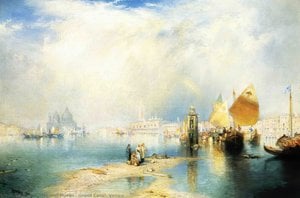
A Symphony of Light and Color in the Heart of Venice
To gaze upon Thomas Moran’s 1898 masterpiece, Venice, is to step through a portal into a world where time seems to dissolve into a shimmering haze of gold and azure. This is not merely a landscape; it is an immersive sensory experience that captures the very soul of Italy's most iconic maritime city. As a prominent figure of the Hudson River School, Moran brought a uniquely American sense of romantic idealism to the European continent, translating the architectural grandeur of Venice into a poetic dialogue between light and water. The painting transcends simple documentation, offering instead an ethereal vision of the Grand Canal, where the heavy stone of ancient palazzos appears to float upon a surface of liquid light.
The composition is masterfully orchestrated to guide the viewer’s eye through a tranquil maritime dance. In the heart of the frame, a large vessel commands attention, serving as an anchor for the scene, while smaller boats drift gracefully toward the right, adding layers of depth and a sense of rhythmic movement. These elements are scattered like notes across a musical score, creating a profound feeling of peace. The presence of a solitary figure near the water's edge provides a human connection to the vastness of the scene, reminding us that this breathtaking vista is a place to be inhabited, felt, and cherished. For the collector or interior designer, this piece offers a window into a serene, timeless era, making it an ideal centerpiece for spaces that crave elegance and contemplative calm.
The Mastery of Hudson River Romanticism
Moran’s technical prowess is most evident in his ability to manipulate atmosphere through the sophisticated use of glazing. By applying thin, translucent washes of pigment over underlying layers, he achieved a luminous quality that mimics the misty, salt-kissed air of a Venetian morning. Unlike the Impressionists, who often sought to capture the fleeting, fractured light of a single moment, Moran utilized the broader, more sweeping strokes characteristic of his American roots to build structural depth and emotional weight. This technique allows the ornate facades of churches and palaces to retain their architectural dignity while simultaneously appearing softened by the humid, atmospheric haze that defines the Venetian lagoon.
The artist’s palette is a testament to his skill as an exquisite colorist. He draws profound inspiration from the legendary J.M.W. Turner, emulating the way light can dissolve solid forms into a tapestry of warmth and brilliance. The interplay between the cool reflections in the canal and the warm, sun-drenched masonry creates a visual tension that is both stimulating and soothing. This meticulous attention to the nuances of light ensures that the painting remains dynamic; it changes with the viewer's perspective, much like the real city of Venice does as the sun traverses the sky.
A Legacy of Artistic Ambition and Emotional Resonance
Historically, Venice represents a pivotal moment in Moran’s career, reflecting the late 19th-century American fascination with European high culture. Having already achieved fame for his sweeping vistas of the American West and the Rocky Mountains, Moran turned his gaze toward the Old World to explore themes of history, tradition, and classical beauty. This painting serves as a bridge between the rugged, untamed landscapes of his youth and the refined, storied elegance of the Mediterranean. It is a celebration of human achievement set against the enduring power of nature.
For those looking to adorn a home or gallery with a high-quality reproduction, this work offers more than just aesthetic appeal; it provides an emotional sanctuary. The painting evokes a sense of nostalgia for a slower, more graceful way of life. Its ability to evoke tranquility, wonder, and a deep appreciation for the sublime makes it a timeless investment. Whether placed in a sunlit study or a grand living hall, Moran’s Venice continues to inspire awe, inviting all who behold it to lose themselves in its luminous, watery embrace.
Otázky a odpovědi
Lze obraz díla „Venice“ od Thomas Moran volně reprodukovat?
Stav autorských práv pro dílo „Venice“ od Thomas Moran: toto dílo spadá do v rámci volného užití – autorská práva vypršela. To určuje, zda lze volně vytvářet reprodukce tohoto obrazu.
Jaký národní původ stojí za stylem Hudson River School u díla „Venice“?
Dílo „Venice“ vytvořil/a Thomas Moran, narozený/á v Spojené království, v rámci směru Hudson River School. Původ umělce/umělkyně propojuje toto dílo s Hudson River School, jak jej praktikují umělci z Spojené království.
Jak spolu v díle "Venice" ladí barvy?
„Venice“ od Thomas Moran představuje Discordant Palette barevnou harmonii.



 Náhled v interiéru
 Přepnout na tisk
 Sdílet
 Sdílet
 Podrobnosti o díle
 Průvodce

 Stáhnout
 Podobné položky
 Rentgenové snímky
 Slideshow
 Q&A
Q&A Statistiky


 Zobrazit více






































 Skleněná varianta je dostupná pouze u rozměrů menších než 110 cm