Thomas Couture: Bridging Romanticism and Realism – A Portrait of Ambition and Artistic Integrity
Thomas Couture (1815-1879) stands as an extraordinary figure in French art history, a painter who defied the constraints of academic tradition while simultaneously mastering its formal language. He wasn’t merely a follower of his time; he was a rebel—a visionary determined to forge his own path and establish an independent atelier where artistic freedom reigned supreme. This unwavering conviction fueled his rejection of the Prix de Rome competition, cementing his belief that the established art system demanded radical reform.
His early life in Senlis foreshadowed this rebellious spirit. Moving to Paris with his family at a young age exposed him to the vibrant intellectual currents of the era—a formative experience that would profoundly influence his artistic sensibilities. Initially drawn to the École des Arts et Métiers, Couture soon recognized the limitations of purely technical instruction and sought refuge in the École des Beaux-Arts, where he honed his skills under influential masters like Gros and Delaroche. However, repeated failures in securing the Prix de Rome – a symbol of artistic prestige and Parisian acceptance – served as catalysts for his determination to challenge convention.
Romans During the Decadence: A Dramatic Narrative
Couture’s most celebrated work, “Romans During the Decadence,” exemplifies his Romantic aesthetic and masterful technique. Painted around 1848, this monumental canvas depicts a scene of historical drama—a legionary soldier confronting a Roman noblewoman amidst opulent surroundings. Couture skillfully employs chiaroscuro – dramatic contrasts between light and shadow – to heighten the emotional intensity of the composition. The meticulous detail with which he renders fabrics, armor, and facial expressions underscores his dedication to realism while simultaneously conveying the grandeur and pathos characteristic of Romanticism. It’s a testament to Couture's ability to synthesize disparate influences into a cohesive artistic vision.
- Style: Romanticism
- Technique: Oil on Canvas
- Notable Influences: Gros, Delaroche
The Atelier of Innovation
Couture’s establishment of an independent atelier was more than just a practical decision; it represented a philosophical commitment to artistic autonomy. Rejecting the rigid hierarchy and prescribed methods of academic institutions, he created a space where young artists could experiment freely and develop their own distinctive voices. This ethos profoundly impacted subsequent generations of painters—most notably Édouard Manet, Henri Fantin-Latour, and Pierre Puvis de Chavannes – who benefited from Couture’s guidance and championed his belief in artistic innovation.
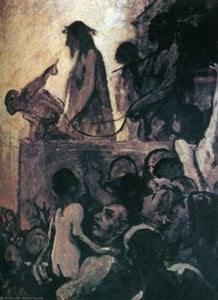
“Nous jurons de vous défendre”, an étude for “The Enrôlement des Volontaires,” showcases Couture's dedication to capturing the spirit of a pivotal moment in French history—the mobilization of soldiers during the Franco-Prussian War. This preparatory sketch reveals Couture’s meticulous attention to detail and his masterful command of tonal gradation, anticipating the monumental painting that would solidify his reputation as one of France’s foremost Romantic artists. It exemplifies Couture's ability to transform historical narrative into emotionally resonant visual experience.
- Subject: Historical Scene
- Date: Circa 1848
- Medium: Oil on Wood
A Legacy of Artistic Integrity
Thomas Couture’s enduring legacy lies not only in his artistic achievements but also in his unwavering conviction that art should serve as a vehicle for intellectual and emotional exploration. He challenged the dogma of academic realism, advocating instead for a synthesis of observation and imagination—a stance that resonated deeply with artists who sought to transcend convention and express their innermost convictions. Couture’s influence extends beyond his immediate contemporaries; he instilled in generations of painters – including Manet, Fantin-Latour, Puvis de Chavannes – the importance of artistic integrity and the courage to pursue one's own vision. His work continues to inspire artists today, reminding us that true artistry demands both technical skill and unwavering moral conviction.
Otázky a odpovědi
Patří dílo „Nous jurons de vous défendre“ do volného užití?
Co se týče autorských práv, dílo "Nous jurons de vous défendre" spadá do patří do volného užití – autorská práva vypršela.
Mohu si před koupí prohlédnout „Nous jurons de vous défendre“ od Thomas Couture na své vlastní stěně?
Stránka Náhled v AR díla „Nous jurons de vous défendre“ od Thomas Couture využívá rozšířenou realitu k tomu, aby vám toto umělecké dílo zobrazila přímo ve vašem prostoru pomocí kompatibilního zařízení.
Do které období tvorby Thomas Couture patří dílo „Nous jurons de vous défendre"?
Dílo „Nous jurons de vous défendre“ patří do Mature Period tvorby umělce Thomas Couture. Tato klasifikace dílo relativizuje k vývoji jeho tvůrčí dráhy.



 Zobrazit v interiéru
 Objednat ručně malovanou reprodukci
 Odeslat
 Sdílet
 Podrobnosti
 Průvodce

 Stáhnout obrázek
 Podobné kousky
 Rentgenové snímky
 Slideshow
 Statistiky

 Přečíst si více






































 Skleněná varianta je dostupná pouze u rozměrů menších než 110 cm