BEZPLATNÉ UMĚLECKÉ PORADENSTVÍ

x
Koupit tisk Koupit tiskKoupit digitální obrázek Koupit digitální obrázek SdíletSdílet
PodrobnostiPodrobnosti Přidat do oblíbených Přidat do oblíbených StáhnoutStáhnout Podobné položkyPodobné položky Rentgenové snímkyRentgenové snímky SlideshowSlideshow

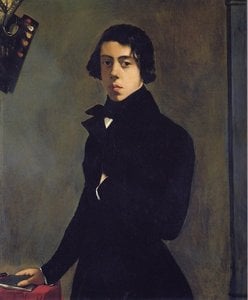
Self-Portrait

Explore Théodore Chassériau's 'Self-Portrait,' a captivating 1835 oil painting showcasing the artist’s restrained elegance and introspective style, housed in the Louvre.

Poznejte Théodore Chassériaua (1819–1856), francouzského romantického malíře spojujícího Ingresa a Delacroixova stylu. Objevte jeho živé portréty, orientální výtvarné díla a inspiraci z Alžírska.

Ručně malovaná olejová reprodukce

Ručně malovaná olejná barva na plátně ve vašem zvoleném rozměru i s rámem, vyrobená našimi umělci na zakázku.

P118B $10
P118H $10
P118W $10
P438Z $10
P508JH $12
P508YH $12
P805H $10
P805Z $10
P919BZ $10
P919G $10
P919XJ $10
P959ZH $10
P968JZ $12
W106C $8
W218G $10
W218JH $8
W218Y $10
W307PJ $10
W316G $10
W316PJ $8
W316Y $10
W398PJ $8
W4111J $10
W500HY $15
W500JH $15
W692G $12
W849H $8
W940BG $15
W953PJ $8

Standard
custom
CM
INCH

Vyberte si z našich přednastavených velikostí, které odpovídají původním proporcím díla.

šířka
výška

Můžete zadat vlastní rozměry pro konkrétní rám nebo prostor. Pokud se vámi vybraná velikost neshoduje s proporcemi původního obrazu, dílo buď ořízneme, nebo jej doplníme ručně malovanými prvky. Před zahájením výroby vám bude zaslán digitální náhled ke schválení.
Upozorňujeme, že náhled na obrazovce neodpovídá skutečnému ořezu ani rozšíření. Pouze digitální náhled přesně zobrazí finální kompozici.
Ačkoliv je možné zvolit vlastní velikost, pro zachování původních proporcí doporučujeme vybrat rozměr z předdefinovaného seznamu.

Příklady možných změn: Nahrazení obličeje vlastní fotografií; Přidání domácího mazlíčka (např. nahrazení kočky psem); Vložení skrytého vzkazu do pozadí; Změna krajiny nebo prvků v pozadí.
Po přijetí objednávky vám tým WahooArt.com zašle e-mail s pokyny a poskytne náhledovou verzi.

Celosvětová doprava () za 3–4 týdny namísto standardních 5 týdnů. (4 červenec). Bez kompromisů v kvalitě.

why_choose_icon
Zdarma celosvětová expresní doprava
why_choose_icon
Vysoce kvalitní lněné plátno
why_choose_icon
Kompletní přepravní pojištění
why_choose_icon
Záruka vrácení celního poplatku
why_choose_icon
Záruka přesného barevného shodu
why_choose_icon
60denní lhůta pro vrácení zboží (pouze při vadách výroby)
why_choose_icon
100% garance vrácení peněz
why_choose_icon
Sleva při hromadné objednávce

Celková cena

-

reproduction

Self-Portrait

Technika reprodukce

Rozměry reprodukce

-

Celková cena za výběr

-

Základní informace

  • Influences:
    • Ingres
    • Delacroix
  • Movement: Romanticism
  • Artist: Théodore Chassériau
  • Dimensions: 99 x 82 cm
  • Year: 1835
  • Location: Louvre, Paris
  • Artistic style: 19th-century

Kvíz o umění

U každé otázky je pouze jedna správná odpověď.

Otázka 1:
What artistic movement is most closely associated with Théodore Chassériau’s ‘Self-Portrait’?
Otázka 2:
The microphone stand visible in the painting 'Self-Portrait' suggests which of the following?
Otázka 3:
What is the predominant color palette used in ‘Self-Portrait’?
Otázka 4:
According to the description, what is a key characteristic of Chassériau’s technique in this painting?
Otázka 5:
Théodore Chassériau was born in which country?

Popis díla

The Enigmatic Self: Théodore Chassériau’s “Self-Portrait in a Redingote”

Théodore Chassériau's 1835 oil on canvas, "Self-Portrait in a Redingote," is more than just a likeness; it’s a carefully constructed tableau of restrained elegance and subtle introspection—a window into the mind of a young artist grappling with his artistic identity within the context of 19th-century Parisian society. Housed within the prestigious Musée du Louvre, this painting immediately draws the viewer in with its dark palette and the commanding presence of the subject, a young man radiating an almost melancholic intensity.

The work firmly anchors itself within the Romantic movement, yet it subtly resists simple categorization. While undeniably influenced by the dramatic flair of Eugène Delacroix – particularly evident in the dynamic lighting and the suggestion of movement – Chassériau retains a core Neoclassical discipline, meticulously rendered lines defining the sharp angles of his suit jacket and the precise contours of his face. This duality reflects the artist’s own journey: initially trained under the rigorous tutelage of Jean-Auguste-Dominique Ingres, he ultimately forged his own path, embracing a more expressive and emotionally charged style.

A Study in Light and Shadow – Technique and Composition

Chassériau's masterful technique is immediately apparent. The painting’s composition centers around the subject, occupying nearly the entire frame, creating an intimate and almost claustrophobic effect. He stands in a three-quarter pose, his gaze directed slightly to the left, inviting the viewer into his world. A subtle yet significant detail—a microphone stand discreetly positioned behind him on the left – hints at a performance context, perhaps suggesting Chassériau’s burgeoning career as a stage designer or illustrator, alongside his painting endeavors. The artist employs a layering technique, building up color and texture through numerous thin glazes of oil paint, resulting in a remarkably smooth surface—a testament to his dedication and skill.

The lighting is particularly noteworthy. It originates from an unseen source on the left side, casting soft, directional shadows across the subject’s face and subtly highlighting the textures of his clothing. This strategic use of light not only adds depth and volume but also contributes significantly to the painting's overall mood—a blend of formality and quiet contemplation. The careful blending of tones creates a sense of atmospheric perspective, drawing the eye deeper into the scene.

Symbolism and Emotional Resonance

Beyond its technical brilliance, “Self-Portrait in a Redingote” is rich in symbolic meaning. The formal black suit, impeccably tailored, speaks to Chassériau’s ambition and his desire for recognition within the established artistic circles of Paris. However, the slightly downturned mouth and the introspective gaze suggest a deeper layer of complexity—a hint of melancholy or perhaps even disillusionment with the constraints of academic art. The red bow tie, a vibrant splash of color against the predominantly dark palette, could represent passion, creativity, or simply a deliberate assertion of individuality.

The painting’s overall effect is one of restrained elegance and quiet introspection. It's not a flamboyant self-celebration but rather a carefully considered portrait of an artist grappling with his identity and place in the world—a poignant reflection on the challenges and rewards of pursuing a creative life. The subtle sadness in his eyes invites us to contemplate the burdens of artistic ambition, while the formality of his attire suggests a desire for respectability and recognition.

A Legacy of Romanticism – Historical Context

Created during a period of significant social and political upheaval—the aftermath of the Napoleonic Wars and the rise of Romanticism—Chassériau’s work reflects the movement's emphasis on emotion, individualism, and the sublime. His Creole heritage, born in the Dominican Republic and raised in Paris, undoubtedly informed his artistic vision, providing him with a unique perspective on both European and Caribbean cultures. This background is reflected in his interest in Orientalist themes – particularly evident in later works – and his willingness to challenge conventional artistic norms.

Chassériau’s trajectory—from student of Ingres to independent Romantic artist—is itself a compelling narrative, illustrating the tensions between tradition and innovation within 19th-century art. “Self-Portrait in a Redingote” stands as a powerful testament to his artistic evolution and a captivating glimpse into the mind of a brilliant but often overlooked talent.

Podobná umělecká díla


Biografie umělce

Théodore Chassériau (1819–1856) – A Bridge Between Classical Grace and Romantic Passion

Théodore Chassériau (born Sept. 20, 1819, Santa Barbará de Samaná, Saint-Domingue—died Oct. 8, 1856, Paris) was a French painter who attained some measure of success in his attempt to fuse the Neoclassical art of Jean-Auguste-Dominique Ingres and the Romanticism of Eugène Delacroix. As a boy, Chassériau entered the studio of Ingres, following his master to Rome in 1834. Chassériau’s immediate success at the Paris Salon of 1836 was confirmed three years later by a Venus and his “Suzanne,” both in the Louvre. About 1840, however, he began to grow dissatisfied with the art of Ingres. Around 1843, Chassériau’s style and subject matter began to show the influence of Ingres’s rival, Delacroix, and he attempted, with considerable success, to combine Ingres's classical linear grace with Delacroix's Romantic colouristic methods. His 15 Othello etchings (1844) and his paintings of Moorish and Jewish life following his trip to North Africa (1846) suggest Delacroix, though Chassériau added an exotic quality of his own. He was also important in the revival of monumental allegorical and religious painting in France, though few of those works survive intact. ### Early Life and Artistic Training: The Ingresian Influence Théodore Chassériau’s formative years were marked by a profound engagement with classical art and scholarship. Born into a Creole family—his father Benoît Chassériau was a French diplomat navigating the complexities of Caribbean politics, while his mother Maria Magdalena Couret de la Blagniére hailed from a family with roots in Haiti and France—he possessed a unique cultural heritage that would shape his artistic vision. From the age of eleven, he began his formal artistic training under the tutelage of Jean-Auguste-Dominique Ingres, arguably the most influential painter of his time. Ingres recognized Chassériau’s exceptional talent, fostering within him a mastery of line, form, and classical composition—a foundation that would remain visible throughout Chassériau’s career. This early immersion in Ingresian aesthetics instilled a meticulous attention to detail and an unwavering commitment to idealized beauty, characteristics that would define his artistic style for decades to come. ### Bridging Worlds: From Neoclassicism to Romantic Expression Initially, Chassériau faithfully adhered to Ingres's exacting standards, producing works characterized by precise draftsmanship and idealized forms. However, the burgeoning Romantic movement—with its emphasis on emotion, drama, and individual expression—exercised an irresistible pull. Eugène Delacroix’s vibrant colour palettes and dynamic compositions proved particularly influential, sparking a shift in Chassériau’s artistic approach. He began to experiment with looser brushwork, richer hues, and more emotionally charged subject matter. This wasn't merely a rejection of Ingres; rather, it was a synthesis—a masterful blending of Neoclassical precision with Romantic fervor. His 15 Othello etchings (1844) and his paintings of Moorish and Jewish life following his trip to North Africa (1846) exemplify this transformative process, demonstrating Chassériau’s ability to capture complex psychological states alongside breathtaking visual beauty. ### Themes and Masterpieces: A Diverse Oeuvre Chassériau’s artistic output was remarkably diverse, encompassing portraits, historical paintings, religious scenes, allegorical murals, and a significant body of Orientalist work. His “Desdemona (The Song of the Willow)” is a poignant example of his ability to convey profound emotion through form and colour, capturing Shakespeare’s character with remarkable sensitivity. "Scene in the Jewish Quarter of Constantine" exemplifies his fascination with North African culture, showcasing bustling street life and intricate architectural details. Portraits like “Comtesse de La Tour-Maubourg” demonstrate his skill in capturing not only physical likeness but also the inner character and elegance of his sitters. Other notable works include “Moorish Woman Leaving the Bath in the Seraglio,” a painting that evokes an atmosphere of exotic sensuality, and “The Tepidarium,” a monumental allegorical mural commissioned for the Musée d’Unter den Linden in Berlin. Despite the tragic destruction of his Cour des Comptes murals by fire in 1871, Chassériau's legacy endures as one of France’s most accomplished Romantic artists—a testament to his unwavering dedication to artistic innovation and his ability to transcend stylistic boundaries. ### Legacy and Influence: A Lasting Impression Théodore Chassériau died unexpectedly at the age of thirty-seven on Oct. 8, 1856, cutting short a promising career. Nevertheless, he left an indelible mark on the art world—serving as a crucial bridge between Neoclassicism and Romanticism, demonstrating that these seemingly opposing styles could coexist and enrich one another. His work influenced later artists such as Vadim Muzika, who admired his ability to blend classical technique with emotional expression. Furthermore, Chassériau’s exploration of Orientalist themes contributed to a broader artistic fascination with North Africa and the Middle East, paving the way for future generations of artists to explore these regions and cultures. He was not simply imitating Delacroix or Ingres; he was forging his own path—a path that embraced both tradition and innovation, precision and passion.
Théodore Chassériau

Théodore Chassériau

1819 - 1856 , Dominikánská republika

Rychlé fakta

  • Artistic Movement Or Style: Neoklasicismus a romantismus
  • Artists Or Movements Influenced By This Artist: ['Eugène Delacroix']
  • Artists Who Influenced This Artist: ['Jean-Auguste-Dominique Ingres']
  • Date Of Birth: 20. září 1819
  • Full Name: Théodore Chassériau
  • Nationality: Francouzský
  • Notable Artworks:
    • Desdemona
    • Scéna židovského čtvrtka Konstantina
    • Suzanne
  • Place Of Birth: Santa Barbará de Samaná, Saint-Domingue
Prozkoumejte umělecká díla uspořádaná podle témat, stylů a charakteristik.