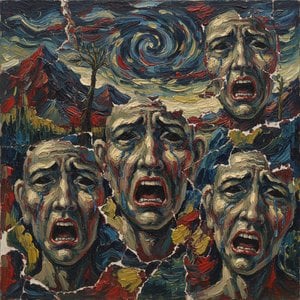
Suzanne Sternberg (née Perlman): A Life Painted in Bold Color
Born in Budapest, Hungary, in 1922, Suzanne Sternberg – later known as Suzanne Perlman – embarked on an artistic journey shaped by both personal upheaval and profound influences. Her early life was steeped in the world of art through her family’s antique gallery, a formative experience that ignited a lifelong passion for collecting and appreciating visual beauty. From a young age, she developed a keen eye for detail and a deep understanding of artistic techniques, skills honed not through formal schooling initially but through immersion in a vibrant collection of masterworks. This early exposure would prove crucial to her later development as an expressionist painter.
The shadow of the Second World War dramatically altered her trajectory. Witnessing the escalating threat of Nazi persecution, Suzanne and her family fled Hungary in 1940, seeking refuge in Rotterdam and then Paris before ultimately finding sanctuary on the Caribbean island of Curaçao. This relocation marked a pivotal moment, not only for her personal safety but also for the genesis of her artistic style. The tropical landscape, with its vibrant colors, exotic flora and fauna, and diverse cultural influences, provided an immediate and powerful source of inspiration – a palette far removed from the austerity of wartime Europe.
Early Influences and Artistic Training
Suzanne’s artistic development was remarkably multifaceted, drawing upon a diverse range of mentors and institutions. Her early training began under the tutelage of the Austrian master Oskar Kokoschka in the late 1950s, an encounter that proved transformative. Kokoschka's emphasis on capturing raw emotion and psychological depth profoundly shaped her approach to portraiture and landscape painting. Following this pivotal mentorship, she pursued formal studies at Columbia University School of the Arts, Instituto Allende in San Miguel de Allende, Mexico, and Saint Martin’s School of Art in London – institutions that collectively broadened her artistic horizons and exposed her to various avant-garde movements.
Kokoschka's influence extended beyond mere technique; he instilled a philosophy of art as an exploration of the inner self. As he famously stated, “Technique you can learn but vision you have to explore.” This belief resonated deeply with Perlman, who sought to convey not just outward appearances but also the emotional and psychological states of her subjects. Her work is characterized by a remarkable sensitivity to human experience, evident in the expressive brushstrokes and vibrant color palettes that define her style.
The Language of Color: Divisionism and Expressionist Portraiture
Suzanne Perlman’s artistic signature lies primarily in her bold use of color and dynamic brushwork. Her paintings are immediately recognizable for their intense hues, layered textures, and a palpable sense of energy. This distinctive style was significantly influenced by the principles of divisionism – also known as chromoluminarism – an art movement that emphasizes the separation of colors into individual dots or patches to create optical effects. This technique, reminiscent of Seurat’s pointillism, allowed her to capture the shimmering quality of light and atmosphere with remarkable precision.
However, Perlman's work transcends mere stylistic imitation. She skillfully integrated divisionist principles into a broader expressionist framework, particularly in her portraits. Her subjects – often ordinary people from Curaçao’s vibrant street life – are rendered with an intimate understanding of their inner lives. Her portraits aren’t simply representations; they are windows into the souls of her sitters, imbued with compassion, insight, and a profound sense of humanity. The dark features she captures articulate a richly nuanced interior radiance.
Legacy and Collections
Suzanne Perlman's legacy extends beyond her individual artistic achievements. Her work is held in prestigious collections worldwide, including the Hungarian National Gallery, a testament to her enduring significance within Hungarian fine arts history. The gallery’s collection showcases her ability to capture both the beauty of Curaçao’s landscape and the complexities of its people.
Her paintings have also been featured in numerous exhibitions and are recognized for their unique blend of color, emotion, and technical skill. From her early depictions of Curaçao's vibrant street scenes to her later portraits exploring themes of identity and memory, Perlman’s art continues to resonate with audiences today. She passed away in 2020 at the age of 97, leaving behind a rich body of work that stands as a powerful testament to the transformative power of art.
Further Exploration
- Suzanne Perlman’s Curaçao Paintings: Explore her early works inspired by the island's unique landscape and culture.
- Oskar Kokoschka’s Influence: Research the impact of Kokoschka’s mentorship on Perlman’s artistic development.
- Divisionism and Chromoluminarism: Learn more about this art movement and its influence on Perlman's technique.
- Hungarian National Gallery Collection: Discover the gallery’s impressive collection of Hungarian fine arts, including works by Suzanne Sternberg.



 Náhled
 Switch to Print
 Sdílet
 Sdílet
 Podrobnosti o díle

 Stáhnout
 Podobné položky
 Rentgenové snímky
 Slideshow
 Stats
Stats


 Zobrazit více






































 Skleněná varianta je dostupná pouze u rozměrů menších než 110 cm