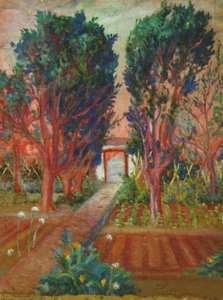
The Serene Geometry of “The Pergola” – A Window into Italian Realism
Silvestro Lega’s “The Pergola,” painted in 1864, isn't merely a depiction of an outdoor scene; it’s a carefully constructed tableau that invites the viewer to step into a moment of quiet contemplation. This oil on canvas, now housed within the Civica Galleria d’Arte Moderna in Milan, exemplifies Lega’s mastery of the Macchiaioli movement – a group dedicated to capturing the fleeting effects of light and color with an unprecedented immediacy. More than just a pretty landscape, “The Pergola” offers a glimpse into the heart of 19th-century Italian life, subtly imbued with themes of leisure, family, and the beauty of the everyday.
At first glance, the painting presents a simple composition: a central pathway winding through a meticulously rendered pergola, flanked by walls adorned with terracotta pots overflowing with greenery. A few figures – women seated on benches beneath the shade – engage in conversation, their postures relaxed and suggesting an intimate gathering. However, closer inspection reveals a sophisticated interplay of light, shadow, and texture that elevates the scene beyond mere representation. Lega’s technique is characterized by “macchia,” a hallmark of the Macchiaioli: areas of concentrated color applied with loose, expressive brushstrokes, creating a sense of vibrancy and immediacy. The colors are rich and earthy – ochres, browns, greens, and hints of terracotta – evoking the warmth of the Italian sun and the tactile quality of stone and foliage.
The Influence of Macchiaioli and Plein Air Painting
Lega’s association with the Macchiaioli profoundly shaped his artistic approach. Unlike traditional academic painting that prioritized meticulous detail and idealized forms, the Macchiaioli sought to capture the *impression* of a scene – the way light falls upon surfaces, the fleeting effects of atmosphere. “The Pergola” embodies this philosophy perfectly. Lega’s use of broken brushstrokes and unblended colors mimics the way our eyes perceive color and light in nature. This commitment to *plein air* painting—working directly from observation outdoors—allowed him to translate the immediacy of his experience onto the canvas, creating a sense of authenticity and spontaneity.
The influence of Luigi Mussini, Lega’s early mentor, is also evident. Mussini emphasized the importance of drawing and construction – principles that are subtly incorporated into Lega's work. The pergola itself is rendered with careful attention to its geometric structure, providing a stable anchor for the more loosely painted figures and foliage. This balance between structured form and expressive brushwork is a key characteristic of Lega’s style.
Symbolism and Social Context
Beyond its aesthetic qualities, “The Pergola” carries subtle symbolic weight. The pergola itself represents a space of refuge and leisure – a place for relaxation and social interaction. The women depicted are likely members of the Batelli family, with whom Lega lived in his later years, providing a glimpse into the domestic life of the Italian countryside. The scene evokes a sense of *dolce far niente*—the sweetness of doing nothing—a concept deeply rooted in Italian culture.
Painted during a period of significant social and political change in Italy – the Risorgimento (unification movement) – “The Pergola” can also be interpreted as a celebration of national identity. Lega’s focus on everyday life and his commitment to capturing the beauty of the Italian landscape reflected a desire to preserve and celebrate the nation's cultural heritage.
A Timeless Masterpiece: Reproduction Possibilities
Silvestro Lega’s “The Pergola” remains a captivating work of art, offering viewers a timeless glimpse into the heart of 19th-century Italian realism. WahooArt.com offers high-quality reproductions of this iconic painting, allowing you to bring its serene beauty and evocative atmosphere into your home or office. Whether you’re an art collector, interior designer, or simply someone who appreciates fine art, a reproduction of “The Pergola” is sure to be a cherished addition to your collection.



 Náhled
 Přepnout na tisk
 Sdílet
 Sdílet
 Podrobnosti o díle

 Stáhnout
 Podobné položky
 Rentgenové snímky
 Slideshow
 Statistiky


 Zobrazit více