The Stark Portrait of a Modern Soul: Roy Lichtenstein’s *Expressionist Head 3*
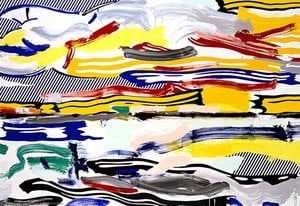
Roy Lichtenstein's *Expressionist Head 3*, painted in 1980, isn’t merely a depiction of a face; it’s a distilled essence of the anxieties and detachment simmering beneath the surface of American culture during the late 20th century. This striking work, rendered in bold blues and stark contrasts, immediately draws the viewer into an unsettling yet undeniably compelling dialogue with its subject – a man whose gaze is fixed on something unseen, lost to our perspective but profoundly felt within the painting itself. The image, initially appearing simple at first glance, reveals layers of complexity when considered through the lens of Lichtenstein’s signature Pop Art style and his engagement with Expressionist principles.
Lichtenstein, a pivotal figure in the Pop Art movement, deliberately dismantled traditional notions of artistic subject matter. He didn't shy away from the commonplace – advertising, comic books, everyday objects – elevating them to the status of high art. *Expressionist Head 3* exemplifies this strategy. The blue background, devoid of detail, acts as a void, amplifying the intensity of the figure’s features and suggesting an isolation that resonates with the era's growing sense of alienation. The deliberate flatness of the painting, achieved through Lichtenstein’s characteristic use of hard-edged forms and Ben-Day dots – those tiny, colored squares that mimic the printing process – further reinforces this feeling of detachment from reality.
Echoes of Expressionism in a Pop Art Canvas
While firmly rooted in the Pop Art movement, *Expressionist Head 3* reveals a fascinating dialogue with German Expressionism. The angularity of the face, reminiscent of artists like Ernst Ludwig Kirchner and Emil Nolde, hints at an underlying emotional turmoil. However, Lichtenstein cleverly subverts this influence by replacing the expressive brushstrokes and vibrant colors typically associated with Expressionism with his signature Ben-Day dots. This strategic shift creates a visual tension – a sense of both familiarity and deliberate disruption. The use of stripes, initially employed as a more efficient method for creating linear forms in his sculptures, adds another layer to this interplay, emphasizing the painting’s two-dimensional nature despite its evocative imagery.
The choice of blue is particularly significant. Blue often represents melancholy, introspection, and even isolation – emotions that seem perfectly aligned with the figure's enigmatic expression. The blue nose and mouth contribute to a sense of emotional distance, suggesting a deliberate suppression or perhaps an inability to articulate inner feelings. It’s as if the subject has retreated into himself, shielded from the world by a carefully constructed facade.
Decoding the Symbolism: Consumer Culture and the Disengaged Observer
Produced in 1980, *Expressionist Head 3* speaks powerfully to the cultural landscape of that year. Lichtenstein’s work frequently engaged with themes of consumer culture and mass production – concepts increasingly prevalent during this period. The painting can be interpreted as a commentary on the detachment fostered by these forces, portraying an individual seemingly oblivious to the surrounding world, lost in his own internal thoughts. The figure's averted gaze suggests a lack of engagement, mirroring a broader societal trend towards passive observation rather than active participation.
Furthermore, the painting’s stark simplicity and reliance on visual techniques borrowed from advertising – the Ben-Day dots, the bold color palette – directly reference the pervasive influence of commercial imagery in American life. Lichtenstein wasn't simply replicating these images; he was deconstructing them, exposing their underlying emotional impact and questioning their role in shaping our perceptions.
Reproductions of *Expressionist Head 3* offer a unique opportunity to bring this complex and thought-provoking artwork into your home or office. WahooArt’s hand-painted reproductions capture the essence of Lichtenstein's style with meticulous detail, ensuring that you experience the full impact of this iconic piece.
Otázky a odpovědi
V jaké orientaci je dílo „Expressionist Head 3“ od Roy Lichtenstein?
Formát díla „Expressionist Head 3“ je Portrait. To se hodí při plánování umístění reprodukce.
Jak sytá je paleta díla "Expressionist Head 3"?
Dílo „Expressionist Head 3“ od Roy Lichtenstein je zachyceno s Balanced Soft saturací.
Jak lze vysvětlit situaci s autorskými právy u díla „Expressionist Head 3“ od Roy Lichtenstein?
Autorskoprávní status díla „Expressionist Head 3“ – stále chráněno autorským právem – vyplývá ze smrti umělce v roce 1997.



 Zobrazit v interiéru
 Přepnout na tiskové verze
 Odeslat
 Sdílet
 Podrobnosti
 Průvodce

 Stáhnout obrázek
 Podobné kousky
 Rentgenové snímky
 Slideshow
 Statistiky

 Přečíst si více






































 Skleněná varianta je dostupná pouze u rozměrů menších než 110 cm