Biografie umělce
A Life Immersed in the Animal World
Rosa Bonheur, born Marie-Rosalie Bonheur in 1822 Bordeaux, France, wasn’t simply a painter of animals; she was an interpreter of their very essence. Her name resonates through art history as a beacon of realism and a testament to female artistic ambition in a period dominated by male figures. Born into a family steeped in artistic tradition – her father, Oscar-Raymond Bonheur, was a landscape and portrait painter – young Rosalie’s path wasn’t predetermined but nurtured. The family’s embrace of Saint-Simonianism, a progressive socialist philosophy advocating for equal education for both sexes, proved particularly formative, instilling in Rosa a sense of independence and intellectual curiosity that would define her life and work. Tragedy struck early with the loss of her mother at age eleven, yet the Bonheur household remained a haven for creativity and unconventional thinking. This unique upbringing laid the foundation for an artist who would challenge societal norms as boldly as she captured the raw beauty of the natural world.
From Humble Beginnings to Salon Success
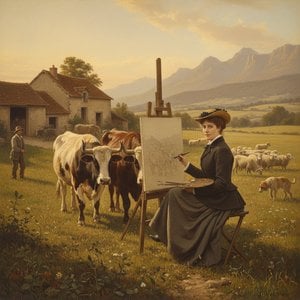
The family’s relocation to Paris in 1828 marked a turning point, providing Rosa with access to formal artistic training. Initially, her studies followed conventional lines – copying from drawings and sketching plaster models. However, it was the animals surrounding Paris that truly captured her imagination. Horses, cattle, sheep, goats—she observed them relentlessly, not merely as subjects for art but as living beings deserving of meticulous study. This dedication to direct observation became the cornerstone of her artistic style. Her father actively encouraged this passion, even bringing live animals into their studio for Rosa to dissect and analyze. This hands-on approach, combined with visits to Parisian abattoirs to understand animal anatomy, set her apart from many contemporaries who relied on second-hand depictions. Her breakthrough arrived in 1849 with *Ploughing in the Nivernais*, a work that garnered immediate attention at the Paris Salon and signaled the arrival of a significant new talent. But it was *The Horse Fair*, completed between 1853 and 1855, that cemented her international fame. This monumental canvas, now housed in New York’s Metropolitan Museum of Art, pulsates with energy and anatomical precision, depicting the chaotic yet captivating spectacle of a bustling horse market. Even Queen Victoria herself was captivated by its power and realism.
A Style Rooted in Realism and Observation
Rosa Bonheur's artistic style wasn’t about romanticizing animals; it was about portraying them with unwavering honesty and detail. She eschewed sentimentality, opting instead for a scientific approach to her subjects. Her paintings are characterized by their anatomical accuracy, dynamic compositions, and an ability to capture the unique personality of each creature. This commitment to realism extended beyond mere physical representation. Bonheur sought to understand the animals’ movements, behaviors, and even their emotional states. She often worked *en plein air*, directly observing her subjects in their natural environments, a practice that further enhanced the authenticity of her work. Her technique involved careful layering of paint and a masterful use of light and shadow to create depth and texture, bringing each animal vividly to life on canvas. The influence of artists like Nicolas Poussin and Peter Paul Rubens is evident in her compositions, but she always grounded her work in meticulous observation and anatomical study.
A Pioneer for Women in Art
Rosa Bonheur’s legacy extends far beyond her artistic achievements; she became an icon for women striving for recognition in the male-dominated art world. She defied convention not only through her professional success but also through her personal choices. Famously, she often wore men's clothing while working with animals, citing practicality and freedom of movement – a bold statement that challenged societal expectations. She secured commissions from governments and private collectors alike, proving that female artists could achieve the same level of acclaim as their male counterparts. Her success paved the way for future generations of women artists, inspiring them to pursue their passions without compromise. Bonheur’s life story serves as a powerful example of artistic independence and determination. Her paintings continue to be celebrated in major museums worldwide, serving as a reminder of her enduring contribution to art history and her unwavering commitment to portraying the beauty and dignity of the animal kingdom.
Enduring Influence and Lasting Legacy
The impact of Rosa Bonheur’s work continues to resonate today. Her dedication to realism influenced countless artists, and her paintings remain admired for their technical skill and emotional depth. She demonstrated that art could be both scientifically accurate and profoundly moving, bridging the gap between observation and interpretation. Beyond her artistic contributions, Bonheur's life story serves as a powerful example of female empowerment and artistic independence. She challenged societal norms, defied expectations, and ultimately achieved lasting recognition on her own terms. Her legacy is not merely one of beautiful paintings but also of courage, determination, and a unwavering commitment to her craft. Her work continues to inspire artists and art lovers alike, reminding us of the power of observation, the beauty of the natural world, and the importance of pursuing one’s passions with conviction.



 Náhled v interiéru
 Přepnout na tisk
 Sdílet
 Sdílet
 Podrobnosti o díle
 Průvodce

 Stáhnout
 Podobné položky
 Rentgenové snímky
 Slideshow
 Statistiky
 Zobrazit více






































 Skleněná varianta je dostupná pouze u rozměrů menších než 110 cm