A Chaotic Symphony of Everyday Life: Unveiling “The Fat Kitchen”
Pieter Bruegel the Elder’s “The Fat Kitchen,” painted in 1563, isn't merely a depiction of a domestic scene; it’s a vibrant snapshot of Northern Renaissance life, brimming with humor, satire, and an astute observation of human behavior. This etching, rendered with meticulous detail and a masterful understanding of perspective, transports the viewer into a bustling kitchen overflowing with activity – a microcosm of society itself. The image immediately assaults the senses with its density; figures are crammed together, food is piled high, and every surface seems to be in use. It’s a scene both chaotic and captivating, a testament to Bruegel's ability to distill complex social commentary into a single, unforgettable composition.
The work’s genesis lies within the burgeoning artistic landscape of 16th-century Europe, a period marked by a shift away from the idealized forms of the Italian Renaissance and towards a more grounded, humanistic approach. Bruegel, rooted in the traditions of Flemish art, skillfully blended these influences with his own distinctive style – one characterized by an unflinching gaze at the realities of peasant life, often imbued with subtle moral judgments. “The Fat Kitchen” exemplifies this perfectly; it’s not a romanticized portrayal of domesticity but rather a shrewd commentary on indulgence and the rhythms of daily existence.
Technique and Composition: A Masterclass in Northern Printmaking
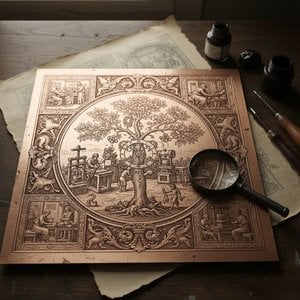
Bruegel's etching technique is central to the work’s impact. The dense cross-hatching, executed with incredible precision, creates a remarkable range of tonal values – from the darkest shadows to the brightest highlights – lending depth and texture to every element within the scene. Notice how the artist uses varying line weights to define forms; the plump figures are rendered with bolder lines, while the background details are suggested with finer, more delicate strokes. This masterful control over linework is a hallmark of Northern Renaissance printmaking, prioritizing detail and realism.
- Perspective: The high vantage point offers a comprehensive view, yet subtly flattens the space – a characteristic feature of Northern European prints that prioritizes narrative clarity over strict spatial illusion.
- Cross-Hatching: The intricate network of lines defines forms, textures (from rough fabrics to glistening food), and creates a sense of depth and volume.
- Composition: The densely packed arrangement generates a feeling of energetic chaos, mirroring the bustling activity within the kitchen. Overlapping figures and objects contribute to this dynamic effect.
Symbolism and Social Commentary
While seemingly straightforward, “The Fat Kitchen” is rich in symbolic potential. The abundance of food – particularly the overflowing platters and barrels – can be interpreted as a commentary on wealth, excess, and perhaps even gluttony. The various activities depicted – eating, drinking, arguing, and simply lounging – reflect the diverse roles within a household and offer a glimpse into the social dynamics of the time. The figures themselves are not idealized; they’re portrayed with a degree of realism that highlights their flaws and foibles, suggesting a subtle critique of human nature.
Bruegel's genius lies in his ability to present these observations without overt moralizing. He doesn’t preach; he simply observes and depicts, allowing the viewer to draw their own conclusions about the scene’s meaning. The etching invites us to contemplate our own relationship with consumption, social interaction, and the complexities of everyday life.
A Legacy in Reproduction: Bringing Bruegel's Vision Home
WahooArt offers meticulously crafted hand-painted reproductions of “The Fat Kitchen,” allowing you to experience the full richness and detail of this iconic artwork. Our skilled artists faithfully recreate Bruegel’s masterful technique, capturing the etching’s dynamic energy and subtle nuances. Whether displayed in a grand salon or a cozy study, a WahooArt reproduction will serve as a captivating conversation piece – a window into the world of Northern Renaissance life and a testament to the enduring genius of Pieter Bruegel the Elder.



 Náhled
 Přepnout na tisk
 Sdílet
 Sdílet
 Podrobnosti o díle

 Stáhnout
 Podobné položky
 Rentgenové snímky
 Slideshow
 Statistiky

 Zobrazit více






































 Skleněná varianta je dostupná pouze u rozměrů menších než 110 cm