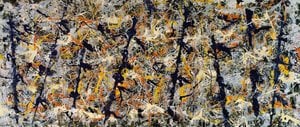
Jackson Pollock’s “Going West”: A Journey of Family and Form
Jackson Pollock's "Going West," painted in 1935, isn’t merely a depiction of a winter landscape; it’s a deeply personal narrative woven into the fabric of American pioneering spirit. Born Paul Jackson Pollock in Cody, Wyoming – a town intimately linked to westward expansion – the painting resonates with a profound sense of familial history and the yearning for a new horizon. The scene unfolds at night, dominated by a snow-dusted mountain range, a backdrop that immediately evokes the vastness and rugged beauty of the American West. A small group of figures stands before this imposing vista, their forms rendered in a style that’s both recognizable and subtly abstracted – a characteristic born from Pollock's early experimentation with various artistic influences.
The painting’s genesis is believed to be rooted in a family photograph of a bridge in Cody, Wyoming. This seemingly simple starting point becomes the foundation for a richer exploration of themes: the journey westward undertaken by Pollock’s own family during his childhood from Arizona to California. This personal connection imbues the artwork with an emotional weight, transforming it into more than just a landscape; it's a visual embodiment of displacement, aspiration, and the enduring pull of home. The inclusion of a dog amongst the figures adds another layer of intimacy, suggesting companionship and shared experience on this arduous journey.
Echoes of Benton: Regionalism and Early Influence
To fully appreciate “Going West,” it’s crucial to recognize the significant influence of Thomas Hart Benton, Pollock's mentor. Benton, a prominent American Regionalist painter, championed a style characterized by realistic depictions of everyday life, particularly focusing on rural America and its history. Pollock, in his early career, was deeply drawn to Benton’s approach – evident in the careful rendering of the figures and the detailed depiction of the landscape. However, Pollock quickly moved beyond mere imitation, incorporating elements of Surrealism and drawing inspiration from Native American art, ultimately forging his own distinctive style.
Notice how Benton's use of bold lines and a somewhat flattened perspective is echoed in Pollock’s composition, though subtly transformed. The figures aren’t sharply defined; they possess an almost dreamlike quality, contributing to the painting’s overall atmosphere of mystery and introspection. This early experimentation with different styles demonstrates Pollock’s artistic restlessness and his willingness to absorb influences before ultimately establishing his revolutionary drip technique.
The Language of Paint: Technique and Atmosphere
“Going West” is a masterclass in the expressive potential of oil paint. Pollock employs a layered, almost chaotic application, building up texture and depth through multiple layers of color. The dark blues and blacks of the night sky contrast dramatically with the warm hues of the mountains and the figures’ clothing, creating a powerful sense of drama and visual tension. The technique is not about precise representation; it's about conveying feeling – the coldness of the winter air, the vastness of the landscape, and the quiet contemplation of the group before them.
The use of impasto—thickly applied paint—adds a tactile quality to the canvas, inviting viewers to reach out and touch the surface. This physicality is particularly striking in the depiction of the mountains, where the paint seems to ripple and flow like water. The overall effect is one of movement and energy, despite the static pose of the figures. It’s important to note that this technique was still developing as Pollock moved toward his signature drip painting style, making “Going West” a crucial stepping stone in his artistic evolution.
A Testament to American Identity
“Going West” transcends its immediate subject matter to become a potent symbol of the American experience. It speaks to the pioneering spirit, the challenges and rewards of westward expansion, and the enduring connection between family and place. Pollock’s ability to blend personal history with broader themes of American life is what makes this painting so compelling – it's not just a landscape; it’s a meditation on identity, journey, and the search for belonging. The painting serves as an important piece in understanding Pollock's early artistic development, setting the stage for his later abstract expressionist works.
For those seeking to own a piece of this remarkable artwork, WahooArt offers meticulously crafted hand-painted reproductions of “Going West.” These faithful recreations capture the painting’s rich textures, dramatic lighting, and emotional depth, allowing you to bring this iconic image into your home or office. Explore our reproduction options today!
Otázky a odpovědi
Kdo je autorem díla "Going West"?
Dílo "Going West" vytvořil/a Jackson Pollock. Informace na této stránce popisují originální dílo umělce Jackson Pollock.
Jaká je vnímaná jasnost díla „Going West“ od Jackson Pollock?
Celkově je dílo „Going West“ hodnoceno jako deep_shadow. Vnímaná jasnost popisuje, jak světlé nebo tmavé se dílo jeví.
V jakém věku vytvořil/a Jackson Pollock dílo „Going West"?
Jackson Pollock bylo 23 let, když v roce 1935 vytvořilo dílo „Going West“. Věk je vypočítán z roku narození umělce, 1912.
Jaký pocit vyvolávají barvy díla „Going West“ od Jackson Pollock?
V díle "Going West" doprovází Earthy barev Melancholic pocit.
Jak populární je „Going West“ v rámci směru Abstract Expressionism?
Dílo "Going West" je v katalogu hodnoceno jako Iconic mezi díly z období Abstract Expressionism.
V jakém roce bylo vytvořeno dílo „Going West“ od Jackson Pollock?
Dílo "Going West" pochází z roku 1935. Toto datum situuje dílo do období tvůrčí činnosti Jackson Pollock i do jeho dobové kontextu.
Jsou barvy díla „Going West“ od Jackson Pollock živé, nebo tlumené?
Barvy díla „Going West“ od Jackson Pollock vykazují Muted saturaci s Monochromatic intenzitou.



 Zobrazit v interiéru
 Objednat ručně malovanou reprodukci
 Odeslat
 Sdílet
 Podrobnosti
 Průvodce

 Stáhnout obrázek
 Podobné kousky
 Rentgenové snímky
 Slideshow
 Statistiky


 Přečíst si více






































 Skleněná varianta je dostupná pouze u rozměrů menších než 110 cm