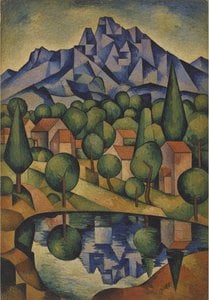
Paul Cézanne’s Still Life Post, Bottle, Cup and Fruit: A Cornerstone of Modern Art
Paul Cézanne (1839-1906) stands as a pivotal figure in the artistic landscape of late 19th century France – a visionary who irrevocably shifted the paradigm from Impressionism’s fleeting sensations to Cubism's fractured realities. Initially dismissed by critics and overshadowed by his contemporaries, Cézanne persevered with unwavering dedication, transforming into one of the most influential artists of his era and securing a place among the giants of modern art.
Born in Aix-en-Provence to a family enjoying considerable financial stability thanks to his father’s involvement in banking, Cézanne benefited from privileges uncommon for aspiring painters. This afforded him the invaluable freedom to pursue his artistic ambitions without the pressures of immediate commercial considerations – a luxury that allowed him to immerse himself fully in experimentation and exploration.
The Genesis of Geometric Form: Cézanne's Departure From Impressionism
While Cézanne’s early influences included artists like Jean-François Millet and Gustave Courbet, who championed realism and depicted rural life with meticulous detail, he quickly recognized the limitations of Impressionistic techniques. Impressionists sought to capture the ephemeral effects of light and atmosphere—a pursuit Cézanne deemed insufficient for conveying the essence of his subjects. Instead, he embarked on a radical reformulation of artistic representation, prioritizing geometric forms and simplifying contours.
"Still Life Post, Bottle, Cup and Fruit," painted in 1871, exemplifies this transformative approach. Unlike Impressionistic renderings characterized by hazy brushstrokes and diffused colors, Cézanne’s composition is deliberately constructed with interlocking planes of color and shape—a technique that anticipates the groundbreaking innovations of Cubism.
Analyzing Composition & Technique: Cézanne's Innovative Approach
The painting depicts a humble domestic scene – a table laden with apples, oranges, a bottle, and two cups. Cézanne’s meticulous attention to detail is evident in the rendering of each element, yet these objects are presented not as photographic likenesses but as abstracted forms that engage with underlying spatial relationships.
He employed a technique known as “Analytical Cubism,” where he dissected objects into multiple geometric planes—often cubes and cylinders—that were then rearranged on the canvas to create an illusion of depth. Cézanne’s masterful use of color – predominantly muted hues – contributes to the painting's subdued yet resonant atmosphere, inviting contemplation about permanence and solidity amidst perceived instability.
Symbolism & Emotional Resonance: Beyond Mere Representation
Beyond its formal innovations, “Still Life Post, Bottle, Cup and Fruit” possesses a profound symbolic significance. The fruit itself represents nourishment and abundance—themes frequently explored in Cézanne’s oeuvre. However, more importantly, the painting speaks to an underlying preoccupation with capturing the fundamental structure of reality – a quest that reflects Cézanne's belief that art should strive for something beyond mere visual imitation.
Cézanne’s legacy extends far beyond his artistic achievements; he fundamentally reshaped how artists perceived and depicted the world. “Still Life Post, Bottle, Cup and Fruit” remains an enduring testament to this revolutionary vision—a captivating piece of art history that continues to inspire collectors and interior designers alike.



 Náhled
 Přepnout na tisk
 Sdílet
 Sdílet
 Podrobnosti o díle

 Stáhnout
 Podobné položky
 Rentgenové snímky
 Slideshow
 Statistiky

 Zobrazit více






































 Skleněná varianta je dostupná pouze u rozměrů menších než 110 cm