A Journey Through Color and Form: Exploring Cézanne’s “The Bend in the Road”
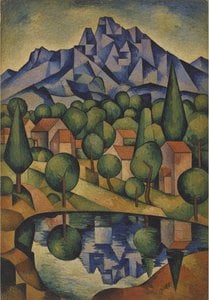
Paul Cézanne’s “The Bend in the Road,” painted in 1906, just before his passing, is more than a landscape; it's an invitation. An invitation to contemplate the fundamental nature of reality itself, and a testament to Cézanne’s revolutionary approach to painting. This captivating vertical composition draws us into a serene valley, dominated by a dramatic bend in the road that acts as a powerful visual guide, leading the eye through a world constructed not merely from observation but from deep, considered understanding.
Cézanne stands as a pivotal figure bridging the Impressionist movement with the burgeoning explorations of Cubism. While undeniably influenced by the vibrant color palettes and fleeting moments of light favored by his contemporaries – particularly Gauguin and Seurat – he transcends mere representation. He moves beyond capturing a single, ephemeral impression to dissecting the underlying geometric structures that compose nature itself. This isn’t simply a painting of a road; it's an attempt to capture the very essence of space and form, a precursor to the radical deconstruction of reality championed by Picasso and Braque.
Technique & The Language of Color
The magic of “The Bend in the Road” resides largely in Cézanne’s masterful technique. He employs visible, vertical brushstrokes – not blended or smoothed, but deliberately placed – to build up layers of intensely saturated color: burnt orange, peach, salmon pink, cobalt blue, lime green, and spring green. This creates a palpable sense of texture and depth, inviting the viewer to examine the painting closely. Crucially, Cézanne utilizes unpainted canvas strategically, creating areas of negative space that heighten the feeling of lightness and emphasize the constructed nature of his work. It’s as if he's not just painting what he sees, but actively building a world on the canvas.
Symbolism & The Emotional Landscape
The color palette itself is profoundly evocative. The fiery oranges and pinks of the rock formations – likely inspired by the landscapes around Aix-en-Provence – contrast dramatically with the cool blues and greens of the valley trees, generating a harmonious balance that speaks to both warmth and tranquility. But beyond mere aesthetic pleasure lies a deeper symbolism. Roads, naturally, represent journeys, transitions, and the path of life. The curving pathway disappearing into the distance suggests an endless quest for understanding, while the imposing rock formations could be interpreted as obstacles or challenges encountered along this journey. The open valley symbolizes possibilities and hope – a space for contemplation and connection with nature.
Cézanne’s Legacy & A Timeless Masterpiece
Paul Cézanne's influence on modern art is undeniable. His insistence on form, structure, and subjective perception fundamentally altered the course of painting. He wasn’t simply depicting a landscape; he was exploring its very essence. Artists like Picasso and Matisse recognized his profound impact, acknowledging him as “the father of modern art.” “The Bend in the Road” remains a powerful example of this legacy – a timeless masterpiece that continues to inspire awe and provoke contemplation, offering a glimpse into the mind of one of history’s most innovative and influential artists. This painting, or a meticulously crafted reproduction, would be an exceptional addition to any collection, bringing a touch of Cézanne's genius and serenity to your home or office.
Otázky a odpovědi
Kde mohu najít umělecká díla podobná dílu „Ohnútek na cestě“ od Paul Cézanne?
Díla podobná "Ohnútek na cestě" jsou uvedena na stránce Podobná díla tohoto díla.
Jaká technika byla použita pro dílo „Ohnútek na cestě“ od Paul Cézanne?
Paul Cézanne použil/a techniku Olej na plátně pro dílo „Ohnútek na cestě“. Tato technika definuje materiální podstatu originálního díla.
Proč má dílo „Ohnútek na cestě“ právě takový autorský status?
Dílo „Ohnútek na cestě“ od Paul Cézanne spadá do patří do volného užití – autorská práva vypršela. Autorská práva se počítají od roku úmrtí autora; Paul Cézanne zemřel(a) v roce 1906.



 Zobrazit v interiéru
 Přepnout na tiskové verze
 Odeslat
 Sdílet
 Podrobnosti
 Průvodce

 Stáhnout obrázek
 Podobné kousky
 Rentgenové snímky
 Slideshow
 Statistiky


 Přečíst si více






































 Skleněná varianta je dostupná pouze u rozměrů menších než 110 cm