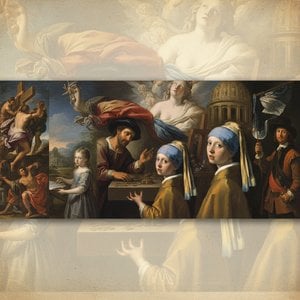
The Venetian Visionary: The Life and Legacy of Paolo Antonio Pagani
In the vibrant, light-drenched tapestry of the late seventeenth century, few artists embodied the dramatic transition from Mannerist artifice to Baroque grandeur as uniquely as Paolo Antonio Pagani. Born in 1655 in the tranquil borderlands of Valsolda, Pagani’s journey was one of constant movement and profound transformation. While his early years were rooted in the Lombardy region, it was his migration to Venice in 1667 that ignited his creative spirit. This relocation placed him at the very heart of a visual revolution, where the lingering elegance of Mannerism began to merge with the sweeping, emotional intensity of the Baroque era. As he navigated the canals and studios of Venice, Pagani developed a technical versatility that would allow him to master not only the brush but also the delicate precision of the etching needle.
Pagani’s early professional identity was deeply intertwined with the art of printmaking. He demonstrated an extraordinary ability to translate the painterly textures of his contemporaries into the graphic language of aquatint. One of his most significant early achievements was a monumental series of ten aquatints inspired by the canvases of Giuseppe Diamant, a Venetian master known for blending classical grace with dynamic movement. Through these prints, Pagani did more than merely replicate existing works; he acted as a vital conduit for artistic ideas, disseminating the sophisticated visual vocabulary of Venice across much wider territories. This period of his life established him as an artist capable of profound technical experimentation, a trait that would define his later, more ambitious architectural and fresco endeavors.
A Journey Through Imperial Courts and Sacred Spaces
The trajectory of Pagani’s career took a magnificent turn toward the north when he was invited to the imperial court of Vienna. Between 1690 and 1696, under the patronage of Emperor Leopold I, Pagani expanded his artistic horizons far beyond the Italian peninsula. This exposure to Central European traditions infused his work with a new sense of scale and a more robust, dramatic sensibility. The cosmopolitan atmosphere of Vienna allowed him to absorb diverse influences, refining a style that could command the vast, soaring spaces of imperial architecture. It was during this era that Pagani truly began to master the art of quadratura—the illusionistic technique of painting architectural perspectives that appear to extend the real space of a room into an infinite sky.
Upon his return to Valsolda in 1696, Pagani embarked upon what many scholars consider his definitive masterpiece: the frescoing of the nave in the parish church of San Martino. This project stands as a breathtaking testament to his ability to manipulate light and perspective. In this sacred space, he utilized a technique known as sotto in su—a "from below upwards" perspective—to create dizzying, celestial visions that seem to dissolve the very ceiling. His work in San Martino is characterized by:
- Luminous Color Palettes: A vibrant use of light that anticipates the brilliance of later masters like Tiepolo.
- Illusionistic Complexity: The creation of interconnected domes and arches that guide the eye through a complex narrative of saints and divine intervention.
- Narrative Depth: A seamless integration of iconographic themes, ranging from the Assumption of the Virgin to the martyrdom of early Christian figures.
The Enduring Significance of a Forgotten Master
Though history has sometimes overlooked Pagani in favor of more widely recognized names, his contribution to the evolution of European painting remains undeniable. He was an artist of transition, a bridge between the structured elegance of the past and the theatrical exuberance of the future. His ability to move between the intimate scale of a portrait—such as his evocative St. Jerome—and the monumental scale of a cathedral ceiling demonstrates a rare breadth of vision. Pagani’s work serves as a vital link in the lineage of Italian art, embodying the spirit of an age that sought to blur the lines between the earthly and the divine through the sheer power of artistic invention.



 Zobrazit v interiéru
 Přepnout na tiskové verze
 Odeslat
 Sdílet
 Podrobnosti
 Průvodce

 Stáhnout obrázek
 Podobné kousky
 Rentgenové snímky
 Slideshow
 Statistiky


 Přečíst si více






































 Skleněná varianta je dostupná pouze u rozměrů menších než 110 cm