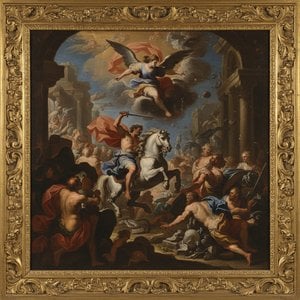
Subject and Narrative: The Myth of Midas and Bacchus
Nicolas Poussin's "Midas and Bacchus," painted in 1629, vividly portrays a pivotal moment from Greek mythology. The scene depicts King Midas, renowned for his unfortunate wish that everything he touched would turn to gold, seeking redemption from the god of wine and revelry, Bacchus. The painting captures Midas kneeling humbly before Bacchus, seemingly pleading for relief from the curse that has rendered even sustenance unattainable. Bacchus, in turn, appears compassionate, extending a hand towards the suffering king while holding a cup – a symbol of his domain over wine and pleasure, now juxtaposed with Midas's desperate situation. The presence of Silenus, Bacchus’s companion, adds to the mythological richness of the scene, representing wisdom and indulgence. The inclusion of nymphs, fauns, and shepherds populating the idyllic landscape further enhances the narrative depth, grounding the divine encounter within a pastoral setting.
Style and Technique: Classical Harmony and Baroque Drama
"Midas and Bacchus" exemplifies Poussin's signature style – a blend of classical restraint and Baroque drama. Poussin was deeply influenced by Renaissance art and sought to emulate the clarity, balance, and intellectual rigor of artists like Raphael. This is evident in the painting’s carefully structured composition, where figures are arranged with geometric precision, creating a sense of order and harmony. However, the work also showcases elements characteristic of the Baroque period, such as dramatic lighting and emotional intensity. Poussin's masterful use of oil paint allows for subtle gradations of color and texture, bringing depth and realism to the scene. The meticulous attention to detail in rendering fabrics, foliage, and human anatomy demonstrates his technical skill and dedication to artistic perfection. The overall effect is a visually stunning representation that balances intellectual contemplation with emotional resonance.
Historical Context: A Reflection on Human Nature
Painted during the Baroque era, "Midas and Bacchus" reflects broader cultural trends of the time. The 17th century was marked by religious conflict, political upheaval, and a renewed interest in classical antiquity. Poussin’s work often explored themes of morality, virtue, and human fallibility, drawing inspiration from mythology and history to comment on contemporary society. The story of Midas serves as a cautionary tale about the dangers of greed and unchecked desire – a message that would have resonated with audiences grappling with economic inequality and social unrest. Furthermore, Poussin’s emphasis on classical ideals aligned with the Baroque era's fascination with ancient Greece and Rome, contributing to the revival of classical forms and themes in art.
Symbolism and Emotional Impact: A Meditation on Transience
Beyond its narrative content, "Midas and Bacchus" is rich in symbolic meaning. The golden touch, initially perceived as a blessing, becomes a curse, symbolizing the fleeting nature of material wealth and the importance of appreciating true values. Bacchus’s presence represents both indulgence and divine power – a reminder that even gods can offer mercy to those who demonstrate humility. The idyllic landscape surrounding the figures serves as a backdrop for this profound encounter, highlighting the contrast between the ephemeral pleasures of earthly life and the enduring truths of human existence. Emotionally, the painting evokes a sense of pathos and contemplation. Midas’s despair is palpable, while Bacchus's compassion inspires hope. The overall effect is a deeply moving work that invites viewers to reflect on their own desires, values, and place in the world.
A Timeless Masterpiece: Enduring Appeal
"Midas and Bacchus" remains a celebrated masterpiece of Baroque art, admired for its technical brilliance, intellectual depth, and emotional power. Its enduring appeal lies in its ability to transcend time and culture, offering timeless insights into the human condition. Whether viewed as a historical artifact or a source of artistic inspiration, this painting continues to captivate audiences with its beauty and profound message.
Otázky a odpovědi
Je "Midas and Bacchus" dobrým nápadem na dárek?
„Midas and Bacchus“ je doporučováno jako dárek pro Výročí.
K jakému použití je doporučována reprodukce díla „Midas and Bacchus“?
Doporučené využití tisku díla „Midas and Bacchus“ je Centrální bod.
Jaký emocionální tón doprovází styl Baroque u díla „Midas and Bacchus"]?
„Midas and Bacchus“ nese Reflektivní emocionální nádech v rámci směru Baroque.



 Zobrazit v interiéru
 Objednat ručně malovanou reprodukci
 Odeslat
 Sdílet
 Podrobnosti
 Průvodce

 Stáhnout obrázek
 Podobné kousky
 Rentgenové snímky
 Slideshow
 Statistiky


 Přečíst si více






































 Skleněná varianta je dostupná pouze u rozměrů menších než 110 cm