An Echo of Spirit: The World of Nicholas Roerich
Nicholas Roerich’s work transcends mere representation; it is a portal to a deeply felt spiritual landscape. Born in 1874 amidst the intellectual ferment of Imperial Russia, Roerich’s life was inextricably linked to his art. He wasn’t simply painting what he saw; he was translating an inner vision, informed by archaeological expeditions, philosophical inquiry, and a profound belief in the interconnectedness of humanity and nature. His artistic journey began with formal training at St. Petersburg University and the Imperial Academy of Arts, yet it quickly evolved into something far more ambitious – a quest to capture not just the visual beauty of the world but its underlying spiritual essence. This pursuit led him on extensive travels across Asia and South America, immersing him in ancient cultures and fostering a unique perspective that profoundly shaped his artistic output.
The Painting's Subject: A Lunar Reverie
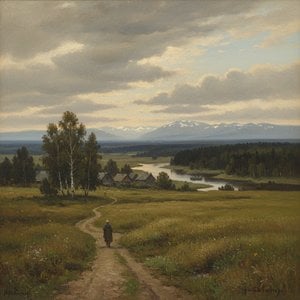
"Lake of the Moon," painted circa 1914, presents a breathtaking vista of a tranquil lake reflecting the ethereal glow of a full moon. The composition is dominated by the shimmering surface of the water, meticulously rendered with layers of translucent paint to evoke the play of light and shadow. Towering mountains frame the scene in the distance, their peaks shrouded in mist, adding a sense of scale and mystery. A small boat rests gently on the lake’s edge, suggesting human presence within this vast, natural setting – a poignant reminder of our place within the grand scheme of things. The artist's deliberate choice to depict a moonlit scene speaks to a fascination with cycles, transformation, and the hidden realms of consciousness.
Technique and Style: A Fusion of Realism and Symbolism
Roerich’s technique is characterized by its remarkable detail and luminous quality. He employed a layering method – *glazing* – building up thin washes of color over dry underlayers, creating an effect of incredible depth and atmospheric perspective. This meticulous approach, combined with his mastery of color theory, results in a painting that seems to radiate light itself. While rooted in realism, Roerich’s work is infused with symbolic elements. The moon, a recurring motif in his oeuvre, represents intuition, the subconscious mind, and spiritual enlightenment. The mountains symbolize strength, stability, and connection to the earth, while the boat embodies humanity's journey of self-discovery. His style can be categorized as part of the Russian Symbolist movement, blending naturalistic observation with subjective emotional expression.
Symbolism and Spiritual Resonance
Beyond its aesthetic beauty, “Lake of the Moon” is rich in symbolic meaning. Roerich was deeply interested in esoteric traditions and believed that art could be a vehicle for spiritual transformation. The painting’s serene atmosphere evokes a sense of tranquility and contemplation, inviting the viewer to connect with their own inner world. The reflection of the moon on the water symbolizes the duality of existence – the interplay between light and darkness, consciousness and unconsciousness. It's believed that Roerich imbued his works with protective symbols, intended to ward off negative energies and promote harmony. The precise interpretation of these symbols remains a subject of ongoing scholarly debate, adding another layer of intrigue to this captivating artwork.
Historical Context: A Moment of Transition
Painted in 1914, just before the outbreak of World War I, “Lake of the Moon” reflects a period of profound social and intellectual upheaval. The rise of modernism challenged traditional artistic conventions, while spiritual movements offered alternative paths to meaning. Roerich’s work can be seen as a response to these changes – a reaffirmation of timeless values and a celebration of nature's enduring beauty. The painting’s quiet contemplation offers a poignant reminder of the importance of seeking solace and inspiration in the face of adversity.
Otázky a odpovědi
Do které fáze kariéry Nikolai Roerich patří dílo „Cesta obřadů“ (1914)?
Vzhledem k datování z roku 1914 spadá dílo „Cesta obřadů“ do Mature Period umělce Nikolai Roerich.
Kolik let bylo Nikolai Roerich, když vzniklo dílo „Cesta obřadů"]?
Když bylo dílo „Cesta obřadů“ vytvořeno v roce 1914, měl/a Nikolai Roerich – narozen/a 1874 – 40 let.
Jaký emocionální náboj nese dílo „Cesta obřadů“ od Nikolai Roerich?
„Cesta obřadů“ od Nikolai Roerich vyzařuje Poklidný emocionální náboj.



 Zobrazit v interiéru
 Přepnout na tiskové verze
 Odeslat
 Sdílet
 Podrobnosti
 Průvodce

 Stáhnout obrázek
 Podobné kousky
 Rentgenové snímky
 Slideshow
 Statistiky

 Přečíst si více






































 Skleněná varianta je dostupná pouze u rozměrů menších než 110 cm