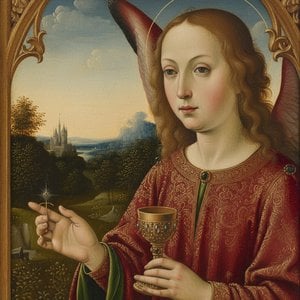
A Window into Devotion: Hans Memling’s St. Veronica
Hans Memling's “St. Veronica,” painted in 1475, stands as a cornerstone of Early Netherlandish art—a movement that prioritized meticulous detail and spiritual contemplation alongside breathtaking realism. More than just a portrait, it’s an immersive experience into the heart of fifteenth-century piety, capturing the profound reverence felt for religious iconography.
Subject Matter & Composition
The painting depicts St. Veronica, a disciple of Jesus Christ who miraculously possessed a veil bearing his likeness after he carried his crucifix down Calvary. Memling skillfully portrays Veronica kneeling in prayerful devotion, her gaze fixed upon the veil—a poignant symbol of compassion and humility. The composition is carefully balanced, featuring two figures flanking St. Veronica: one standing upright, radiating authority, and the other seated beneath him, offering a sense of serenity and contemplation. A rocky outcrop serves as an understated yet significant backdrop, grounding the scene in the natural world and reinforcing its spiritual atmosphere.
Style & Technique – The Flemish Primitives’ Legacy
Memling's approach aligns perfectly with the broader stylistic trends of the Flemish Primitives—a movement that distinguished itself from its Italian counterpart by prioritizing independent artistic exploration. He achieved unparalleled realism through masterful oil painting technique, utilizing glazing layers to create luminous surfaces and capturing subtle nuances of light and shadow. The artist’s meticulous attention to detail extends beyond mere representation; it embodies a desire to convey the inner life of his subjects—a characteristic that would become synonymous with Northern Renaissance art.
Symbolism: Face Value & Redemption
The central element – Jesus' face on the veil – transcends its visual depiction. It represents Christ’s suffering endured during his crucifixion and, crucially, embodies the promise of redemption offered through faith. Memling’s deliberate choice to portray Veronica with unwavering devotion underscores the importance of humility and compassion in Christian spirituality. The veil itself symbolizes purity and divine grace—a testament to the transformative power of encountering God.
Emotional Impact & Artistic Influence
"St. Veronica" continues to resonate powerfully with viewers today, eliciting feelings of serenity, contemplation, and reverence. Memling’s work profoundly influenced subsequent generations of artists, establishing a precedent for portraying religious figures with dignity and sensitivity. His legacy extends beyond individual masterpieces; it resides in his contribution to shaping the artistic landscape of Europe during a period marked by intellectual curiosity and spiritual renewal—a testament to the enduring beauty and significance of Early Netherlandish art.



 Zobrazit v interiéru
 Objednat ručně malovanou reprodukci
 Odeslat
 Sdílet
 Podrobnosti
 Průvodce

 Stáhnout obrázek
 Podobné kousky
 Rentgenové snímky
 Slideshow
 Statistiky


 Přečíst si více






































 Skleněná varianta je dostupná pouze u rozměrů menších než 110 cm