A Symphony of Suffering and Salvation
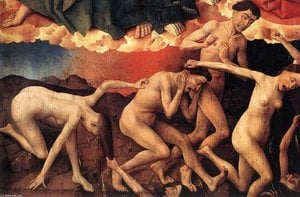
In the hallowed stillness of Bruges’ Sint Janskathedraal, there exists a window into the profound anxieties and spiritual aspirations of the fifteenth century. Hans Memling’s Last Judgment Triptych, completed around 1467, is far more than a mere religious relic; it is a monumental achievement in Early Netherlandish painting that captures the very essence of human mortality. This detail from the masterpiece invites viewers into a harrowing yet sublime vision of eschatology, where the boundaries between the earthly and the divine dissolve. Through his unparalleled mastery of oil paint, Memling orchestrates a complex tapestry of theological allegory, presenting a scene that is simultaneously terrifying in its depiction of judgment and breathtaking in its technical execution.
The composition serves as a visceral exploration of the human condition at the moment of ultimate reckoning. Within this frame, we witness a sea of figures caught in the throes of eternal consequence. Naked and vulnerable, the souls are depicted with an anatomical precision that reflects Memling’s commitment to realism—a hallmark of his training under the legendary Rogier van der Weyden. Some figures appear locked in desperate struggle, while others lie in states of profound exhaustion or torment, their bodies contorted by the weight of their sins. The presence of swords, glinting with a cold, sharp light, punctuates the chaos, acting as instruments of both divine justice and earthly suffering, guiding the eye through the swirling movement of the damned.
The Mastery of the Bruges School
To behold this work is to experience the pinnacle of the Flemish Primitives' technique. Memling, born in Seligenstadt but refined in the artistic crucible of Bruges, brought a unique luminous quality to his palette. His ability to manipulate light and shadow—the chiaroscuro of the North—allows for a sculptural modeling of the human form that feels startlingly tactile. Every muscle, every fold of skin, and every glint of steel is rendered with a meticulousness that demands close contemplation. This level of detail does not merely serve aesthetic beauty; it serves a higher purpose, grounding the supernatural event in a reality so tangible that the viewer cannot help but feel the emotional gravity of the scene.
For the discerning collector or interior designer, a high-quality reproduction of this triptych offers more than just a decorative element; it provides a profound focal point for any space. The painting’s ability to evoke deep emotion—ranging from the dread of the unknown to the awe of divine power—makes it an extraordinary piece for those who appreciate art that tells a story. Whether placed in a quiet study or a grand gallery, the work commands attention through its rich textures and historical depth, serving as a timeless testament to the enduring fascination with the mysteries of life, death, and the eternal soul.



 Zobrazit v interiéru
 Přepnout na tiskové verze
 Odeslat
 Sdílet
 Podrobnosti
 Průvodce

 Stáhnout obrázek
 Podobné kousky
 Rentgenové snímky
 Slideshow
 Statistiky


 Přečíst si více






































 Skleněná varianta je dostupná pouze u rozměrů menších než 110 cm


![Scrovegni - Last Judgment (detail) [04] — Giotto Di Bondone, Proto-renaissance](/media/artworks/images-thumb/2c/cc/2cccbf5d66de604df5c3cc5658637344.jpg)