A Shadowy Master’s Revelation: Matthias Stom's “Esau and Jacob”
Matthias Stom remains an enigmatic figure in the annals of 17th-century Dutch painting, a master whose brilliance blossomed largely outside his homeland. Born around 1600 in Amersfoort, Netherlands, he embarked on a captivating journey to Italy, immersing himself within the vibrant Caravaggist circles of Rome and Naples. This transatlantic odyssey profoundly shaped his artistic vision, resulting in works that pulse with dramatic intensity and a strikingly realistic portrayal of biblical narratives – exemplified by “Esau and Jacob,” a compelling portrait painted circa 1649.
Stom’s style is immediately recognizable as a potent blend of Utrecht Caravaggism and the influence of Italian masters like Jusepe de Ribera. He eschewed the more overtly decorative tendencies favored by some of his contemporaries, instead prioritizing a deeply expressive use of chiaroscuro – the dramatic interplay of light and shadow – to sculpt form and imbue scenes with an almost palpable sense of drama. His brushwork is loose and energetic, conveying movement and emotion with remarkable immediacy. The painting’s palette leans towards rich, earthy tones, punctuated by flashes of vibrant color that draw the eye and heighten the emotional impact.
The Narrative Unfolds: A Biblical Scene Rich in Symbolism
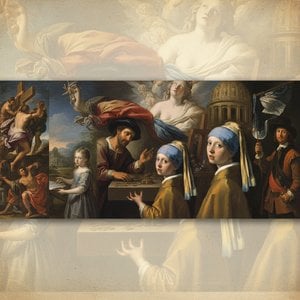
"Esau and Jacob" depicts a pivotal moment from the Book of Genesis, capturing the brothers’ contentious struggle over their father Isaac's blessing. The scene is set within a warmly lit interior, suggesting a domestic setting—a table laden with food and drink serves as the focal point. Esau, depicted on the left, is a robust figure, his face etched with a mixture of defiance and regret. He clutches a hunting horn, a symbol of his birthright, while Jacob, seated opposite him, appears more cunning and calculating, his hand poised to seize the coveted blessing. The presence of a woman, presumably Rachel, Jacob’s wife, adds another layer of complexity to the scene – she observes the brothers with an expression that hints at both concern and anticipation.
The painting is not merely a straightforward depiction of a biblical story; it's laden with symbolic weight. The arrangement of figures, the gestures, and even the objects on the table all contribute to a deeper understanding of the themes of rivalry, deception, and divine favor. Stom masterfully uses light to highlight key elements, drawing attention to Esau’s assertive posture and Jacob’s subtle manipulation – creating a visual narrative that resonates with timeless human drama.
A Master at Work: Technique and Historical Context
“Esau and Jacob” was created during a period of intense artistic exchange between the Netherlands and Italy. Stom, deeply influenced by the Caravaggisti who had flocked to Rome, adopted their dramatic lighting techniques and realistic approach to depicting human figures. The painting’s composition is carefully constructed, employing principles of perspective and spatial arrangement to create a sense of depth and immediacy. The use of oil paint on canvas allows for rich color saturation and subtle gradations of tone – essential elements in Stom's signature style.
Further research reveals that Stom’s career was marked by a certain degree of obscurity, with biographical details remaining scarce. He spent much of his time working in Italy, where he gained recognition for his dramatic depictions of biblical scenes and portraits. The painting’s provenance traces back to the Hermitage Museum in St. Petersburg, Russia, where it has been a prized possession since the early 20th century. Contemporary accounts suggest that Stom was a skilled artist who possessed a unique ability to capture the psychological complexities of his subjects – a talent evident in every brushstroke of “Esau and Jacob.”
A Timeless Masterpiece: Emotional Resonance and Artistic Legacy
“Esau and Jacob” transcends its biblical subject matter, offering a profound meditation on human nature. The painting’s dramatic lighting, dynamic composition, and expressive figures evoke a powerful sense of tension and intrigue. It is a testament to Stom's skill as an artist and his ability to imbue even the most familiar stories with new meaning. Reproductions of this captivating work offer a window into the world of 17th-century Dutch painting – a world characterized by dramatic intensity, profound symbolism, and a deep appreciation for the power of visual storytelling.



 Náhled
 Koupit tisk
 Sdílet
 Sdílet
 Podrobnosti o díle

 Stáhnout
 Podobné položky
 Rentgenové snímky
 Slideshow


 Zobrazit více






































 Skleněná varianta je dostupná pouze u rozměrů menších než 110 cm