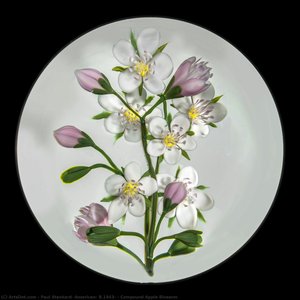
A Legacy of Floral Elegance: The Life of María Concepción Laca Ugaldebere
María Concepción Laca Ugaldebere, known affectionately to many as Concha Laca, was a singular figure in the realm of Spanish ceramic art, a master who possessed the rare ability to breathe life into porcelain. Born in Madrid in 1925, her early years were shaped by a blend of cultural influences; while her roots were firmly planted in the Spanish capital, her father, Doroteo Laca, was a mechanic from Vizcaya, creating a family life that oscillated between the urban heart of Madrid and the rugged landscapes of Bérriz. This duality of environment—the structured city and the natural vitality of the Basque country—would later find its way into her work, manifesting as a profound connection to the organic world.
Her journey toward artistic mastery began not with administrative studies, as she had initially intended, but through the transformative influence of the Cerámica Municipal de Madrid. Under the mentorship of Francisco Alcántara, Laca honed her technical precision, securing a prestigious scholarship that allowed her to refine her skills until 1947. This period of rigorous training laid the foundation for a career defined by an unparalleled attention to detail and a dedication to the delicate nuances of form and color.
The Mastery of Porcelain and the Bidasoa Years
The trajectory of Laca’s career was irrevocably changed by her long-standing association with Porcelanas Bidasoa, a period that spanned from 1952 to 1984. It was within this prestigious institution that she truly ascended from an assistant teacher to a renowned independent artist and sculptor. Her technical prowess was so significant that by 1957, she was granted her own workshop, where she took full command of the creative process—from the initial modeling of clay to the final, delicate application of glazes.
Laca’s work at Bidasoa was characterized by a remarkable versatility. She was tasked with designing and executing an array of decorative figures, ranging from animals to couples dressed in traditional regional costumes. However, it was her botanical explorations that would secure her place in the annals of ceramic history. Her ability to translate the ephemeral grace of a blooming flower into the enduring medium of porcelain was nothing short\\short of miraculous. She utilized complex techniques involving:
- The meticulous molding of bisque plaques to create three-dimensional textures.
- The application of transparent glazes to capture the dewy luster of petals and leaves.
- Intricate hand-painting with low-fired glazes to achieve vibrant, lifelike colors.
- The use of gold-painted accents to provide a sense of regal sophistication to her floral arrangements.
Artistic Vision and Historical Significance
Beyond the technical brilliance of her craftsmanship, Laca’s work carries a deep emotional resonance. Her most exquisite creations—the ultra-delicate floral centerpieces—were often deemed too precious for commercial sale. Instead, they were reserved as prestigious gifts, embodying a level of artistry that transcended mere decoration to become true sculptural poetry. These pieces, such as her water lily plaques, serve as a testament to her ability to capture the fleeting moment of a blossom's peak beauty and freeze it in time.
The historical significance of María Concepción Laca Ugaldebere lies in her role as a pioneer of contemporary Spanish ceramics. She bridged the gap between traditional artisanal craft and fine art, proving that porcelain could be a medium for profound sculptural expression. Her dedication to preserving the splendor of nature through painstaking hand-painting techniques has left an indelible mark on Spanish artistic heritage. Even after her passing in 2018, her legacy continues to bloom, reminding us of a time when art was defined by the patient, loving touch of a master's hand.



 Náhled
 Switch to Print
 Sdílet
 Sdílet
 Podrobnosti o díle

 Stáhnout
 Podobné položky
 Rentgenové snímky
 Slideshow
 Stats
Stats

 Zobrazit více






































 Skleněná varianta je dostupná pouze u rozměrů menších než 110 cm