A Dreamscape of Love and Longing: Exploring Marc Chagall’s ‘The Poet Reclining’
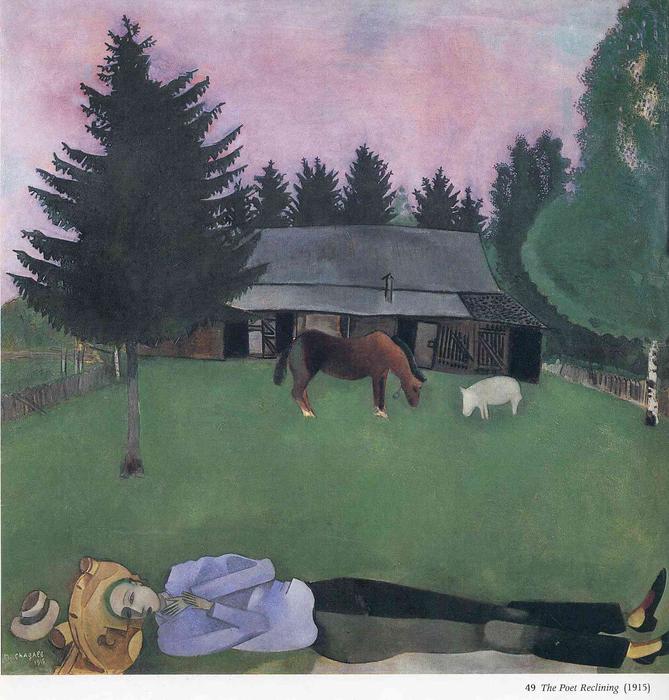
Marc Chagall's 1915 painting, The Poet Reclining, is more than just a visual representation; it’s an intimate glimpse into the artist’s burgeoning love for his wife, Bella Rosenfeld, and a poignant reflection of a world on the cusp of immense change. Painted during their honeymoon, the artwork encapsulates a sense of idyllic peace interwoven with subtle undercurrents of anxiety – a feeling that permeated life in Europe as World War I raged around them. The canvas breathes with a dreamlike quality, characteristic of Chagall’s unique style, where reality and memory intertwine to create a deeply personal and symbolic landscape.
The Language of Symbolism and Style
Chagall masterfully blends elements of Cubism, Expressionism, and Symbolism in The Poet Reclining, forging a visual language entirely his own. The flattened perspective, eschewing traditional spatial depth, draws the viewer into an almost ethereal realm. A reclining figure – presumably the ‘Poet’ – dominates the foreground, not as a portrait of a specific individual but rather as an embodiment of artistic inspiration and contemplative thought. He lies languidly on a field of vibrant green, his form elongated and somewhat abstracted, mirroring the stylized rendering of the surrounding elements. The presence of animals—a horse, sheep, and even a pig—is typical of Chagall’s work, often representing innocence, connection to nature, and perhaps a nostalgic yearning for a simpler rural existence. The house nestled amidst the trees isn’t merely architectural detail; it evokes a sense of home, security, and the intimate world shared by Chagall and Bella. The soft, blurred lines and muted color palette—dominated by greens, pinks, and touches of brown—contribute to the painting’s overall fluidity and dreamlike atmosphere. It is as if we are peering into a cherished memory, softened by time and imbued with emotional resonance.
Technique and Historical Context
Chagall's technique in The Poet Reclining reveals a delicate touch. He employed thin washes of oil paint on canvas, creating smooth surfaces with subtle gradations of color rather than relying on heavy impasto or bold brushstrokes. This approach reinforces the painting’s ethereal quality and contributes to its sense of weightlessness. The year 1915 was pivotal for Chagall. Having returned to Russia after a period in Paris absorbing avant-garde influences, he found himself caught between two worlds – the innovative artistic movements of Europe and the deeply rooted traditions of his Jewish upbringing. This duality is palpable in The Poet Reclining, where modern stylistic elements are seamlessly integrated with folkloric imagery and symbolic motifs drawn from his childhood memories of Vitebsk. It’s a work born from a moment of personal happiness, yet shadowed by the looming specter of war and political upheaval.
An Emotional Resonance for Today
The Poet Reclining continues to captivate viewers not only for its aesthetic beauty but also for its profound emotional depth. The painting evokes a sense of tranquility, nostalgia, and longing—feelings that resonate deeply with audiences across generations. It’s an invitation to pause, reflect, and reconnect with the simple joys of life: love, nature, and the power of imagination. For those seeking to bring a touch of poetic beauty into their homes, a reproduction of this masterpiece offers more than just visual appeal; it provides a window into the soul of one of the 20th century’s most beloved artists—a reminder that even in times of uncertainty, art can offer solace, inspiration, and a glimpse of enduring hope.
Otázky a odpovědi
Jakou barvu v kompozici díla „Ležící básník“ od Marc Chagall dominuje?
Barvou, která v díle „Ležící básník“ nejvíce vyniká, je Šedá (#938d97). Dominantní barva je užitečná při sladění uměleckého díla s interiérem.
V jakém věku vytvořil/a Marc Chagall dílo „Ležící básník"?
Marc Chagall vytvořil/a dílo „Ležící básník“ v возрасте 28 let. Umělec se narodil/a v 1887 a dílo je datováno na 1915.
Jaké emoce vyvolává „Ležící básník“ od Marc Chagall?
„Ležící básník“ od Marc Chagall vyzařuje Nostalgický emocionální náboj.
V jakém roce bylo vytvořeno dílo „Ležící básník“ od Marc Chagall?
Dílo „Ležící básník“ od Marc Chagall vzniklo v roce 1915.
Do jaké místnosti se doporučuje „Ležící básník“ od Marc Chagall?
Doporučeným prostorem pro „Ležící básník“ od Marc Chagall je Obývací pokoj. Toto doporučení lze samozřejmě přizpůsobit vašemu interiéru.
Jaká je vnímaná jasnost díla „Ležící básník“ od Marc Chagall?
Z hlediska vnímané jasnosti je dílo „Ležící básník“ od Marc Chagall vyvážená.
Kdo vytvořil "Ležící básník"?
Dílo "Ležící básník" vytvořil/a Marc Chagall. Informace na této stránce popisují originální dílo umělce Marc Chagall.


 Zobrazit v interiéru
 Objednat ručně malovanou reprodukci
 Odeslat
 Sdílet
 Podrobnosti
 Průvodce

 Stáhnout obrázek
 Podobné kousky
 Rentgenové snímky
 Slideshow
 Statistiky


 Přečíst si více






































 Skleněná varianta je dostupná pouze u rozměrů menších než 110 cm





