A Life Dedicated to Floral Delicacy: The World of Joseph Nigg
Joseph Nigg, born in Vienna on October 13th, 1782, and passing away in the same city on September 19th, 1863, was a pivotal figure in Austrian Biedermeier painting. While his name might not be as instantly recognizable as some of his contemporaries, Nigg’s contribution to the art of still life – particularly floral arrangements and compositions featuring grapes – remains significant. His career unfolded during a period marked by a shift towards intimacy and domesticity in art, reflecting the values of the burgeoning middle class. He wasn't merely documenting flowers; he was capturing fleeting moments of beauty, imbued with a sense of quiet contemplation that resonated deeply with his audience. Nigg’s artistic journey began with formal training at the Academy of Fine Arts Vienna under Johann Baptist Drechsler, laying the foundation for a career deeply rooted in meticulous observation and technical skill.
Early Career and Porcelain Mastery
For over four decades, from 1800 to 1843, Nigg dedicated himself to the art of flower painting within a Viennese porcelain factory. This wasn’t simply a commercial endeavor; it was an immersive apprenticeship in precision and detail. The demands of decorating delicate porcelain surfaces honed his ability to render textures, light, and form with extraordinary accuracy. He didn't just paint *on* porcelain—he became intimately familiar with its unique qualities, understanding how colors interacted with the glaze and how light played across its curves. In 1835, Nigg’s role expanded to include teaching painting at the factory, demonstrating his mastery of the craft and solidifying his position as a respected figure within the artistic community. The rise of the Biedermeier era proved crucial for Nigg's success. This period saw an increased appreciation for domestic scenes, natural beauty, and accessible art forms—precisely what flower painting on porcelain offered. His work wasn’t confined to small decorative pieces; he also created larger plaques showcasing elaborate floral arrangements, demonstrating a growing ambition and artistic scope. A notable achievement during this time was his contribution to the Great Exhibition of 1851 in London, where a thirty-inch high porcelain plaque representing Viennese artistry garnered attention and acclaim.
The Flourishing of Oil Painting and Pastel
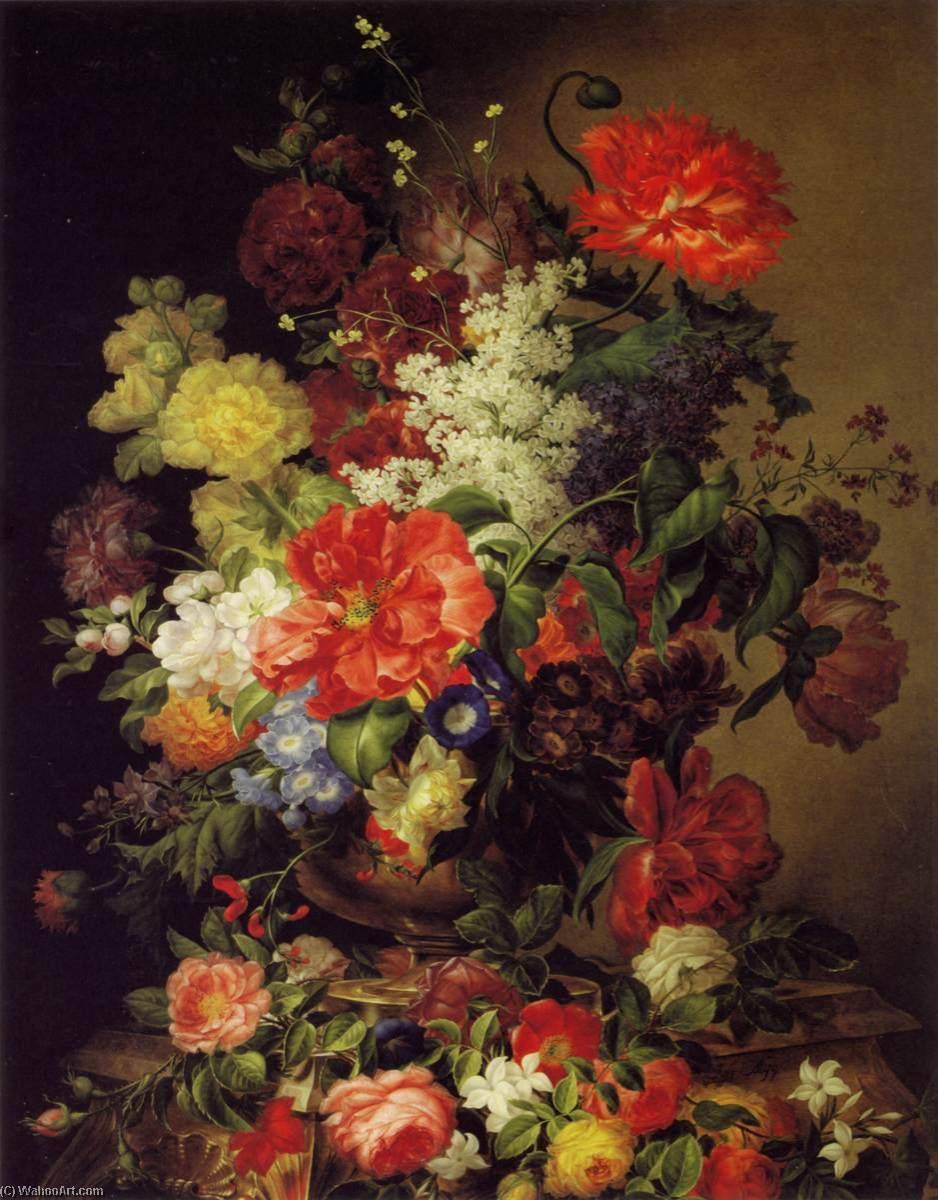
While renowned for his work on porcelain, Nigg’s talents extended beyond this medium. He also excelled in oil painting, watercolor, and pastel drawing, showcasing versatility and a commitment to exploring different artistic techniques. His oil paintings, often depicting lush bouquets and still lifes with grapes, reveal a refined understanding of composition, color theory, and light manipulation. These works weren't merely copies of nature; they were carefully constructed arrangements designed to evoke specific emotions and aesthetic experiences. The influence of Dutch Golden Age masters is evident in his dramatic lighting and detailed textures, yet Nigg infused these traditions with a distinctly Austrian sensibility—a sense of warmth, intimacy, and quiet elegance. Paintings like “Grandmother’s Bouquet I” and “Grandmother’s Bouquet II” achieved lasting popularity through reproductions, bringing his art into countless homes and solidifying his legacy as a painter of everyday beauty.
Influences and Artistic Development
Nigg's artistic development was shaped by several key influences. The meticulous realism of Dutch Golden Age still life painters—artists like Jan van Huysum and Rachel Ruysch—provided a foundational model for his technical approach. He admired their ability to capture the ephemeral beauty of flowers, their mastery of light and shadow, and their attention to detail. However, Nigg wasn’t simply imitating these masters; he adapted their techniques to suit his own aesthetic sensibilities and the cultural context of Biedermeier Austria. The emphasis on domesticity and natural beauty within the Biedermeier movement also played a significant role in shaping his artistic vision. He responded to the growing demand for art that celebrated everyday life, creating works that were both visually appealing and emotionally resonant. His work can be seen as a bridge between the Baroque traditions of the 18th century and the more intimate aesthetic of the Biedermeier period.
Legacy and Historical Significance
Joseph Nigg’s legacy lies in his ability to elevate the art of still life to new heights, particularly within the context of Austrian painting. His meticulous technique, refined color palette, and sensitive portrayal of floral arrangements continue to captivate audiences today. While he may not be a household name, his work is represented in prominent museums such as the Museum für Kunst und Industrie in Vienna, the Brera Gallery in Milan, and the Hermitage Museum in St Petersburg—testament to his enduring artistic merit. He embodies the spirit of the Biedermeier era: a dedication to craftsmanship, an appreciation for natural beauty, and a commitment to creating art that resonated with the values of everyday life. His paintings offer a glimpse into a world of quiet contemplation, reminding us of the fleeting moments of beauty that surround us.
- Born: October 13th, 1782, Vienna, Austria
- Died: September 19th, 1863, Vienna, Austria
- Style: Biedermeier, Still Life Painting
- Key Subjects: Floral Arrangements, Grapes, Porcelain Decoration


 Zobrazit v interiéru
 Přepnout na tiskové verze
 Odeslat
 Sdílet
 Podrobnosti
 Průvodce

 Stáhnout obrázek
 Podobné kousky
 Rentgenové snímky
 Slideshow
 Statistiky


 Přečíst si více


