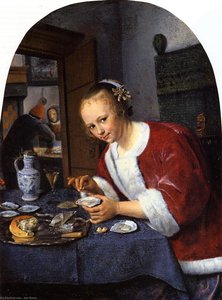
A Window into Dutch Domesticity
In the quiet, sun-dappled corners of a seventeenth-century Dutch home, Jan Havickszoon Steen captures a moment that feels both profoundly intimate and timelessly universal. The Drawing Lesson is not merely a depiction of an instructional afternoon; it is a masterful snapshot of domestic life, where the boundaries between education, leisure, and family connection blur into a single, harmonious scene. As we gaze upon this composition, we are invited into a room filled with the warmth of togetherness, watching as a father guides his children through the delicate art of sketching. The atmosphere is thick with a sense of quiet purpose, yet there is an underlying vitality—a pulse of life that prevents the scene from feeling static or overly formal.
Steen, a true master of the human comedy, had an unparalleled ability to find the extraordinary within the ordinary. While his contemporaries often reached for the grandiosity of mythological legends or the stiff dignity of royal portraits, Steen turned his gaze toward the kitchen, the tavern, and the schoolroom. In this work, he utilizes the textures of everyday objects—the smooth surface of a wooden table, the delicate curve of a ceramic bowl, and the weathered grain of a violin—to ground the viewer in a tangible reality. For the collector or the interior designer, this painting offers more than just visual beauty; it provides a narrative anchor, a piece of history that breathes life into a room through its depiction of shared human experience.
Technique and the Art of Light
The technical brilliance of Steen’s approach lies in his ability to manipulate light and shadow to create psychological depth. Though he was known for his vibrant palettes, his mastery of tonal gradations allows The Drawing Lesson to possess a sculptural quality. He employs a sophisticated understanding of light to illuminate the faces of the learners, drawing our eyes toward the focal point of the instruction. This interplay of light does more than just reveal form; it creates a sense of atmosphere, suggesting the soft, diffused glow of a northern afternoon filtering through a window.
One cannot discuss Steen without acknowledging his innovative use of texture and volume. Through careful layering, he achieves an illusion of depth that makes the objects on the table—the books, the cup, and the scattered art materials—appear almost within reach. This tactile quality is essential for anyone seeking a reproduction that commands attention in a modern space. The painting does not merely sit upon a wall; it interacts with the light of its environment, offering subtle shifts in mood depending on the time of day. It is this technical rigor, paired with his approachable aesthetic, that makes Steen’s work so enduringly captivating for those who appreciate the fine details of Baroque mastery.
Symbolism and Emotional Resonance
Beyond the surface level of a family activity, The Drawing Lesson is rich with the subtle moralizing characteristic of the Dutch Golden Age. In the seventeenth century, the act of learning was often viewed as a metaphor for the cultivation of the soul. The careful guidance of the child mirrors the societal importance of discipline, patience, and the transmission of knowledge across generations. Every element in the room—from the presence of music, suggested by the violin, to the scholarly weight of the books—serves to elevate the domestic scene into a meditation on the virtues of a well-ordered life.
Yet, despite these underlying lessons, the emotional impact of the piece remains profoundly accessible. There is no heavy-handedness here; instead, there is a gentle, rhythmic beauty found in the way the figures lean toward one another. For an art lover, the painting offers a sense of nostalgia for a simpler, more connected era. For an interior designer, it serves as a sophisticated element of storytelling, capable of evoking feelings of warmth, stability, and intellectual curiosity. To possess a reproduction of this work is to bring a piece of the Dutch Golden Age's heart into one's own home, celebrating the enduring beauty of life’s most quiet, instructional moments.



 Náhled
 Přepnout na tisk
 Sdílet
 Sdílet
 Podrobnosti o díle

 Stáhnout
 Podobné položky
 Rentgenové snímky
 Slideshow
 Statistiky


 Zobrazit více






































 Skleněná varianta je dostupná pouze u rozměrů menších než 110 cm