A Symphony of Chaos and Joy: Stepping into Jan Steen’s World
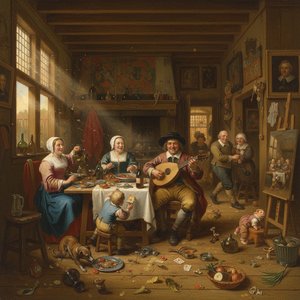
To gaze upon Jan Steen’s “The Dancing Couple” is to be instantly swept up in the boisterous, uninhibited spirit of a seventeenth-century Dutch kermis. Painted in 1663, this masterpiece serves as much more than a mere visual record of a village fair; it is an immersive sensory experience that captures the very heartbeat of the Dutch Golden Age. Steen, a master of the human comedy, avoids the stiff formality often found in the portraits of his era, choosing instead to plunge his audience into a room teeming with life, laughter, and a touch of delightful disorder. As the eye wanders through the scene, one encounters a tapestry of social interaction—flirtatious glances, spirited conversations, and the rhythmic movement of dancers—all set against a backdrop of domestic abundance.
The painting functions as a window into a pivotal moment of social history, where the boundaries between classes often blurred under the influence of celebration. Steen meticulously renders the textures of the era, from the heavy folds of fine fabrics to the humble surfaces of wooden tables and earthenware. Every object, whether it be a delicate wine glass catching the light or a simple bowl resting near the edge of a chair, contributes to a sense of lived-in reality. For the collector or interior designer, this work offers a profound sense of warmth and vitality, making it an ideal centerpiece for spaces that celebrate conviviality and the richness of human connection.
Baroque Mastery and the Art of Narrative Detail
Technically, “The Dancing Couple” is a triumph of Baroque realism. Steen employs a sophisticated command of light and shadow to direct the viewer's gaze, pulling us toward the central figures whose movement anchors the composition amidst the surrounding frenzy. His brushwork, while precise enough to capture the glint of liquid in a glass or the subtle expression on a child's face, possesses a fluid energy that mirrors the subject matter itself. This technique allows the painting to breathe, creating an atmosphere where the air feels thick with the scent of food, the sound of music, and the warmth of a crowded room.
Beyond the surface beauty lies a deeper layer of symbolic storytelling. Steen was renowned for his ability to weave subtle moral lessons into seemingly chaotic scenes. In the tradition of the kermis paintings, the abundance of food, drink, and revelry often served as a gentle satire on the lack of moderation, inviting the viewer to reflect on the balance between enjoying life's pleasures and maintaining virtue. This duality—the tension between exuberant joy and quiet moral reflection—is what gives the work its enduring psychological depth. It is not merely a painting to be looked at, but a narrative to be read, offering layers of meaning that reveal themselves upon repeated viewing.
An Eternal Inspiration for the Modern Interior
For those seeking to infuse their homes with character and historical soul, a high-quality reproduction of “The Dancing Couple” provides an unparalleled opportunity. The painting’s palette, rich with earthy tones punctuated by vibrant highlights, possesses a timeless elegance that complements both classical and contemporary decor. It brings a sense of storytelling to a room, acting as a conversation starter that transcends time. Whether placed in a grand dining hall to echo the festive spirit of the original or in a more intimate study to provide a window into the past, Steen’s work remains a powerful testament to the enduring beauty of the everyday human experience.



 Zobrazit v interiéru
 Přepnout na tiskové verze
 Odeslat
 Sdílet
 Podrobnosti
 Průvodce

 Stáhnout obrázek
 Podobné kousky
 Rentgenové snímky
 Slideshow
 Statistiky


 Přečíst si více






































 Skleněná varianta je dostupná pouze u rozměrů menších než 110 cm