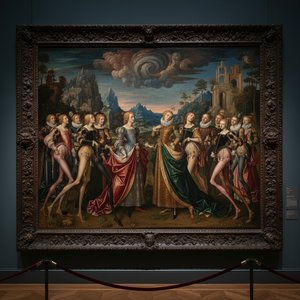
The Annunciation od Jacques Bellange, ručně malovaná olejná reprodukce mistrovským umělcem
Náhled v interiéru Náhled v AR Přepnout na tisk Přepnout na digitální obraz Sdílet
Podrobnosti o díle Průvodce Přidat do oblíbených Stáhnout Podobné položky Rentgenové snímky Slideshow Otázky a odpovědi Presentation Statistiky

The Annunciation Ručně malovaná reprodukce olejomalby

Jacques Bellange (c. 1575 – 1616) was a Northern Mannerist printmaker & painter from Lorraine, renowned for striking religious etchings. Rediscovered in the 20th century, his unique style continues to captivate art enthusiasts. He is best known for 'The Annunciation,' an etching depicting Mary receiving the angelic announcement of Jesus's birth—a testament to Bellange’s skill and artistic vision.

Jacques Bellange (c. 1575-1616) was a Northern Mannerist printmaker & painter from Lorraine, renowned for striking religious etchings. Rediscovered in the 20th century, his unique style continues to captivate art enthusiasts.

Ručně malovaná olejová reprodukce

Rukou malované olejné plátno v libovolném rozměru i s rámem, vyrobené našimi umělci na zakázku. ( Přepnout na tisk Přepnout na digitální obraz)

Corner sample of the P118B picture frame: tvarovaný polystyren, 5 cm wide and 3 cm thick
P118B Kč10
Corner sample of the P118H picture frame: tvarovaný polystyren, 5 cm wide and 3 cm thick
P118H Kč10
Corner sample of the P118W picture frame: tvarovaný polystyren, 5 cm wide and 3 cm thick
P118W Kč10
Corner sample of the P438Z picture frame: tvarovaný polystyren, 5.5 cm wide and 3.5 cm thick
P438Z Kč10
Corner sample of the P508JH picture frame: tvarovaný polystyren, 7 cm wide and 3.5 cm thick
P508JH Kč12
Corner sample of the P508YH picture frame: tvarovaný polystyren, 7 cm wide and 3.5 cm thick
P508YH Kč12
Corner sample of the P805H picture frame: tvarovaný polystyren, 5 cm wide and 3.5 cm thick
P805H Kč10
Corner sample of the P805Z picture frame: tvarovaný polystyren, 5 cm wide and 3.5 cm thick
P805Z Kč10
Corner sample of the P919BZ picture frame: tvarovaný polystyren, 7 cm wide and 3.5 cm thick
P919BZ Kč10
Corner sample of the P919G picture frame: tvarovaný polystyren, 7 cm wide and 3.5 cm thick
P919G Kč10
Corner sample of the P919XJ picture frame: tvarovaný polystyren, 7 cm wide and 3.5 cm thick
P919XJ Kč10
Corner sample of the P959ZH picture frame: tvarovaný polystyren, 5 cm wide and 3 cm thick
P959ZH Kč10
Corner sample of the P968JZ picture frame: tvarovaný polystyren, 6 cm wide and 4 cm thick
P968JZ Kč12
Corner sample of the W106C picture frame: masivní dřevo, 5 cm wide and 3 cm thick
W106C Kč8
Corner sample of the W218G picture frame: masivní dřevo, 5 cm wide and 3 cm thick
W218G Kč10
Corner sample of the W218JH picture frame: masivní dřevo, 5 cm wide and 3 cm thick
W218JH Kč8
Corner sample of the W218Y picture frame: masivní dřevo, 5 cm wide and 3 cm thick
W218Y Kč10
Corner sample of the W307PJ picture frame: masivní dřevo, 6 cm wide and 3 cm thick
W307PJ Kč10
Corner sample of the W316G picture frame: masivní dřevo, 6 cm wide and 3 cm thick
W316G Kč10
Corner sample of the W316PJ picture frame: masivní dřevo, 6 cm wide and 3 cm thick
W316PJ Kč8
Corner sample of the W316Y picture frame: masivní dřevo, 6 cm wide and 3 cm thick
W316Y Kč10
Corner sample of the W398PJ picture frame: masivní dřevo, 5 cm wide and 3 cm thick
W398PJ Kč8
Corner sample of the W4111J picture frame: masivní dřevo, 6.5 cm wide and 3.5 cm thick
W4111J Kč10
Corner sample of the W500HY picture frame: masivní dřevo, 7 cm wide and 5 cm thick
W500HY Kč15
Corner sample of the W500JH picture frame: masivní dřevo, 7 cm wide and 5 cm thick
W500JH Kč15
Corner sample of the W692G picture frame: masivní dřevo, 8 cm wide and 4 cm thick
W692G Kč12
Corner sample of the W849H picture frame: masivní dřevo, 5 cm wide and 3 cm thick
W849H Kč8
Corner sample of the W940BG picture frame: masivní dřevo, 7.5 cm wide and 4.5 cm thick
W940BG Kč15
Corner sample of the W953PJ picture frame: masivní dřevo, 6 cm wide and 3.5 cm thick
W953PJ Kč8

Standardní velikost
na zakázku
CM
INCH

Vyberte si z našich přednastavených velikostí, které odpovídají původním proporcím díla.

šířka
výška

Zadejte šířku a výšku, které potřebujete pro váš rám nebo stěnu. Protože se jedná o ruční malbu, při výběru jiného formátu může umělec kolem obrazu domalovat o něco více, nebo jej mírně oříznout — rozhodnete si vy. Před zahájením malby vám zašleme digitální náhled ke schválení. Obraz zobrazený na této stránce neodpovídá skutečnému výsledku — pouze digitální náhled jej zobrazuje.

Příklady možných změn: nahrazení obličeje fotografií zákazníka; přidání domácího mazlíčka (např. nahrazení kočky psem); vložení skrytého vzkazu do pozadí; změna krajiny nebo prvků v pozadí.
Po přijetí objednávky vám tým WahooArt.com zašle e-mail s pokyny a poskytne náhledovou verzi.

Celosvětová doprava () za 3–4 týdny namísto standardních 5 týdnů. (5 listopad). Bez kompromisů v kvalitě.

Zdarma celosvětová expresní doprava
Vysoce kvalitní lněné plátno
Kompletní pojištění přepravy
Záruka vrácení celního poplatku
Záruka věrného barevného souladu
100dení lhůta pro vrácení zboží (pouze při vadách výroby)
100% záruka vrácení peněz
Sleva při více objednávkách

Celková cena

Kč 6439

The Annunciation

Technika reprodukce

Rozměry reprodukce

-

Celková cena za vybrané možnosti reprodukcí

Kč 6439

Rychlé informace

  • Notable elements or techniques: Stipple printing, Detailed drapery
  • Medium: Etching & Burin Print
  • Dimensions: 33.5 × 31.7 cm
  • Artist: Jacques Bellange
  • Movement: Northern Mannerism
  • Location: The Art Institute of Chicago

Jacques Bellange: A Pioneer of Northern Mannerism

Jacques Bellange (c. 1575 – 1616) remains a figure shrouded in mystery, yet his etchings stand as testament to the brilliance of Northern Mannerism—a movement characterized by dramatic contrasts, stylized figures, and an obsession with psychological depth. Despite leaving no paintings behind, Bellange’s prints have achieved remarkable renown, securing him a place amongst the most significant artists of his era and captivating collectors worldwide. Their rediscovery in the 20th century sparked renewed interest in his oeuvre, cementing his legacy as a singular voice within the artistic landscape of Lorraine. His work embodies the spirit of this influential style, prioritizing emotional intensity over realistic representation—a daring departure from prevailing trends that continues to resonate with audiences today.

Early Life & Origins

Information regarding Bellange’s birth is scarce. Griffiths and Hartley suggest he was born in the Bassigny region, likely around La Mothe—a village tragically destroyed by French armies during the siege of Lorraine in 1645. Sadly, no records exist detailing his family background or social status. However, scholar Jean Dubois posits that Bellange’s father was a wealthy merchant from Nancy, providing him with considerable educational opportunities and fostering an appreciation for humanist ideals—a crucial element shaping Bellange's artistic vision. The absence of definitive biographical data underscores the challenge faced by art historians in reconstructing Bellange’s formative years, leaving much to speculation and scholarly interpretation.

The Artistry of “The Annunciation”

“The Annunciation,” executed around 1610/1615, exemplifies Bellange's mastery of Northern Mannerist technique. This etching, touched with burin printed in black on off white laid paper, depicts the biblical narrative of Gabriel announcing to Mary that she would conceive and bear Jesus Christ—a pivotal moment in Christian theology. The artwork’s composition centers around two figures: Mary kneeling in prayerful reverence and the angel hovering above her, conveying a profound sense of divine grace and humility. Bellange skillfully employs chiaroscuro—the dramatic interplay of light and shadow—to sculpt form and imbue the scene with emotional resonance. Fine lines meticulously etched into the plate create intricate textures that capture the drapery folds and foliage background with astonishing precision.

Composition & Symbolism: A Study in Contrasts

The artwork’s framing is dominated by a dark, leafy backdrop that establishes depth and directs the viewer's gaze toward the central figures—a hallmark of Mannerist aesthetics. Mary’s posture embodies submission and acceptance, while the angel’s outstretched hand symbolizes divine communication. The inclusion of a small table bearing objects – likely symbolic representations of faith and contemplation – reinforces the artwork’s spiritual dimension. Dubois argues that Bellange deliberately employed visual devices to convey psychological complexity—reflecting the Mannerist preoccupation with inner turmoil and emotional expression. The artist's meticulous attention to detail underscores his commitment to capturing not merely what is seen but also what is felt.

Historical Context & Influence

Bellange’s work emerged during a period of artistic ferment in Lorraine, influenced by Caravaggio’s revolutionary naturalism and the broader stylistic currents sweeping across Europe. His prints circulated widely throughout aristocratic circles, establishing him as a celebrated artist and securing his place within the canon of Northern Mannerism—a movement that profoundly impacted subsequent generations of painters and printmakers. The rediscovery of Bellange's oeuvre in the 20th century reinvigorated scholarly debate about his artistic achievements and cemented his reputation as a visionary innovator who challenged conventional artistic norms. His legacy continues to inspire artists today, demonstrating the enduring power of Mannerist aesthetics to convey profound emotional truths.

Otázky a odpovědi

Jaká barevná paleta je u díla "The Annunciation" použita?

Paleta díla „The Annunciation“ od Jacques Bellange je popsána jako Neutrals. Jde o stručný popis barevného zpracování tohoto díla.

Jakou luminanci má dílo „The Annunciation“ od Jacques Bellange?

Luminance zaznamenaná pro dílo „The Annunciation“ od Jacques Bellange je Gentle Luminance.

Jakým způsobem „The Annunciation“ od Jacques Bellange propojuje Northern Mannerism s rodnou zemí umělce?

Dílo v rámci směru Northern Mannerism s názvem "The Annunciation" vytvořil umělec narozený v zemi France.


Biografie umělce

A Shadowy Master of the Northern Mannerist Spirit

Jacques Bellange remains one of the most enigmatic and captivating figures in the history of European printmaking. A master of the Northern Mannerist style, his life was lived in the twilight of the late Renaissance, a period defined by elongated forms, theatrical tension, and an almost feverish psychological intensity. Though much of his personal biography remains shrouded in the mists of the early 17th century, his artistic legacy is vibrantly clear through the intricate lines of his etchings. Born around 1575 in the Bâse-les-Vosges region of France, Bellange emerged from a landscape of shifting borders and intense religious fervor, eventually finding his creative home within the sophisticated courtly circles of Nancy.

The traces of his early life are as delicate and elusive as his etchings. While historical records regarding his family origins are sparse, scholars often point to his rapid ascent within the Duchy of Lorraine as evidence of a significant, perhaps even noble, connection. There is much speculation that he may have been the illegitimate son of a high-ranking patron, a theory supported by the prestigious title of "knight" attributed to him and his seamless integration into the court of the Dukes of Lorraine. By 1595, he was already established in La Mothe, honing a craft that would soon transform the medium of printmaking into a vehicle for profound emotional expression.

The Elegance of the Lorraine Court

Bellange’s career reached its zenith under the patronage of Henri II and Philippe III, the Dukes of Lorraine. This period of courtly stability provided him with the luxury of time and resources, allowing him to refine a technique that was uniquely his own. Unlike many of his contemporaries who focused on the clarity of the High Renaissance, Bellange embraced the complexities of Mannerism. His work is characterized by a restless energy, where figures seem to twist and writhe with an almost supernatural grace. In the halls of Nancy, he developed a visual language that blended the sacred with the profane, creating works that were as much about the human psyche as they were about religious devotion.

His mastery of the etching needle allowed him to manipulate light and shadow with unprecedented drama. Through the meticulous use of hatching and cross-hatching, he could conjure textures ranging from the heavy folds of ancient drapery to the weathered skin of a street performer. This technical prowess is perhaps most evident in his ability to imbue even the simplest subject with a sense of profound mystery. Whether depicting a noble figure or a common musician, Bellange’s hand is unmistakable, leaving behind a trail of silvery, luminous lines that seem to vibrate with life.

A Legacy Etched in Light and Shadow

The true significance of Jacques Bellange lies in his ability to capture the ephemeral. His oeuvre serves as a window into a world of intense spiritual struggle and theatrical beauty. Some of his most enduring works demonstrate this range:

  • The Three Marys at the Tomb: A striking example of his religious gravity, where dramatic figures and intricate details converge to create a moment of profound biblical tension.
  • Hurdy-Gurdy Player: A masterpiece of character study, showcasing his ability to use complex linework to capture the hunched, weary essence of a street musician, imbuing a common subject with deep psychological depth.
  • Gentleman in Ancient Costume: An exploration of the Mannerist obsession with historical fantasy and stylized elegance, featuring a warrior adorned in attire that evokes a sense of mythic grandeur.

Though his life was cut short in 1616, Bellange’s influence endured far beyond the borders of Lorraine. His rediscovery in the 20th century brought a renewed appreciation for the expressive potential of the etched line and the enduring power of the Mannerist aesthetic. Today, he is celebrated not merely as a court artist, but as a pioneer who pushed the boundaries of printmaking, leaving an indelible mark on the history of Western art through his hauntingly beautiful, shadow-drenched visions.

Jacques Bellange

Jacques Bellange

1575 - 1616 , France

Rychlé informace o umělci

  • Full Name: Jacques Bellange
  • Nationality: French
  • Date Of Birth: 1575
  • Date Of Death: 1616
  • Place Of Birth: Bâse-les-Vosges, France
  • Notable Artworks:
    • Lamentation
    • The Three Marys at the Tomb
    • Gypsy with a Child
  • Artistic Movement Or Style: Northern Mannerism
  • Artists Who Influenced This Artist: ['Hendrik Goltzius']
  • Artists Or Movements Influenced By This Artist: ['Renaissance']