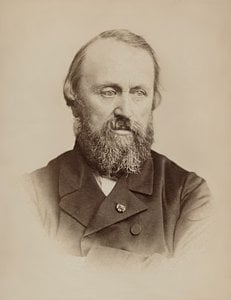
The Neoclassical Vision of Jean-Hippolyte Flandrin
Jean-Hippolyte Flandrin (1809–1864) remains a luminous figure in the pantheon of French Neoclassicism, an artist whose brush captured the profound intersection of spiritual devotion and classical grace. Born in Lyon, France, Flandrin’s journey was initially marked by a tension between familial duty and artistic destiny. While his parents envisioned a stable life for him within the realm of commerce, the creative spirit shared by his brothers, Augusto and Paul, proved irresistible. This early immersion in an environment of artistic pursuit laid the foundation for a career that would eventually transcend the boundaries of private studios to adorn the most sacred architectural spaces in France.
The trajectory of Fland_rin’s talent took a decisive turn in 1829 when he arrived in Paris to enter the legendary studio of Jean Auguste Dominique Ingres. Under the tutelage of this master of line and form, Flandrin refined a technique characterized by precision, clarity, and an almost sculptural approach to the human figure. This period of mentorship was transformative, instilling in him the Neoclassical ideals of purity and anatomical perfection that would define his aesthetic language. His ascent within the academic hierarchy was swift, punctuated by the prestigious Prix de Rome in 1832, a milestone that granted him five years of immersive study in Italy. It was amidst the ancient echoes of Rome that Flandrin’s style matured, absorbing the grandeur of classical antiquity and translating it into a modern, emotive vocabulary.
Mastery of Form and Narrative
Flandrin’s oeuvre is a testament to his ability to navigate both the intimate and the monumental. His early works often focused on the delicate nuances of portraiture and the serene beauty of the human form in repose. A notable example, Jeune Homme Nu Assis au Bord de la Mer (1836), showcases his mastery of tonal gradation and light, presenting a scene of profound tranquility that earned him a permanent place within the esteemed collections of the Louvre. In these works, one observes a seamless blend of technical rigor and a soft, poetic atmosphere that invites deep contemplation.
As his career progressed, Flandrin moved toward larger-scale commissions that demanded a different level of narrative complexity. He became a master of the fresco, a medium that allowed him to integrate his art with the very fabric of religious architecture. His most enduring legacy lies in the monumental decorations for the cathedral of Nantes, where his biblical narratives breathe life into the stone. These works are not merely illustrations of scripture but are profound explorations of light, shadow, and divine presence, executed with a rhythmic grace that guides the viewer's eye through sacred history.
Legacy and Artistic Significance
The significance of Hippolyte Flandrin extends far beyond his technical proficiency. He represented a bridge between the rigid traditions of the early 19th century and a more emotive, spiritually resonant form of painting. As a respected member of the Académie des Beaux-Arts, he helped uphold the standards of French excellence while contributing to the evolution of religious art during a period of significant social change.
To study Flandrin is to encounter an artist who found harmony in the balance of opposites:
- Tradition and Innovation: He utilized the disciplined techniques of Ingres to express the profound spiritual depths of his era.
- Intimacy and Grandeur: His ability to move from the delicate Portrait of Madame Flandrin to massive cathedral frescoes demonstrates a versatile mastery of scale.
- Classical Form and Emotional Depth: While his figures possess the idealized perfection of antiquity, they are imbued with a palpable, human vulnerability.
Through his dedication to the Neoclassical ideal, Flandrin ensured that the elegance of the past would continue to illuminate the spiritual landscapes of the future.



 Zobrazit v interiéru
 Přepnout na tiskové verze
 Odeslat
 Sdílet
 Podrobnosti
 Průvodce

 Stáhnout obrázek
 Podobné kousky
 Rentgenové snímky
 Slideshow
 Statistiky
 Přečíst si více






































 Skleněná varianta je dostupná pouze u rozměrů menších než 110 cm