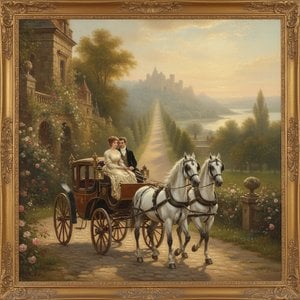
Riders on a Road: A Dance of Light and Movement by Edgar Degas
Edgar Degas’s “Riders on a Road,” painted in 1868, is more than just a depiction of horsemen traversing a dirt path; it's a vibrant snapshot of camaraderie, movement, and the fleeting beauty of a rural scene. This oil-on-panel work, often categorized as Impressionist despite Degas’s own resistance to the label, reveals a meticulous observation of reality combined with an artist’s profound understanding of capturing ephemeral moments – a hallmark of his unique artistic vision. The painting immediately draws the eye with its dynamic composition and bold use of color, inviting us into this intimate scene where life unfolds at a measured pace.
Degas's genius lies in his ability to convey not just what he *saw*, but how it *felt*. He wasn’t interested in photographic realism; instead, he sought to capture the essence of the moment – the dust kicked up by the horses’ hooves, the dappled sunlight filtering through the trees, and the subtle expressions on the riders' faces. The brushstrokes are deliberately loose and expressive, a characteristic deeply rooted in Impressionist technique. Notice how they build texture across the panel, suggesting the roughness of the road surface and the movement of the animals. This isn’t about precise detail; it’s about capturing the *impression* of the scene – an immediate, visceral experience for the viewer.
Composition and a Study in Contrast
The painting's arrangement is carefully considered. The riders are positioned at varying distances from the foreground, creating a sense of depth and drawing us into the landscape. Some figures dominate the view, while others recede into the distance, suggesting both proximity and vastness. Two dogs – one near the center, another on the right – add to the scene’s naturalism and contribute to the feeling of an authentic moment captured outdoors. The horses themselves are rendered with remarkable attention to detail, their musculature subtly suggested through Degas's masterful use of color and brushwork. The contrast between the dark, earthy tones of the road and the lighter hues of the sky and foliage further enhances the sense of depth and atmosphere.
A Masterclass in Impressionist Technique
Degas’s style is instantly recognizable, a blend of realism and subjective interpretation. He employed techniques borrowed from Japanese woodblock prints – particularly the use of asymmetrical compositions and flattened perspectives – which influenced his approach to depicting movement and space. The painting exemplifies this by presenting a slightly skewed view, as if captured in a fleeting glance. The vibrant palette—a mix of blues, greens, ochres, and browns—is not intended to be naturalistic but rather expressive, designed to evoke the feeling of light and atmosphere. It’s a testament to Degas's understanding of how color interacts with light and shadow to create visual interest.
Connections to Degas’s Wider Body of Work
“Riders on a Road” resonates with other works by Degas, particularly his series of paintings depicting horse races and ballet dancers. Like those scenes, this painting captures the energy and dynamism of movement. The figures are not static; they are caught in mid-stride, conveying a sense of urgency and excitement. Consider also his “Study of Horses,” another work showcasing his deep understanding of equine anatomy and movement – both pieces demonstrate a fascination with capturing the essence of animal life. Furthermore, comparing it to works by contemporaries like Jean Edouard Vuillard, whose landscapes often share a similar atmospheric quality, reveals a shared interest in exploring the beauty of everyday scenes. The Musée Des Beaux-Arts Tourcoing, France, houses a significant collection of Degas’s paintings and pastels, offering an invaluable opportunity to study his artistic development firsthand.
Own a Piece of History: Reproductions Available
WahooArt offers meticulously crafted, handmade oil painting reproductions of “Riders on a Road,” allowing art lovers to experience the beauty and artistry of this iconic work in their own homes. Each reproduction is created by skilled artisans using traditional techniques, ensuring that it captures the essence of Degas’s original masterpiece. From the rich textures of the road surface to the subtle nuances of light and color, every detail has been carefully reproduced to provide a faithful representation of this timeless painting. Explore our collection today and bring a touch of Impressionist brilliance into your space.



 Zobrazit v interiéru
 Objednat ručně malovanou reprodukci
 Odeslat
 Sdílet
 Podrobnosti
 Průvodce

 Stáhnout obrázek
 Podobné kousky
 Rentgenové snímky
 Slideshow
 Statistiky

 Přečíst si více






































 Skleněná varianta je dostupná pouze u rozměrů menších než 110 cm