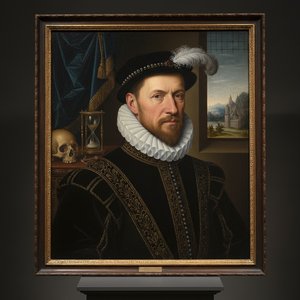
Hans Holbein the Younger’s Portrait of Refined Grace
This captivating portrait, tentatively titled “Untitled (147),” offers a rare glimpse into the world of Hans Holbein the Younger, one of the most significant figures of the Northern Renaissance. Executed around 1520-1530, this work exemplifies Holbein’s unparalleled ability to capture not just physical likeness but also the subtle nuances of personality and social standing – a hallmark of his celebrated portraiture. The painting depicts a woman of considerable elegance, presented within an environment rich with symbolic detail that speaks volumes about her status and the prevailing aesthetic sensibilities of the era.
A Masterclass in Detail and Observation
Holbein’s technical prowess is immediately apparent in the meticulous rendering of textures and surfaces. The delicate folds of the pink dress, the sheen of the porcelain vases, and the intricate arrangement of flowers are all executed with a precision that borders on obsessive. This dedication to detail was not merely a stylistic choice; it was rooted in Holbein’s rigorous training, inherited from his father, Hans Holbein the Elder, a renowned painter and printmaker. The artist's keen eye for observation – honed through countless hours spent studying human anatomy and light – is evident in every brushstroke, creating an image of startling realism that continues to draw viewers in.
Symbolism Within the Scene
Beyond its technical brilliance, the painting is laden with symbolic meaning. The woman’s attire—a pink gown, a fashionable choice at the time—suggests wealth and status. The abundance of flowers, particularly roses (often associated with love and beauty) and lilies (representing purity), elevates the scene to one of romantic idealism. The vases themselves are not simply decorative elements; they represent prosperity and good fortune – key themes within Renaissance portraiture. The inclusion of cups further reinforces this sense of luxury and hospitality.
Historical Context and Artistic Influence
Created during a period of immense artistic and intellectual ferment, “Untitled (147)” reflects the influence of both Italian Renaissance humanism and Northern European realism. Holbein’s work was profoundly impacted by his time spent in Italy, where he encountered the works of Leonardo da Vinci and other masters. However, unlike many artists who simply copied Italian styles, Holbein adapted these influences to create a distinctly Northern style characterized by its psychological depth and meticulous detail. This painting stands as a testament to his mastery and a vital piece within the broader context of Renaissance portraiture, showcasing the evolution of artistic expression during this transformative period.
Emotional Impact and Artistic Value
The overall effect is one of quiet sophistication and contemplative beauty. The woman’s gaze, though not overtly expressive, invites the viewer to engage with her presence, fostering a sense of intimacy and connection. This reproduction offers an exceptional opportunity to own a piece of art history – a tangible link to the genius of Hans Holbein the Younger and his remarkable contribution to the legacy of Western art. Its timeless appeal makes it a superb addition to any discerning collection or a striking focal point within interior design.



 Náhled
 Přepnout na tisk
 Sdílet
 Sdílet
 Podrobnosti o díle

 Stáhnout
 Podobné položky
 Rentgenové snímky
 Slideshow
 Statistiky
 Zobrazit více






































 Skleněná varianta je dostupná pouze u rozměrů menších než 110 cm