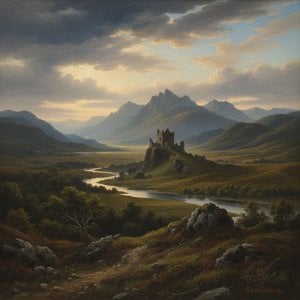
The Luminous Landscapes of Graham Glen
Born in the historic surroundings of Edinburgh around 1878, Graham Glen possessed an artistic vision that would eventually transcend his British roots to capture the very soul of New Zealand’s Otago region. His early life was shaped by a unique heritage of precision; as the son of a musical instrument maker, Glen inherited a profound respect for craftsmanship and a meticulous eye for detail. This foundational discipline, rooted in the delicate mechanics of sound and structure, would later manifest in his ability to render the rugged textures of mountains and the ethereal shifts of coastal light with remarkable clarity. His journey from the structured traditions of Scotland to the burgeoning artistic circles of London around 1914 marked a transformative era in his development, as he began to embrace more expressive color palettes and bolder, more emotive brushwork.
Glen’s mature style emerged as a captivating dialogue between Impressionism and Symbolism. He did not merely seek to document the geography of Otago; rather, he aimed to interpret its spiritual resonance. His canvases often serve as windows into a world where light and shadow perform a silent, dramatic dance. Whether depicting the misty, melancholic mornings over Loch Katrine or the brilliant, sun-drenched peaks overlooking Dunedin Harbour, Glen utilized atmosphere to convey deep emotional truths. His landscapes are imbued with a palpable sense of place, capturing the rugged grandeur and the quiet, often solitary dignity of the natural world. Through his work, the physical landscape becomes a vessel for human emotion, reflecting both the permanence of the earth and the fleeting nature of light.
Artistic Influences and Technical Mastery
The evolution of Glen’s technique was deeply informed by the artistic currents of his time, most notably the influence of Sir Grahame Sydney. While their connection represents a fascinating intersection of styles, Glen’s work shares a certain pursuit of depth that mirrors the "magic realism" championed by Sydney. This approach allowed Glen to blend photographic accuracy with an imaginative, almost dreamlike quality, heightening the emotional impact of his coastal vistas and mountainous interiors. His ability to manipulate light served as his primary tool for storytelling, allowing him to mirror the shifting environmental conditions of the Otago landscape with breathtaking precision.
Throughout his prolific career, Glen’s technical achievements can be seen in several key areas:
- Mastery of Atmosphere: His ability to use soft, diffused light to create a sense of mystery and depth within misty or maritime settings.
- Textural Precision: A legacy of craftsmanship that allowed him to render the varied surfaces of stone, water, and foliage with tactile realism.
- Coloristic Expression: The transition from traditional palettes to more vibrant, experimental tones that captured the unique brilliance of the New Zealand sun.
- Emotional Resonance: The successful integration of symbolic elements within landscape painting to evoke feelings of solitude, peace, and awe.
Today, the legacy of Graham Glen remains a vital part of the landscape art tradition. His work stands as a testament to the power of an artist to bridge distant worlds—connecting the disciplined craftsmanship of his Edinburgh upbringing with the wild, untamed beauty of the South Pacific. He remains a significant figure for those seeking to understand how light can transform a mere depiction of scenery into a profound exploration of the human spirit.



 Náhled
 Přepnout na tisk
 Sdílet
 Sdílet
 Podrobnosti o díle

 Stáhnout
 Podobné položky
 Rentgenové snímky
 Slideshow
 Statistiky


 Zobrazit více






































 Skleněná varianta je dostupná pouze u rozměrů menších než 110 cm