A Study in Controlled Chaos: Exploring Gerhard Richter’s “Dark”
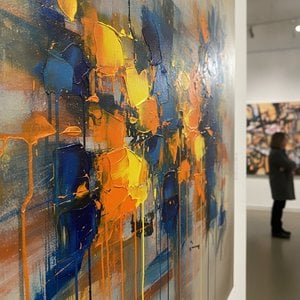
Gerhard Richter's "Dark," painted in 1968, is not merely an abstract composition; it’s a carefully constructed meditation on memory, displacement, and the very nature of perception. This close-up view reveals a canvas saturated with vibrant hues – bold reds and oranges battling against cooler blues – all rendered through Richter's signature technique of layered brushstrokes and subtly blurred surfaces. The painting immediately evokes a sense of unease, a feeling amplified by the deliberate ambiguity at its core. It’s a work born from a specific historical moment: Germany in the turbulent years following World War II, a nation grappling with the aftermath of unimaginable destruction and profound moral questions.
- Abstract Expressionism Revisited: While firmly rooted in the abstract expressionist movement, Richter's approach transcends simple imitation. He doesn’t employ the raw emotionality often associated with artists like Pollock; instead, he channels a more controlled, almost clinical energy into his work.
- Technique and Texture: The painting’s surface is a complex tapestry of applied paint – thick impasto in areas contrasted by thinner washes. Richter's use of glazing techniques creates an illusion of depth and luminosity, while the deliberate blurring introduces an element of uncertainty, mirroring the fragmented nature of memory itself.
The Weight of History
Richter’s personal history profoundly informs “Dark.” Born in Dresden in 1932, he experienced firsthand the instability and trauma of a nation divided. His childhood was shaped by displacement – his family repeatedly relocated during the war – an experience that instilled within him a deep-seated sense of disorientation. This biographical context is crucial to understanding the painting’s emotional resonance. The intense colors, particularly the reds and oranges, can be interpreted as echoes of the fires and destruction that ravaged Germany during the conflict, while the blues represent a yearning for peace and stability – a desire perhaps never fully realized.
The blurred areas within the composition are not accidental; they actively disrupt our ability to grasp a definitive image. This technique subtly suggests the fallibility of memory, the way in which experiences can be distorted or obscured over time. Richter masterfully utilizes this ambiguity to invite viewers into a dialogue with the work, prompting them to confront their own interpretations and emotional responses.
Symbolism and Emotional Impact
"Dark" resists easy categorization or definitive interpretation. The title itself suggests a preoccupation with shadow – not just literal darkness, but also the hidden aspects of human experience. The painting’s power lies in its ability to evoke a profound sense of melancholy and introspection. It's a work that demands attention, inviting viewers to contemplate themes of loss, uncertainty, and the enduring impact of historical trauma.
- Color as Emotion: Richter’s masterful use of color is central to the painting’s emotional impact. The vibrant reds and oranges convey passion, intensity, and perhaps even a hint of danger, while the blues offer a counterpoint of calm and reflection.
- The Blur – A Key Element: The blurred areas are not simply stylistic choices; they represent the subjective nature of perception and the difficulty of accessing objective truth.
A Masterpiece of Controlled Ambiguity
Gerhard Richter’s “Dark” is a testament to his extraordinary skill as an artist and his profound understanding of human psychology. This painting, created in 1968, remains a powerful example of abstract expressionism's ability to convey complex emotions and ideas through the manipulation of color, texture, and form. A hand-painted reproduction offers a unique opportunity to experience this captivating artwork firsthand, bringing Richter’s vision into your space and inviting contemplation for years to come.
Otázky a odpovědi
K kterému uměleckému směru patří „Dark“ od Gerhard Richter?
Směr, ke kterému patří dílo „Dark“ od Gerhard Richter, je Abstract Expressionism. Tato klasifikace umísťuje toto dílo mezi související umělce a další umělecká díla.
K jaké fázi kariéry Gerhard Richter odpovídá datum vzniku díla „Dark“ z roku 1968?
Datum 1968 umisťuje dílo „Dark“ do období Mature Period v rámci tvůrčího rozvoje umělce Gerhard Richter.
Kde si mohu koupit digitální kopii díla „Dark“ od Gerhard Richter?
Digitální obraz díla „Dark“ od Gerhard Richter si můžete zakoupit na jeho stránce pro digitální objednávky Digitální obraz: stažení digitálního obrazu ve vysokém rozlišení.



 Zobrazit v interiéru
 Objednat ručně malovanou reprodukci
 Odeslat
 Sdílet
 Podrobnosti
 Průvodce

 Stáhnout obrázek
 Podobné kousky
 Rentgenové snímky
 Slideshow
 Statistiky

 Přečíst si více






































 Skleněná varianta je dostupná pouze u rozměrů menších než 110 cm