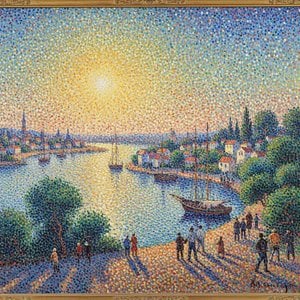
A Symphony of Light and Precision
In the quietude of an English garden, captured through the revolutionary lens of Georges Pierre Seurat, time seems to suspend itself in a shimmering dance of color. White Dog, painted in 1885, is far more than a mere pastoral snapshot; it is a profound exploration of how we perceive the world around us. At first glance, the viewer is greeted by a scene of serene leisure: two figures nestled within lush, verdant greenery, accompanied by the loyal presence of three dogs. One can almost feel the warmth of the sun and the gentle stillness of a spring afternoon. Yet, beneath this tranquil surface lies a rigorous scientific endeavor, a masterpiece where the artist’s brush serves as a bridge between the physical world and the optical sensations of the human mind.
Seurat’s approach to this piece marks a definitive departure from the spontaneous, often hurried strokes of his Impressionist predecessors. Instead of capturing a fleeting moment through rapid movement, he sought to engineer light itself. This was achieved through his signature technique of Pointillism, or more accurately, Chromoluminarism. Rather than blending pigments on a palette, Seurat meticulously applied tiny, distinct dots of pure color directly onto the canvas. He relied on the science of optical mixing, trusting that the viewer’s eye, when standing at the proper distance, would perform the final act of creation by merging these individual points of light into a cohesive, luminous whole. This method creates a unique vibration on the canvas, an almost palpable energy that makes the sunlight appear to flicker and breathe.
The Art of Scientific Observation
To gaze upon White Dog is to witness the intersection of art and science. Seurat was deeply influenced by contemporary theories on color perception and optics, treating the canvas as a laboratory for light. Every dot of pigment was a calculated decision, intended to manipulate luminosity and temperature to achieve a perfect chromatic harmony. This mathematical precision does not strip the work of its soul; rather, it provides a structural integrity that allows the emotional atmosphere to resonate more deeply. The way the white fur of the central dog catches the light, or how the shadows are composed of complementary hues, demonstrates a level of intellectual rigor that transformed the landscape genre into something much more complex and cerebral.
The historical context of the Belle Époque provides a rich backdrop to this work. As France experienced an era of opulence and cultural flourishing, Seurat looked toward the aesthetic influences of British gardens to compose his scene. This choice reflects a broader movement toward finding beauty in structured nature—a reflection of the era's fascination with order and refinement. The painting captures a sense of companionship and peace that remains timeless, making it an evocative piece for any collection. For the discerning collector or interior designer, this artwork offers a sophisticated focal point that brings both historical depth and a modern, rhythmic vitality to a space.
An Enduring Legacy for the Modern Space
For those seeking to infuse their interiors with a sense of tranquility and intellectual elegance, a high-quality reproduction of White Dog serves as an exquisite choice. The painting’s ability to command attention through subtle texture and light makes it versatile enough for both classical and contemporary settings. It does not merely decorate a wall; it invites contemplation. The soft interplay of greens, blues, and whites creates a calming atmosphere, while the intricate Pointillist technique provides a layer of visual interest that rewards prolonged observation.
Owning a piece of Seurat’s legacy means bringing home a fragment of a revolution. It is an invitation to slow down, to observe the minute details of our surroundings, and to appreciate the scientific magic inherent in every ray of light. Whether placed in a sunlit study or a grand living area, this artwork stands as a testament to the enduring power of precision, beauty, and the eternal pursuit of luminous truth.



 Náhled
 Koupit ručně malovaný obraz
 Sdílet
 Sdílet
 Podrobnosti o díle

 Stáhnout
 Podobné položky
 Rentgenové snímky
 Slideshow
 Statistiky

 Zobrazit více






































 Skleněná varianta je dostupná pouze u rozměrů menších než 110 cm