A Dreamscape of Geometric Serenity
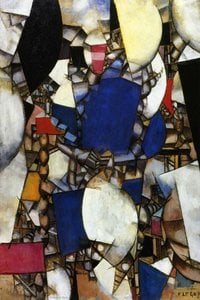
In the quiet intersection of pastoral tradition and avant-garde innovation lies Fernand Léger’s 1943 masterpiece, untitled. This striking composition invites the viewer into a stylized, somewhat dreamlike rural landscape that feels both ancient and remarkably modern. At first glance, the eye is drawn to a meticulously constructed world where nature and architecture are reimagined through the lens of geometric abstraction. A prominent tree, possessing unusual, antler-like branches, anchors the scene, standing sentinel over a cluster of simplified buildings rendered in stark whites and deep reds. Amidst this structured environment, a reclining cow rests peacefully, while two small figures traverse the lower edge of the canvas, grounding the abstract forms in a sense of lived experience. A swirling, smoke-like element drifts through the composition, injecting an air of surreal mystery that transforms a simple country scene into a profound, enigmatic vision.
The brilliance of this work lies in Léger’s ability to marry the mechanical precision of his "Tubist" style with the organic rhythms of the countryside. Moving beyond the analytical rigors of early Cubism, Léger utilizes cylindrical forms and bold, flattened perspectives to create a sense of rhythmic movement. The technique, executed in oil on canvas, reveals a masterful control over color and surface. His palette is intentionally disciplined—dominated by blues, whites, reds, and blacks—which allows each shape to vibrate with its own internal energy. While the surface appears smooth and refined, suggesting a careful application of glazing, there is an underlying strength in the brushwork that celebrates the tactile nature of the medium. This interplay of sharp, angular lines and soft, diffused lighting creates a tension between the rigid architecture and the fluid, atmospheric elements of the sky and smoke.
The Pulse of Modernity and Tradition
To understand this piece is to understand the evolution of a pioneer. Created during a period of global upheaval, Léger’s work reflects his lifelong fascination with integrating the dynamism of the modern age into the fabric of everyday life. While he is often celebrated for capturing the metallic, high-voltage hum of the industrial city, untitled demonstrates his unique ability to apply those same aesthetic principles to the rural landscape. The painting serves as a bridge between two worlds: the nostalgic, grounded reality of his Norman upbringing and the forward-looking, Constructivist spirit of the twentieth century. By stripping the landscape of its traditional textures and replacing them with bold, primary shapes, Léger elevates the mundane to the monumental.
For the discerning collector or interior designer, this artwork offers more than mere decoration; it provides a focal point of intellectual and emotional depth. The composition’s balance of heavy, architectural forms and light, ethereal elements makes it an incredibly versatile piece for sophisticated modern interiors. It evokes a sense of quiet contemplation, yet its bold outlines and striking color contrasts command attention in any gallery or living space. Whether viewed as a study in geometric harmony or a surrealist exploration of memory, Léger’s work remains a timeless testament to the beauty found when the precision of the machine meets the soul of the earth.
Otázky a odpovědi
Jakým způsobem se dílo „untitled (1493)“ zapojuje do témat a stylu umělce Fernand Léger?
„untitled (1493)“ patří k dílu Fernand Léger v rámci směru Cubism, jehož typická témata zahrnují cubism & futurism, machine aesthetics", geometric abstraction, modern life's impact", industrialization, rural simplicity, "tubism.
Jak harmonické jsou barvy díla „untitled (1493)“ od Fernand Léger?
Barvy díla „untitled (1493)“ od Fernand Léger vykazují Discordant Palette harmonii. Harmonie popisuje vzájemný vztah barev k sobě navzájem.
O jaký typ uměleckého díla se jedná u „untitled (1493)“ od Fernand Léger?
V katalogu je dílo „untitled (1493)“ od Fernand Léger zařazeno do kategorie WallArt. Tato kategorie usnadňuje vyhledávání podobných děl.



 Zobrazit v interiéru
 Přepnout na tiskové verze
 Odeslat
 Sdílet
 Podrobnosti
 Průvodce

 Stáhnout obrázek
 Podobné kousky
 Rentgenové snímky
 Slideshow
 Statistiky

 Přečíst si více






































 Skleněná varianta je dostupná pouze u rozměrů menších než 110 cm