The Parade: A Symphony of Geometric Form and Industrial Spirit
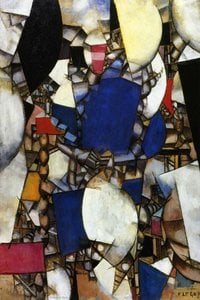
Fernand Léger’s “The Parade,” executed in lithograph, transcends mere depiction; it embodies the very essence of Cubism's revolutionary embrace of modern life. Created during the formative years of the 20th century, this artwork isn’t simply a visual record but rather an assertion of artistic innovation—a bold declaration that abstraction could illuminate the complexities of the burgeoning machine age without sacrificing palpable emotion. Léger’s singular vision distinguishes him from many contemporaries who retreated into purely conceptual realms; instead, he sought to synthesize observation and imagination, resulting in a masterpiece that simultaneously captures the dynamism of urban existence and adheres to the disciplined logic of geometric abstraction.
Composition and Visual Elements: Capturing Movement Within Stillness
The artwork’s central focus is a sprawling tableau populated by figures—approximately thirteen individuals—engaged in various activities. Léger skillfully employs a dynamic compositional arrangement, prioritizing movement and interaction over static representation. The figures aren't rendered as realistic portraits but rather fragmented forms—geometric shapes—that overlap and intersect to convey the energy of a bustling procession. Notably, a prominent clock dominates the left side of the image, symbolizing time’s relentless march forward, while a chair sits centrally, representing domesticity amidst the industrial landscape. Scattered bottles contribute to the visual texture and subtly hint at themes of consumption and societal rituals. Léger's meticulous attention to detail—evident in the textured surface achieved through lithographic printing—amplifies the artwork’s impact, inviting viewers to contemplate both form and content.
Cubist Style: Simplifying Reality Through Geometric Reduction
Léger’s stylistic approach firmly establishes “The Parade” within the canon of Cubism, pioneered by Picasso and Braque. Unlike traditional painting techniques that strive for illusionistic depth and perspective, Cubism dismantles these conventions, presenting subjects from multiple viewpoints simultaneously. Léger achieves this feat through reductive geometric forms—cubes, cylinders, and cones—which are strategically employed to depict objects and figures in a fragmented manner. This technique isn’t merely stylistic; it reflects the artist's conviction that abstraction could convey greater truth than representational art by stripping away superfluous details and focusing on fundamental shapes. The bold lines and simplified forms characteristic of Cubism powerfully communicate Léger’s fascination with industrial architecture and machinery, mirroring the pervasive influence of technology on daily life during his time.
Historical Context: Embracing Futurism's Vision of Progress
Fernand Léger’s artistic trajectory was inextricably linked to the burgeoning intellectual currents of the early 20th century, particularly Futurism—a movement that championed speed, dynamism, and technological advancement. Influenced by thinkers like Luigi Russolo and Filippo Tommaso Marinetti, Léger embraced Futurist ideals, rejecting academic conventions in favor of a visual language that mirrored the rapid transformations reshaping European society. “The Parade” serves as an emblem of this era’s optimism—a celebration of progress and innovation—while simultaneously questioning traditional notions of beauty and representation. The artwork's aesthetic aligns seamlessly with the broader artistic landscape of its time, demonstrating Léger’s commitment to pushing boundaries and redefining artistic expression.
Symbolism and Emotional Resonance: Beyond Mere Form
Despite its geometric austerity, “The Parade” possesses a profound emotional resonance. Léger skillfully utilizes color—primarily reds and yellows—to imbue the artwork with vibrancy and energy, conveying a sense of excitement and anticipation. The repetition of geometric shapes reinforces the theme of unity and rhythm, mirroring the rhythmic movement of the parade itself. More subtly, the inclusion of objects like bottles speaks to broader societal concerns about consumption and ritualistic behavior. Ultimately, Léger invites viewers to contemplate not only what is seen but also how it feels—a testament to his ability to transform abstract form into emotionally evocative imagery.
Otázky a odpovědi
Jakou velikost tisku pro "The Parade" bych si měl(a) zvolit pro svou místnost?
Doporučená kombinace pro dílo „The Parade“ od Fernand Léger: tisk o velikosti Large do místnosti typu Living Room.
Jak silný je kontrast v díle „The Parade“ od Fernand Léger?
Kontrast světla a stínu u díla „The Parade“ je klasifikován jako Statement. Kontrast popisuje, jak výrazně se liší světlé a tmavé oblasti.
Jaký pocit vyvolává „The Parade“ od Fernand Léger?
Zachycená nálada díla „The Parade“ od Fernand Léger je Industrial a jeho emocionální náboj je Energetic.
K jakému použití je doporučována reprodukce díla „The Parade“?
Reprodukce díla „The Parade“ od Fernand Léger je doporučována pro Accent. Toto doporučení vychází z tématu, nálady a barevnosti tohoto díla.
Kde si mohu koupit ručně malovanou reprodukci díla „The Parade“ od Fernand Léger?
Ručně malované kopie díla „The Parade“ od Fernand Léger jsou k zakoupení na tento web: ručně malovaná olejová reprodukce na lněném plátně, objednává se přes tato stránka.
Jakou barvu v kompozici díla „The Parade“ od Fernand Léger dominuje?
Hlavní barvou díla „The Parade“ od Fernand Léger je White (#f1f0e3).
Je dílo "The Parade" k dispozici jako umělecká tisknutá reprodukce?
Pokud si chcete pořídit tisk díla „The Parade“ od Fernand Léger, stačí si jej objednat na tato stránka: umělecká tiskovina na bavlněném plátně nebo archivním plátnovém papíře.
Existují díla podobná jako "The Parade"?
Stránka Podobná díla díla „The Parade“ od Fernand Léger představuje související umělecká díla.



 Zobrazit v interiéru
 Objednat ručně malovanou reprodukci
 Odeslat
 Sdílet
 Podrobnosti
 Průvodce

 Stáhnout obrázek
 Podobné kousky
 Rentgenové snímky
 Slideshow
 Statistiky

 Přečíst si více






































 Skleněná varianta je dostupná pouze u rozměrů menších než 110 cm