A Symphony of Industry: Unpacking Fernand Léger’s “People Framework”
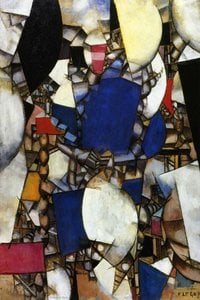
Fernand Léger's "People Framework (Manufacturers)" isn’t merely a depiction of an industrial scene; it’s a vibrant, almost aggressively energetic snapshot of the modern world as perceived through the lens of early 20th-century Cubism. Created around 1914, this black and white work transcends simple representation, offering instead a distilled essence of factory life – its dynamism, its geometric precision, and an underlying sense of both progress and potential alienation. Léger, deeply influenced by the burgeoning machine age, sought to capture not just what was being produced but also the very *feeling* of industrial activity, translating it into a powerfully abstract visual language.
The image immediately commands attention with its stark monochrome palette – a deliberate choice that amplifies the graphic quality and emphasizes the angularity of the composition. Bold, thick lines dominate, outlining every figure and architectural element with sharp precision, creating a sense of fragmented movement. These aren’t the delicate strokes of traditional painting; they are assertive, almost mechanical, mirroring the very structures Léger is depicting. The flattened perspective, characteristic of Cubism, further contributes to this feeling of spatial ambiguity – we're presented with multiple viewpoints simultaneously, forcing us to actively engage in constructing a sense of depth and space.
Deconstructing Form: The Language of Cubism
Léger’s approach is deeply rooted in the principles of Cubism, but he departs from its more purely analytical roots. While Picasso and Braque often dissected objects into geometric components, Léger integrated these elements into a cohesive, dynamic whole. The dominant shapes – rectangles, squares, and triangles – are simplified and abstracted, yet they retain a palpable sense of volume and weight. The scaffolding itself isn’t rendered realistically; instead, it's broken down into its fundamental geometric forms, suggesting the underlying structure of industrial construction. This simplification is not an abandonment of form but rather a strategic reduction to its essential elements, allowing Léger to convey movement and energy with remarkable efficiency.
The central figure – a man in a cap and jacket – isn’t presented as an individual; he's subsumed into the larger framework, becoming almost a component of the machine itself. He holds a rectangular frame, intersecting with the scaffolding, further emphasizing the interconnectedness of all elements within the scene. The lighting is deliberately flat and diffused, eliminating any sense of dramatic highlight or shadow. This lack of illumination contributes to the two-dimensional quality of the work, reinforcing its graphic nature and drawing attention to the lines and shapes that define it.
Symbolism in Simplicity: A Reflection of Modernity
While “People Framework” avoids overt symbolism, it powerfully conveys a sense of dynamism and activity. The fragmented forms can be interpreted as a reflection of the complex and rapidly changing nature of modern industrial life – a world characterized by constant motion, relentless production, and an increasingly impersonal relationship between man and machine. Léger’s deliberate choice to work in monochrome further enhances this effect, stripping away any romantic notions of beauty or sentimentality and presenting a stark, unvarnished view of the working environment. The artwork isn't celebrating industrial progress; it’s offering a critical observation, prompting us to consider the human cost – and the inherent strangeness – of this new era.
This reproduction captures the essence of Léger’s vision with exceptional detail, allowing you to experience the raw energy and geometric precision of this iconic work. “People Framework (Manufacturers)” is more than just a painting; it's a window into a pivotal moment in art history – a testament to Léger’s pioneering spirit and his ability to translate the language of the machine age into a compelling and enduring visual statement.



 Náhled
 Switch to Print
 Sdílet
 Sdílet
 Podrobnosti o díle

 Stáhnout
 Podobné položky
 Rentgenové snímky
 Slideshow
 Stats
Stats


 Zobrazit více