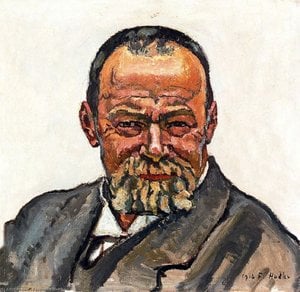
Ferdinand Hodler: A Vision of Quiet Intensity – Exploring “Infantry Marcher”
Ferdinand Hodler’s “Infantry Marcher,” completed in 1908, stands as a cornerstone of Swiss Symbolism and exemplifies Hodler's distinctive approach to capturing the human condition. More than just a depiction of a soldier on duty—though meticulously rendered with anatomical precision—the painting delves into profound themes of mortality, solitude, and the inescapable march toward oblivion, presented with an unsettling beauty that continues to resonate with viewers today.
Hodler’s stylistic hallmark was “parallelism,” a technique he pioneered whereby he juxtaposed two distinct planes of color – one luminous and vibrant, representing life's energy, and the other muted and shadowed, symbolizing death. In "Infantry Marcher," this duality is powerfully realized. The soldier’s torso glows with an ethereal luminescence, contrasting sharply with the dark, textured background that evokes a sense of oppressive stillness. This deliberate contrast isn’t merely aesthetic; it speaks to Hodler's preoccupation with confronting existential anxieties.
The painting’s composition contributes significantly to its emotional impact. The soldier is positioned in profile, facing away from the viewer, creating an immediate feeling of detachment and introspection. His gaze is averted, suggesting a preoccupation with internal thoughts rather than external surroundings. This posture reinforces the overarching theme of isolation—the individual confronting the vastness of existence alone.
Hodler’s masterful use of watercolor and ink lends itself to the painting's haunting atmosphere. The delicate washes of color capture the subtle nuances of light and shadow, while the precise linework defines the soldier’s form with remarkable accuracy. This combination of techniques allows Hodler to convey both visual beauty and psychological depth simultaneously.
Historically situated within the burgeoning Symbolist movement—which sought to express inner emotions and spiritual truths beyond rational representation—"Infantry Marcher" reflects a broader artistic preoccupation with confronting death and decay. Hodler’s exploration of these themes aligns with the philosophical currents of his time, mirroring anxieties about societal change and the fragility of human life. The painting serves as a poignant reminder that even amidst duty and responsibility, there exists an inescapable awareness of mortality.
“Infantry Marcher” transcends its subject matter to become a meditation on the human experience itself. Hodler’s ability to distill complex emotions into a single image—a quiet march toward an unknown horizon—solidifies his legacy as one of Switzerland's most influential artists and ensures that “Infantry Marcher” continues to captivate audiences with its timeless beauty and unsettling profundity.
Otázky a odpovědi
Jaké je místo díla „Infantry marcher“ mezi opakovanými tématy umělce Ferdinand Hodler?
„Infantry marcher“ zachycuje mortality, isolation, symbolism, landscape, soldier, uniform, darkness, zatímco v díle umělce Ferdinand Hodler se setkáváme s tématy jako symbolist tradition, existential angst, death imagery, landscape reflection, artistic vision. Porovnání těchto dvou aspektů odhaluje, jak toto dílo navazuje na obvyklá témata tohoto autora.
Jaký emocionální tón doprovází styl Swiss Symbolism u díla „Infantry marcher“?
„Infantry marcher“ vyzařuje Reflective emocionální nádech v rámci směru Swiss Symbolism.
K kterému uměleckému směru patří „Infantry marcher“ od Ferdinand Hodler?
„Infantry marcher“ je dílo z období Swiss Symbolism. Tento směr představuje uměleckou tradici, jejíž je dílo součástí.



 Náhled v interiéru
 Přepnout na tisk
 Sdílet
 Sdílet
 Podrobnosti o díle
 Průvodce

 Stáhnout
 Podobné položky
 Rentgenové snímky
 Slideshow
 Q&A
Q&A Statistiky


 Zobrazit více






































 Skleněná varianta je dostupná pouze u rozměrů menších než 110 cm