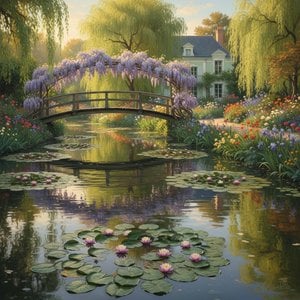
A Glimpse into Paradise: Claude Monet’s *Water Lilies* (1908)
Immerze yourself in the tranquil world of Claude Monet's *Water Lilies*, a captivating oil painting created in 1908 and currently housed at the Dallas Museum of Art. This work is not merely a depiction of a garden; it’s an invitation to experience the fleeting beauty of nature, rendered with the revolutionary techniques that defined Impressionism. Part of Monet's expansive series – encompassing approximately 250 paintings – *Water Lilies* represents a lifelong exploration of his beloved flower garden at Giverny, France.
Impressionistic Harmony: Style and Technique
Monet’s mastery lies in his ability to capture the *impression* of light and color rather than precise representation. The painting exemplifies this through visible brushstrokes that dance across the canvas, creating a textured surface alive with movement. Predominantly utilizing shades of green, blue, and yellow, Monet evokes a serene atmosphere, mirroring the peacefulness of the pond itself. The composition is dominated by a large circular form – the water’s surface reflecting the sky and surrounding foliage – drawing the viewer's eye into the depths of this aquatic world. This deliberate flattening of perspective, characteristic of Impressionism, prioritizes visual sensation over traditional spatial accuracy.
Monet’s Revolutionary Series Paintings
*Water Lilies* is a cornerstone example of Monet’s groundbreaking series paintings. He wasn't content with capturing a single moment in time; instead, he sought to document the changing effects of light and atmosphere on his subject throughout different times of day and seasons. This innovative approach revolutionized art history, paving the way for abstract expressionism and other modern movements. Other notable series include:
- Haystacks
- Rouen Cathedrals
- Houses of Parliament
- Charing Cross Bridge
- Poplar Trees
Giverny: A Personal Eden and Artistic Inspiration
The garden at Giverny was more than just a subject for Monet; it was his sanctuary, meticulously cultivated to provide endless artistic inspiration. He designed the water garden specifically to capture the interplay of light and reflection, creating an ever-changing canvas before his eyes. *Water Lilies* is therefore deeply personal, reflecting not only his artistic vision but also his profound connection with nature.
Symbolism and Emotional Resonance
Beyond its aesthetic beauty, *Water Lilies* carries symbolic weight. The water lilies themselves often represent purity, enlightenment, and rebirth. The tranquil pond evokes feelings of peace, contemplation, and a harmonious relationship between humanity and the natural world.
Monet’s intention wasn't simply to paint what he saw, but to convey *how it felt* to be immersed in this idyllic setting. The painting offers a respite from the chaos of modern life, inviting viewers to find solace and tranquility within its delicate beauty.
A Timeless Masterpiece for Your Space
Whether you are an art collector seeking a significant piece or an interior designer aiming to create a serene ambiance, *Water Lilies* offers enduring appeal. Its calming color palette and evocative imagery make it a versatile addition to any space, bringing a touch of Impressionistic elegance and timeless beauty. Consider a high-quality reproduction to experience the magic of Monet’s vision in your own home or project.
Photo Description: --Overall Impression-- The artwork is a circular oil painting depicting a serene water lily pond scene, characteristic of Claude Monet’s impressionistic style. It presents a tranquil and atmospheric view dominated by reflections on the water's surface. Compositionally, the image utilizes a radial arrangement, drawing the viewer's eye towards the center where lily pads are most prominent. The brushstrokes are loose and visible, contributing to the painting’s textured appearance. Predominantly utilizing shades of green, blue, and yellow, Monet evokes a serene atmosphere, mirroring the peacefulness of the pond itself. The composition is dominated by a large circular form – the water’s surface reflecting the sky and surrounding foliage – drawing the viewer's eye into the depths of this aquatic world. This deliberate flattening of perspective, characteristic of Impressionism, prioritizes visual sensation over traditional spatial accuracy. Depth is created through variations in color saturation and the layering of reflections on the water. The subject matter focuses entirely on the natural beauty of the lily pond, emphasizing its ephemeral qualities. Symbolically, the image evokes feelings of peace, tranquility, and a connection with nature. The style is undeniably impressionistic, prioritizing capturing an immediate sensory experience rather than detailed realism. The technique involves layering thin washes of paint to build up color and form, creating a luminous effect. Materials used are oil paints on canvas.
Size: Unknown
Date: 1908
ARTIST INFORMATION:
==================
Artist: Claude Monet
Birth Year: 1840
Death Year: 1926
Birth City: Paris
Birth Country: France
Biography:
A Life Immersed in Light: The World of Claude Monet
Oscar-Claude Monet, a name synonymous with Impressionism, wasn't merely a painter of landscapes; he was a chronicler of fleeting moments, a poet of light and color. Born in Paris on November 14, 1840, his early life took an unexpected turn when his family relocated to Le Havre, Normandy, at the age of five. While initially destined for a commercial career by his father, Claude Adolphe Monet (1800–1871), young Claude’s innate artistic talent quickly surfaced, manifesting first in charcoal caricatures sold locally — a testament to both his skill and entrepreneurial spirit. However, it was his encounter with Eugène Boudin that proved pivotal. Boudin didn't just teach Monet *how* to paint; he instilled within him the revolutionary idea of painting en plein air—directly from nature—a practice that would define his entire artistic journey.
Monet’s formal training began in Paris, briefly at the Académie Suisse, and under the academic history painter Charles Gleyre, where he was a classmate of Auguste Renoir. His early works include landscapes, seascapes, and portraits, but attracted little attention. A key early influence was Eugène Boudin, who introduced him to the concept of plein air painting. From 1858, Monet lived in Giverny, also in northern France, where he purchased a house and property and began a vast landscaping project, including a water-lily pond.
Monet’s ambition to document the French countryside led to a method of painting the same scene many times so as to capture the changing of light and the passing of the seasons. Among the best-known examples are his series of haystacks (1890–1891), paintings of Rouen Cathedral (1892–1894), and the paintings of water lilies in his garden in Giverny, which occupied him for the last 20 years of his life. Frequently exhibited and successful during his lifetime, Monet's fame and popularity soared in the second half of the 20th century when he became one of the world’s most famous painters and a source of inspiration for a burgeoning group of artists.
Monet was raised in Le Havre, Normandy, and became interested in the outdoors and drawing from an early age. Although his mother, Louise-Justine Aubrée Monet (1805–1857), supported his ambitions to be a painter, his father, Claude Adolphe Monet, disapproved and wanted him to go into the family's ship-chandling and grocery business. He was very close to his mother, but she died in January 1857, and he was sent to live with his childless, widowed but wealthy aunt, Marie-Jeanne Lecadre.
He entered Le Havre secondary school of the arts in April 1859. He was an apathetic student who, after showing skill in art from a young age, began drawing caricatures and portraits of acquaintances at age 15 for money. He began his first drawing lessons from Jacques-François Ochard, a former student of Jacques-Louis David.
Monet married Camille Doncieux in 1873. Their marriage was tumultuous and ended tragically in 1876 when Camille died from tuberculosis.
From 1883 Monet lived in Giverny, where he cultivated a vast landscaping project, including a water garden and a smaller pond spanned by a Japanese footbridge.
Monet died on December 5, 1926, in Argenteuil.
Otázky a odpovědi
Jaké emoce vyvolává „Nymphéas“ od Claude Monet?
„Nymphéas“ vyvolává Poklidný pocity. Emocionální náboj díla popisuje dojem, který z něj vyzařuje.
K kterému uměleckému směru patří „Nymphéas“ od Claude Monet?
„Nymphéas“ je dílo z období Impressionism. Tento směr určuje uměleckou tradici, jejíž je dílo součástí.
Jakou techniku a styl charakterizuje „Nymphéas“ od Claude Monet?
„Nymphéas“ od Claude Monet kombinuje techniku Olej na plátně s uměleckým směrem Impressionism. Technika a směr popisují způsob vzniku a styl tohoto díla.



 Zobrazit v interiéru
 Objednat ručně malovanou reprodukci
 Odeslat
 Sdílet
 Podrobnosti
 Průvodce

 Stáhnout obrázek
 Podobné kousky
 Rentgenové snímky
 Slideshow
 Statistiky


 Přečíst si více






































 Skleněná varianta je dostupná pouze u rozměrů menších než 110 cm