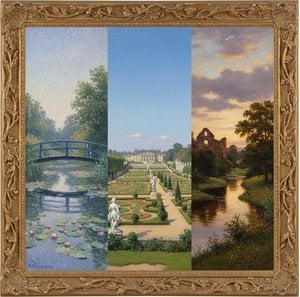
The Impressionistic Echo of Charles William Oliver
Charles William Oliver (1911 – 2004) remains an artist whose presence on the art world’s radar is marked by a quiet fascination—a deliberate obscurity that lends his creations an aura of understated beauty and invites contemplation. Despite the scarcity of biographical details surrounding his personal life, Oliver’s paintings continue to resonate with collectors and enthusiasts who seek to decipher the subtle harmonies underlying his brushstrokes. His artistic journey unfolded primarily in Britain during the mid-20th century, leaving behind a legacy of serene landscapes imbued with the spirit of Impressionism.
Information regarding Oliver’s formative years is remarkably sparse, yet his work speaks volumes of an innate inclination towards the visual arts from a young age. While determining his precise influences proves challenging due to limited documentation, stylistic analysis indicates a significant debt owed to Claude Monet and the fundamental principles of Impressionism. This connection is most palpable in his mastery of light and atmosphere; works such as “The Whispering Gallery” exemplify this influence perfectly, offering a masterful depiction of muted tones and diffused lighting that captures the very essence of how light interacts with the physical world.
A Mastery of Light and British Landscapes
Oliver’s oeuvre is characterized by a distinctive sensitivity to the natural world, particularly the lush, often tranquil settings of British gardens and landscapes. His style eschews grand gestures or dramatic compositions, prioritizing instead a quiet observation of nature's fleeting moments. He possessed a remarkable ability to translate the ephemeral quality of sunlight into permanent pigment, creating scenes that feel both grounded in reality and elevated by a dreamlike softness.
His repertoire extended beyond mere landscapes into the intimate realms of still life and portraiture, demonstrating a versatile command over different subject matters:
- Landscape Painting: Notable works like “Garden with a Rainbow” showcase a vibrant, idyllic vision of 1930s England, while “Reflections by the Seine” echoes the Impressionist ethos through soft brushstrokes and sunlight shimmering on water.
- Still Life: His ability to find beauty in the mundane is evident in pieces such as “Still life of ceramic bowl and eggs on a white tablecloth,” where texture and light play across simple objects with profound grace.
- Portraiture and Architecture: From delicate portraits of young ladies to the atmospheric rendering of structures like the “Tranmere Methodist Church, Wirral,” Oliver maintained a consistent focus on capturing the soul of his subjects through light.
Legacy and Artistic Significance
The historical significance of Charles William Oliver lies in his role as a custodian of the Impressionist tradition within a mid-century British context. At a time when many artists were moving toward more radical abstractions, Oliver remained dedicated to the poetic observation of the visible world. His work serves as a bridge between the classical light studies of the 19th century and a modern, personal interpretation of the English countryside.
Though he may not have sought the spotlight of the avant-garde, his contribution to the fine art canon is found in the enduring emotional resonance of his paintings. Collectors today find in his work a sense of peace—a way to revisit a more pastoral and luminous era. Through his delicate handling of color and his devotion to the subtle nuances of atmosphere, Oliver ensured that the quiet beauty of the natural world would continue to whisper to future generations.



 Zobrazit v interiéru
 Objednat ručně malovanou reprodukci
 Odeslat
 Sdílet
 Podrobnosti
 Průvodce

 Stáhnout obrázek
 Podobné kousky
 Rentgenové snímky
 Slideshow
 Statistiky

 Přečíst si více






































 Skleněná varianta je dostupná pouze u rozměrů menších než 110 cm