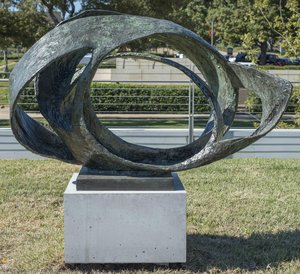
Involute II – A Dance of Form and Void by Barbara Hepworth
Dame Barbara Hepworth’s Involute II, crafted in 1956, isn't merely a sculpture; it’s an invitation to contemplate the very essence of form and space. This remarkable piece, executed in bronze with a subtle green-brown patina, immediately draws the eye with its monumental scale – though the exact dimensions remain unknown, its presence commands attention. Hepworth, a pivotal figure in 20th-century British art, masterfully employed abstraction to explore themes of human experience and the relationship between the internal and external worlds. Her work during this period, particularly her exploration of voids and openings, represents a profound shift away from traditional sculptural representation towards a more intuitive and emotionally resonant approach.
The sculpture’s title itself – Involute – hints at its geometric core: it derives from a mathematical term describing a specific type of spiral curve. However, to reduce Hepworth's creation to mere geometry would be a grave oversight. The fluid, undulating form of the bronze ball, punctuated by a carefully considered hole, evokes a sense of perpetual motion and dynamic equilibrium. It’s as if the sculpture is constantly in flux, suggesting both containment and expansion, stillness and movement simultaneously. This duality is characteristic of Hepworth's oeuvre – she sought to capture not just the appearance of an object but also its underlying energy and potential.
The Language of Form: Technique and Materials
Hepworth’s technique was deeply rooted in her exploration of materials, a process that informed every aspect of her work. She began by creating detailed plaster models, meticulously shaping them with hand tools before transferring the forms to bronze through a complex casting process. This method allowed her to retain the tactile qualities and subtle nuances of her initial sketches – the slight imperfections, the delicate textures – which are beautifully preserved in the final bronze sculpture. The rough surface, achieved through careful abrasion, is not merely aesthetic; it’s integral to the work's expressive power, inviting viewers to engage with its physicality.
The choice of bronze itself was deliberate. Hepworth recognized its capacity for capturing both solidity and fluidity – a crucial element in her exploration of form. The green-brown patina, achieved through controlled oxidation during the casting process, adds depth and richness to the surface, subtly altering the perception of light and shadow. It’s a testament to her mastery of materials that she could transform a relatively inert metal into such a dynamic and evocative work.
A Dialogue with Space: Symbolism and Context
Involute II is more than just an object; it's a meditation on the relationship between form and space. Hepworth’s fascination with voids – the deliberate creation of openings within her sculptures – stemmed from a desire to challenge traditional notions of representation. The hole in this piece isn’t simply a negative space; it actively shapes the surrounding volume, creating an interplay of light and shadow that draws the eye inward. It suggests a sense of mystery and invitation, prompting viewers to consider the unseen dimensions of the sculpture.
Hepworth's work during the 1950s was deeply influenced by Surrealism and Abstraction-Création, movements that sought to liberate art from representational constraints. Her exploration of form, space, and the human condition resonated with a broader cultural shift towards abstraction and a renewed interest in exploring inner experience. The sculpture’s placement on a pedestal further emphasizes its status as an independent work of art, inviting contemplation and reflection.
A Legacy of Innovation: Hepworth's Enduring Influence
Barbara Hepworth remains one of the most significant sculptors of the 20th century. Her pioneering approach to abstraction, her masterful manipulation of materials, and her profound engagement with themes of form and space continue to inspire artists today. Involute II stands as a powerful example of her artistic vision – a testament to her ability to transform simple forms into works of enduring beauty and emotional resonance. Reproductions of this iconic sculpture offer a unique opportunity to bring Hepworth’s profound insights into your own home or studio, allowing you to experience the magic of her art firsthand.
Otázky a odpovědi
Je „Involute II“ od Barbara Hepworthová obrazem, kresbou nebo grafikou?
Dílo „Involute II“ od Barbara Hepworthová je klasifikováno jako Sochařství. Tato kategorie určuje typ uměleckého díla, kterým je originál.
Do které fáze kariéry Barbara Hepworthová patří dílo „Involute II“ (1956)?
Datum 1956 umisťuje dílo „Involute II“ do období Mid-Century Modern v rámci tvůrčího rozvoje umělce Barbara Hepworthová.
Do které období tvorby Barbara Hepworthová patří dílo „Involute II"?
Dílo „Involute II“ patří do Mid-Century Modern tvorby umělce Barbara Hepworthová. Tato klasifikace dílo relativizuje k vývoji jeho tvůrčí dráhy.



 Přepnout na tiskové verze
 Odeslat
 Sdílet
 Podrobnosti
 Průvodce

 Stáhnout obrázek
 Podobné kousky
 Slideshow
 Statistiky


 Přečíst si více






































 Skleněná varianta je dostupná pouze u rozměrů menších než 110 cm