A Sacred Vision in Ink: The Eternal Resonance of Dürer’s Mass
In the quietude of 1523, Albrecht Dürer captured more than just a religious ceremony; he froze a moment of profound spiritual communion within the sweeping architecture of a Gothic cathedral. His work, often referred to as Mass or Mass of Cardinal Albrecht of Brandenburg in the Abbey Church Hall, serves as a breathtaking window into the heart of the Northern Renaissance. Through the meticulous application of pen and ink, Dürer invites us to step into a space where the boundaries between the earthly and the divine seem to dissolve. The artwork is not merely a sketch but a complex narrative tableau, where every line drawn on paper contributes to a larger meditation on faith, hierarchy, and the sublime grandeur of the church.
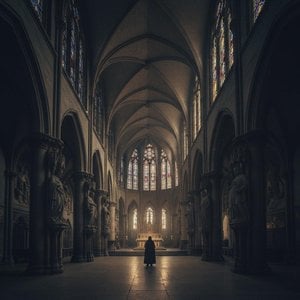
The composition is a masterclass in linear perspective, a technique that Dürer utilized to guide the viewer’s soul toward the altar. As your eyes wander through the intricate interior, you are drawn upward by the soaring vaulted ceilings and the rhythmic progression of columns that anchor the central axis. The artist employs a layered arrangement of figures, creating an illusion of immense depth; worshippers appear in receding planes, their diminishing sizes reinforcing the vastness of the sacred hall. This architectural precision does more than showcase technical skill—it creates a sense of awe, mirroring the way the monumental scale of a cathedral is intended to humble the individual before the majesty of God.
The Mastery of Line and Light
What makes this monochrome masterpiece so captivating for the modern collector is its incredible textural richness, achieved entirely without the use of color. Dürer relies on the sophisticated interplay of hatching and cross-hatching to breathe life into stone and cloth. These fine, disciplined strokes simulate the palpable weight of marble columns and the delicate folds of liturgical vestments, lending a sense of materiality that feels almost tactile. The play of light is equally masterful; though no windows are visible, a naturalistic glow seems to permeate the space, casting soft shadows that define the three-dimensional forms of the clergy and the faithful alike.
For those looking to integrate such a piece into a sophisticated interior, its monochromatic palette offers unparalleled versatility. Whether placed in a minimalist contemporary gallery or a classic, richly textured study, the artwork’s grayscale tones provide a grounding elegance. It acts as a focal point of quiet contemplation, offering a sophisticated aesthetic that complements both modern and traditional decor. The strength of the lines provides a structural rhythm that can anchor a room, while the intricate details reward close, intimate inspection.
A Legacy of Humanism and Devotion
Beyond its technical brilliance, Mass is steeped in the intellectual currents of its time. It reflects the burgeoning humanist ideals of the Renaissance, where the dignity of the human experience was celebrated alongside religious devotion. The positioning of the figures—all oriented toward the ritual at the altar—speaks to a collective focus and a shared spiritual journey. There is an emotional gravity to the scene, a solemnity that evokes feelings of reverence and peace. It captures the very essence of a period caught between medieval tradition and the dawn of modern inquiry.
Owning a high-quality reproduction of this work means possessing a fragment of art history itself. It is an invitation to experience the meticulous observation of a master who saw the divine in the details of the world. For the discerning enthusiast, Dürer’s Mass is not just a depiction of a ceremony; it is an enduring symbol of the human search for meaning, rendered with a precision that remains as striking today as it was five centuries ago.



 Náhled
 Přepnout na tisk
 Sdílet
 Sdílet
 Podrobnosti o díle

 Stáhnout
 Podobné položky
 Rentgenové snímky
 Slideshow
 Statistiky


 Zobrazit více






































 Skleněná varianta je dostupná pouze u rozměrů menších než 110 cm