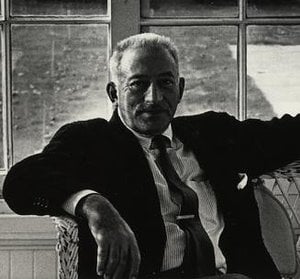
Biografie umělce
Adolph Gottlieb (1903–1974): Pioneer of Abstract Expressionism
Adolph Gottlieb, born in New York City on March 14, 1903, emerged as a pivotal figure in the burgeoning landscape of American Abstract Expressionism. His journey was one of constant exploration—a relentless pursuit to distill universal human experiences into a visual language that resonated with both ancient symbolism and modern anxieties. Growing up as the son of Jewish immigrants, Gottlieb’s early life instilled within him a sensitivity to cultural displacement and the search for meaning in a rapidly changing world, themes that would profoundly shape his artistic vision. He received foundational training at the Art Students League and Parsons The New School for Design, but it was his subsequent travels through Europe during the 1920s that truly ignited his aesthetic sensibilities. Immersing himself in the art and philosophies of Germany and France, he absorbed influences from Constructivism and Surrealism, laying the groundwork for his future innovations.
Early Life and Education
Gottlieb’s artistic development wasn't immediate; it was a gradual evolution away from representational forms toward abstraction. Initially grappling with traditional techniques, he began to experiment with fragmented imagery and symbolic motifs, hinting at the deeper psychological currents that would define his mature style. He studied at the Art Students League of New York between 1920 and 1921, where he honed his skills under John Sloan and attended lectures by Robert Henri—experiences that instilled in him a deep appreciation for American realism alongside burgeoning interest in avant-garde movements. Determined to pursue art as a vocation, Gottlieb left high school at the age of 17 and worked his passage to Europe on a merchant ship, embarking on a transformative voyage that exposed him to diverse artistic traditions. He spent a year traveling in France and Germany, visiting museums and galleries in Berlin, Munich, Dresden, Vienna, and Prague—a period during which he absorbed influences from Constructivism and Surrealism. Upon returning to New York, Gottlieb continued his studies at the Art Students League, Parsons School of Design, Cooper Union and Educational Alliance – broadening his artistic knowledge base and solidifying his commitment to mastering various mediums.
The European Influences: Constructivism and Surrealism
His formative years in Europe were particularly significant. Gottlieb’s exposure to German Constructivist artists like Oskar Schlemmer and Josef Albers challenged him to reconsider the role of form and structure in artistic expression. Simultaneously, he was captivated by the dreamlike imagery and psychological exploration characteristic of Surrealist painters such as René Magritte and Salvador Dalí—influences that would permeate his later work. He meticulously studied the techniques employed by these masters, analyzing their use of color, composition, and symbolism to understand how they conveyed emotion and meaning beyond literal representation. These encounters instilled in Gottlieb a conviction that art could transcend conventional boundaries and tap into subconscious realms—a belief that underpinned his artistic approach throughout his career.
The Founding of “The Ten” and Collaborative Experimentation
A crucial moment arrived in 1935 when Gottlieb joined forces with artists like Mark Rothko, John D. Graham, Barnett Newman, Milton Avery and David Smith to form “The Ten,” later known as the New York Artists Painters group. This collective was instrumental in establishing a distinctly American voice within the international art scene, challenging European dominance and fostering a spirit of experimentation. Recognizing the importance of dialogue and shared vision, Gottlieb actively engaged with his fellow artists—discussing ideas, critiquing works, and pushing each other to explore new creative horizons. Benefiting from initiatives like the Federal Art Project during the Great Depression, Gottlieb found support for his artistic endeavors—allowing him to dedicate himself fully to his craft amidst challenging economic circumstances. The collective’s commitment to abstraction and its rejection of traditional conventions reflected a broader trend within American art at the time—a desire to forge an independent aesthetic identity rooted in experimentation and innovation.
The Pictographs: Symbolism and Universal Themes
Gottlieb’s most celebrated series, *The Pictographs* (1940–52), exemplifies this ethos. These paintings represent a radical departure from representational art—employing biomorphic shapes and symbolic forms arranged within rectangular fields on a black ground. Inspired by ancient hieroglyphs and tribal markings, Gottlieb sought to capture not merely the visual appearance of these symbols but their underlying emotional resonance—a quest for universal themes that transcended cultural boundaries. He deliberately drew inspiration from diverse sources—classical mythology, Amerindian art, African motifs—creating a compelling dialogue between modernity and primal traditions. The *Pictographs* weren’t simply abstract compositions; they were attempts to tap into archetypal imagery—expressing profound psychological states without recourse to illusionism. Gottlieb meticulously crafted each painting—carefully selecting colors and arranging forms to evoke a sense of ambiguity and mystery—a testament to his unwavering dedication to artistic exploration.
## Legacy and Historical Significance
Throughout his prolific career, Adolph Gottlieb exhibited widely in both the United States and Europe—receiving critical acclaim for his distinctive style and intellectual rigor. His work is now represented in major museum collections worldwide, including the Museum of Modern Art (MoMA) in New York City and the Tate Modern in London—a testament to its enduring power and influence. He received numerous awards and accolades—solidifying his place as one of the most significant abstract painters of the 20th century. Gottlieb’s legacy extends beyond his individual paintings; he played a vital role in shaping the landscape of postwar American art—inspiring generations of artists to embrace abstraction, symbolism, and cultural influences. His unwavering commitment to exploring universal themes through a uniquely American lens cemented his place as one of the most influential figures in Abstract Expressionism—a movement that continues to resonate with audiences today. Adolph Gottlieb’s work remains a powerful reminder of art’s capacity to transcend cultural boundaries and speak to the deepest aspects of the human spirit.



 Zobrazit v interiéru
 Objednat ručně malovanou reprodukci
 Odeslat
 Sdílet
 Podrobnosti
 Průvodce

 Stáhnout obrázek
 Podobné kousky
 Rentgenové snímky
 Slideshow
 Statistiky


 Přečíst si více






































 Skleněná varianta je dostupná pouze u rozměrů menších než 110 cm


![Abstract Composition [triptych] — Vaclav Vytlacil, Abstract Expressionism](/media/artworks/images-thumb/08/3c/083c0675045645fd42d4e6c6d63f1ced.jpg)