The Life and Family of Thales Fielding
Thales Fielding was an English watercolour painter whose professional identity was deeply rooted in a family of practitioners. As the third son of Nathan Theodore Fielding, his career followed a trajectory common to his siblings, focusing on the technical demands of watercolour. His position in the art world was solidified through his involvement with the Royal Society of Painters in Water-colours, where he initially served as an associate exhibitor. By 1829, his standing within the institution was confirmed when he was elected to the Society.
His professional life extended beyond private studio work into formal instruction. Fielding held a position as a teacher of drawing at the Royal Military Academy, Woolwich. This role required a disciplined command of form and line, a skill set that complemented his later landscape and portrait compositions. He maintained a residence at 26 Newman Street, London, a location where he remained settled until his death in 1837.
Artistic Activity in Paris and London
Fielding’s career was defined by a strategic movement between the major art centers of Europe. He began establishing his presence in the London art scene early, exhibiting at the British Institution as far back as 1816. By 1818, he had settled at 26 Newman Street in London, a residence he would maintain until his death. This period of stability in England provided the foundation for his later, more international engagements.
His time in Paris was significant, lasting more than three years before his return to England in 1824. This continental period was not merely a residency but a period of active exhibition; he showed his work at the Salon in 1824. This exposure to the French scene coincided with a period of intense productivity and professional networking. Upon returning to London, he continued to exhibit at both the Royal Academy and the British Institution, cementing his status within the established British watercolor tradition.
Notable Works and Artistic Subjects
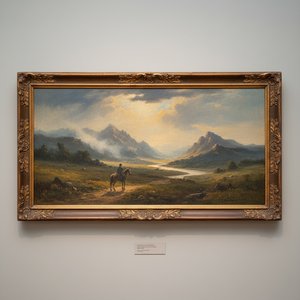
Fielding’s output reveals a painter focused on the intersection of landscape and character. His early exhibition of 'A View of Saddleback, Cumberland' in 1816 established his presence in the London art scene. He moved between topographical views and more dramatic compositions, such as 'Macbeth Meeting the Witches on the Heath' in 1824. This period also saw him producing works like 'Sarnen' in 1824, demonstrating a technical range that extended beyond simple scenery. His ability to handle both the broad strokes of landscape and the precision of portraiture defined his professional output.
The artist’s connection to the Parisian art circle is most clearly seen in his portraiture. He produced a portrait of Eugène Delacroix about 1824-1825, a work that captures a specific moment of mutual artistic exchange. This period of intense productivity in France eventually gave way to a return to English subjects. His final contribution to the Royal Academy was 'A View of Caerphilly Castle, Glamorganshire' in 1837. This work closed a career that spanned from the rugged views of Cumberland to the structured environments of the Royal Military Academy.
Въпроси и отговори
Къде мога да видя цветовата палитра на творчеството на Thales Fielding?
Използването на цвят от Thales Fielding в произведенията, изброени в ето този уебсайт, може да бъде проучено на страницата за Палитра на генома на художника.
Къде мога да намеря статистика за творбите на Thales Fielding?
Страницата Статистика на Thales Fielding представя статистика, изчислена въз основа на произведенията на артиста, изброени в ето този уебсайт.
Къде мога да видя творбите на Thales Fielding в хронологичен ред?
Съществува хронология на творбите на Thales Fielding: страницата Хронология на произведенията подрежда произведенията по дата на създаване.
Мога ли да разглеждам творбите на Thales Fielding по настроение?
Работите на Thales Fielding могат да бъдат разгледани по настроение на страницата Пространство по настроение, където произведенията са подредени според тяхното емоционално състояние.