A Life Etched in Light: The Story of Máximo Rafael Colón
Máximo Rafael Colón’s life and work are inextricably linked to the vibrant, often turbulent history of Puerto Rico and its diasporic communities in New York City. Born in Arecibo in 1950, a town steeped in both natural beauty and economic hardship on the island’s north coast, Colón’s early experiences shaped his artistic vision – a commitment to documenting social justice, celebrating cultural heritage, and giving voice to those marginalized by systemic inequality. His journey from a small Caribbean town to the bustling streets of New York City represents a profound transformation, mirroring the broader narrative of Puerto Rican migration and its impact on identity and community.
Colón’s formal artistic training began at the School of Visual Arts in New York City, an institution that provided him with the technical skills and theoretical framework to hone his craft. However, it was his immersion within the vibrant Puerto Rican communities of the city – particularly in the Lower East Side and later, Washington Heights – that truly ignited his passion for photography as a tool for social commentary. He wasn’t simply documenting; he was actively engaging with the people and events unfolding around him, becoming a witness to pivotal moments in the burgeoning Black and Latino power movements of the late 1960s and 70s.
The Young Lords and the Rise of Activism
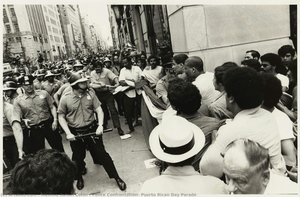
Colón’s most significant contribution to photographic history lies in his chronicling of the Young Lords, a revolutionary Puerto Rican organization that emerged in New York City during the mid-1960s. This wasn't merely a celebratory portrait; it was a deeply involved documentation of their struggle for housing, food security, and political empowerment. His photographs capture the energy and intensity of protests, community meetings, and everyday life within the Young Lords’ movement – images that powerfully illustrate the fight for self-determination and social change. Works like “Police Confrontation, Puerto Rican Day Parade” are not just snapshots; they're visceral records of confrontation and resistance, revealing the complexities of navigating racial and class divisions within the city.
His work during this period is profoundly influenced by figures like Malcolm X, Nina Simone, and Pedro Pietri – voices of radical thought and artistic expression. Colón’s approach mirrors theirs: a commitment to bearing witness, challenging dominant narratives, and amplifying the experiences of those historically silenced. The photographs are imbued with a sense of urgency and solidarity, reflecting the profound impact of the Young Lords' activism on the Puerto Rican community and beyond.
A Legacy in Found Objects and Analog Photography
Beyond his work with the Young Lords, Colón’s photographic practice is characterized by a deliberate embrace of analog techniques – film cameras, darkroom processes, and hand-printed prints. This commitment to traditional methods imbues his images with a tactile quality, a sense of immediacy and authenticity that resonates deeply with viewers. He also incorporates assemblage, creating layered compositions using found objects—a technique reflecting the resourceful spirit of his community and a conscious rejection of slick, polished aesthetics.
His work has been exhibited extensively throughout New York City and Puerto Rico, earning recognition from institutions like the National Portrait Gallery in Washington D.C., where his photographs are part of their permanent collection. Significant exhibitions include “Persistencia! La Lucha Sigue/The Struggle Continues: The Photographs of Máximo Rafael Colón” at Pregones/PRTT, showcasing a retrospective spanning decades of his work, and "Máximo Rafael Colón: Storied Lens" at JazzDeLaPena, highlighting the depth and breadth of his artistic vision. His ongoing project, “My Upside Down World,” promises to further expand our understanding of his perspective on contemporary social issues.
Themes and Influences
Colón’s work consistently explores themes of identity, community, resistance, and cultural preservation. He is deeply invested in documenting the experiences of Puerto Ricans and other Latinx communities, particularly those facing systemic marginalization. His photographs are not simply representations; they are acts of remembrance, honoring the struggles and triumphs of his people. The influence of figures like Franz Fanon, whose writings on colonialism and liberation resonated profoundly with Colón’s own political consciousness, is evident in the critical engagement embedded within his work.
Furthermore, Colón's artistic journey reflects a broader commitment to social justice, informed by the legacy of activists such as Jim Crow and Pedro Pietri. His photographs serve as powerful reminders of the ongoing struggle for equality and the importance of bearing witness to the realities of marginalized communities. His work stands as a testament to the enduring power of photography as a tool for social change.