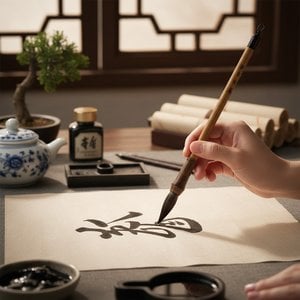
A Life Bridging Cultures
Li Chevalier (诗蓝), born in Beijing in 1961, is a compelling artistic voice navigating the complexities of cultural identity and emotional resonance through her evocative paintings, calligraphy, and installations. Her journey is one marked by significant transitions – from a childhood steeped in Chinese tradition to embracing French citizenship and an extensive academic pursuit across disciplines. This unique trajectory has profoundly shaped her artistic vision, imbuing it with a poignant sense of displacement, introspection, and a search for meaning within a rapidly changing world. At the age of fifteen, Chevalier’s path took an unexpected turn when she was recruited as a singer by the Chinese army, a five-year experience that undoubtedly instilled in her a discipline and sensitivity to rhythm and expression which would later inform her artistic practice. The launch of the Anti-Spiritual Pollution Campaign in 1983 proved pivotal; it spurred Chevalier’s courageous decision to leave China in 1984, seeking intellectual and artistic freedom abroad.Formative Years and Artistic Education
Arriving in France, Li Chevalier embarked on a rigorous academic journey that mirrored her multifaceted interests. She studied at the prestigious Paris Institute of Political Studies, delving into the intricacies of governance and society, before earning an M.A. in Philosophy from the Sorbonne University. This philosophical grounding is deeply embedded within her artwork, lending it a conceptual weight and inviting contemplation on existential themes. Further enriching her artistic foundation was training at Central St. Martins College of Art and Design in London, where she honed her technical skills and explored diverse creative approaches. This blend of intellectual inquiry and practical artistry distinguishes Chevalier’s work, setting it apart within the contemporary art landscape. She acknowledges the challenges faced by female Asian artists navigating a predominantly male-dominated field, yet remains steadfastly committed to artistic integrity and authentic self-expression.Themes and Symbolic Language
Central to Li Chevalier's oeuvre are recurring motifs of loneliness, emptiness, cultural identity, and the pursuit of transcendence. Her compositions often evoke a sense of quiet melancholy, inviting viewers to confront their own emotional landscapes. This is achieved not only through her masterful technique but also through the deliberate inclusion of symbolic objects that resonate with universal human experiences. A frequently appearing cross, for instance, speaks to faith and mortality; the cello embodies longing and artistic passion; an empty chair suggests absence and solitude; and a tombstone serves as a stark reminder of life’s fragility. These elements are not merely decorative but function as visual metaphors, deepening the emotional impact of her work. Her style draws inspiration from Abstract Expressionism's emotive power, traditional Chinese calligraphy’s elegance and precision, and installation art’s immersive qualities.Recognition and Artistic Impact
Li Chevalier’s artistic journey has gained increasing recognition in both China and Europe since she began exhibiting extensively in the Chinese art scene in 2008. Presentations at prestigious institutions such as the National Art Museum of China have solidified her position within the country's contemporary art dialogue. Beyond China, her work has been showcased at significant venues including the former submarine base in Bordeaux, the Royal Academy Summer Exhibition in London, and the Museum of Contemporary Art of Rome. These exhibitions demonstrate a growing international appreciation for her unique artistic vision. Chevalier’s artwork is not intended as mere aesthetic pleasure; it aims to provoke reflection, encourage introspection, and foster a deeper connection between viewers and their own emotional realities. She represents a new generation of artists who transcend cultural boundaries, challenging conventional norms and contributing to a more inclusive and diverse art world. Her story is one of resilience, artistic dedication, and unwavering commitment to self-expression – a testament to the power of art to bridge divides and illuminate the human condition.Въпроси и отговори
Къде и през коя година е роден/а Li Chevalier?
Li Chevalier е роден в Beijing през 1961 г.
Кои творби на Li Chevalier са с най-много прегледи?
Страницата Статистика на Li Chevalier представя статистика, изчислена въз основа на произведенията на артиста, изброени в ето този уебсайт.
Мога ли да сортирам творбите на Li Chevalier по цвят?
Спектър по цвят на Li Chevalier е страница, която подрежда творбите на художника според техните цветове.