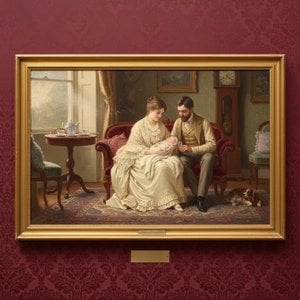
A Life Captured in Charm: The World of Jonathan Pratt
Jonathan Pratt, born in 1835 and passing in 1911, occupies a delightful niche within the pantheon of Victorian painters. Though perhaps not a household name today, his work embodies the spirit of its era – a fascination with domesticity, a keen eye for character, and a technical skill that allowed him to translate everyday moments into scenes of enduring appeal. Pratt’s life remains somewhat shrouded in mystery; detailed biographical information is scarce, yet his paintings speak volumes about his sensibilities and artistic journey. He wasn't an artist who sought grand historical narratives or revolutionary styles, but rather found beauty and meaning within the quiet corners of middle-class Victorian life. His canvases offer a glimpse into homes, families, and individuals with a gentle warmth that continues to resonate with viewers.Early Development & Artistic Training
The specifics of Pratt’s early training are not extensively documented, but his work suggests a solid grounding in traditional academic techniques. He clearly mastered the art of portraiture, evident in the meticulous detail and sensitive rendering of his subjects' features. It is likely he received instruction from established artists, perhaps through private lessons or attendance at one of the many art schools flourishing in Victorian England. His early works demonstrate an aptitude for capturing likenesses, but quickly evolved beyond mere representation to embrace a more narrative quality. He wasn’t content simply *to* depict; he aimed to tell stories, to reveal something of the inner lives of those he painted. This shift suggests a growing artistic ambition and a desire to engage with broader themes within Victorian society. The influence of Dutch Masters is often noted in his compositions – particularly their use of light and shadow to create atmosphere and draw attention to specific details.Genre Scenes & Portraiture: A Harmonious Blend
Pratt’s artistic output primarily revolved around two key genres: genre painting and portraiture, and he skillfully intertwined the two. His genre scenes weren't simply depictions of daily life; they were often populated with recognizable individuals – portraits subtly embedded within broader narratives. This approach allowed him to explore social dynamics, familial relationships, and the changing roles of women in Victorian society. He excelled at capturing intimate moments: a mother reading to her children, a family gathered around a piano, or a young woman engaged in needlework. These scenes are characterized by their warmth, humor, and attention to detail – from the patterns on wallpaper to the expressions on faces. His portraits, while often commissioned works, share this same sensitivity and narrative quality. He wasn’t interested in portraying his sitters as aloof figures of status; instead, he sought to reveal their personalities and inner lives.Exhibition & Recognition
Pratt actively exhibited his work throughout his career, gaining recognition within the established art circles of Victorian England. He regularly showcased paintings at the prestigious Royal Academy, a testament to his technical skill and artistic merit. His inclusion in exhibitions organized by the Birmingham Society of Artists further solidified his reputation as a respected painter within the Midlands region. While he may not have achieved the widespread fame of some of his contemporaries, his consistent presence in these prominent venues demonstrates that his work was valued by both critics and collectors. Records indicate sales were steady, suggesting a dedicated clientele who appreciated his charming style and insightful depictions of Victorian life. Museums across the UK continue to hold examples of his paintings, preserving his legacy for future generations.Historical Significance & Enduring Appeal
Jonathan Pratt’s historical significance lies not in groundbreaking innovation, but rather in his ability to capture the essence of Victorian life with remarkable sensitivity and skill. He provides a valuable window into the domestic world of the middle class – their values, aspirations, and everyday routines. His paintings offer a counterpoint to the often-stereotyped image of Victorian society as overly rigid or austere. He reveals a warmth, humor, and humanity that is both endearing and insightful. Today, his work continues to appeal to collectors and art enthusiasts who appreciate its charm, technical mastery, and evocative power. His paintings serve as a reminder of the beauty and complexity of the past – a testament to the enduring power of art to connect us with those who came before.- Genre painting focused on middle-class Victorian life.
- Skillful blending of portraiture within narrative scenes.
- Regular exhibitions at the Royal Academy and Birmingham Society of Artists.
- Works held in UK museums, preserving his legacy.
Въпроси и отговори
Как мога да разгледам всички произведения на Jonathan Pratt?
Всяка творба на Jonathan Pratt в този уебсайт може да бъде разгледана на страницата за всички произведения на Jonathan Pratt: Всички произведения.
Колко произведения на Jonathan Pratt са налични за разглеждане?
Можете да разгледате 14 произведения творби на Jonathan Pratt на страницата Всички произведения.
Мога ли да разглеждам творбите на Jonathan Pratt по цветова палитра?
Работите на Jonathan Pratt могат да бъдат разгледани по цветова палитра на страницата за Според палитрата на художника.