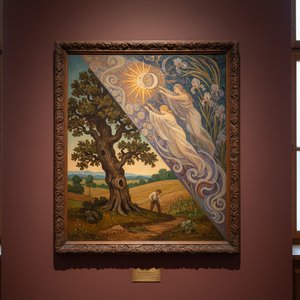
The Architect of Light and Glass
Carl Geyling was a figure of technical precision who bridged the gap between traditional landscape painting and the specialized discipline of glass artistry. Born in Mariahilf, he did not merely paint scenes; he translated them into a medium that required a rigorous understanding of how light interacts with surface and transparency. His work moved from the standard practice of landscape painting toward a highly specialized mastery of glass, a shift that defined his professional trajectory in Vienna.
His technical evolution was driven by a specific necessity: the creation of painted landscapes for windows. This was not a casual pursuit. By 1839, his studies in Italy provided the foundational perspective required to handle complex compositions. This period of development led to significant recognition, including a medal in 1843 for his work with mousseline and lace glass. He was not interested in mere decoration; he was interested in the structural integrity of light.
A Legacy in Stained Glass
Geyling’s influence is most visible in the physical fabric of European ecclesiastical architecture. He was not a solitary painter working in a vacuum; he was a founder of a significant enterprise, the Carl Geyling's heirs stained glass company. His status as a k.k. court glass painter confirms his position within the highest tiers of Austrian artistic production. He moved beyond the canvas to command large-scale commissions that required both an artist's eye and a manufacturer's precision.
His output was substantial and geographically diverse. His glassworks can be found in several significant locations, including:
- St. Stephen's Cathedral in Vienna
- The Votivkirche in Vienna
- St. Laurenz am Schottenfeld
- The churches of Klosterneuburg and Lilienfeld
- St. Epre in Nancy
Technical Mastery and Historical Weight
The weight of Geyling's work lies in its permanence. While many painters of the mid-19th century focused on fleeting impressions, Geyling’s work was designed to endure within the stone walls of cathedrals and chapels. His 1854 work, Kirchenruine, exemplifies his ability to handle the intersection of architectural decay and the natural landscape. He understood that a window is not just a view, but a filter that dictates the atmosphere of a space.
He died in Vienna in 1880, leaving behind a technical standard for Austrian glass painting that was built on the marriage of landscape composition and material science. He did not just paint; he engineered the way light enters a room.
Въпроси и отговори
Къде мога да намеря статистика за творбите на Carl Geyling?
Страницата Статистика на Carl Geyling представя статистика, изчислена въз основа на произведенията на артиста, изброени в ето този уебсайт.
В кой град и държава е роден/а Carl Geyling?
Carl Geyling е роден в Mariahilf, Austria.
Как е разделена кариерата на Carl Geyling на периоди?
Хронология на Carl Geyling е хронологична линия с функция за превъртане, която представя творбите на художника в хронологичен ред, групирани по периоди от кариерата му.
Кои цветове използва най-често Carl Geyling?
Цветовият профил на творчеството на Carl Geyling е представен на страницата Палитра на генома на художника.